
The web is shutting its doors to AI agents — what changes for you
Yelp, Delta, JPMorgan Chase and Charles Schwab are blocking AI agents. What is closed off, why banks lead the charge, and what your options are.
AI agents were supposed to do your errands: book the flight, find the restaurant, clean the inbox, move the money. This week the web answered back. Yelp, Delta Air Lines, JPMorgan Chase, and Charles Schwab are all blocking AI agents in one form or another, and users of Meta's Muse, xAI's Grok, OpenAI's Dots, and Instinct are hitting walls that were not there weeks ago. If you run agents — locally or in the cloud — this changes what you can honestly expect them to do.

What happened
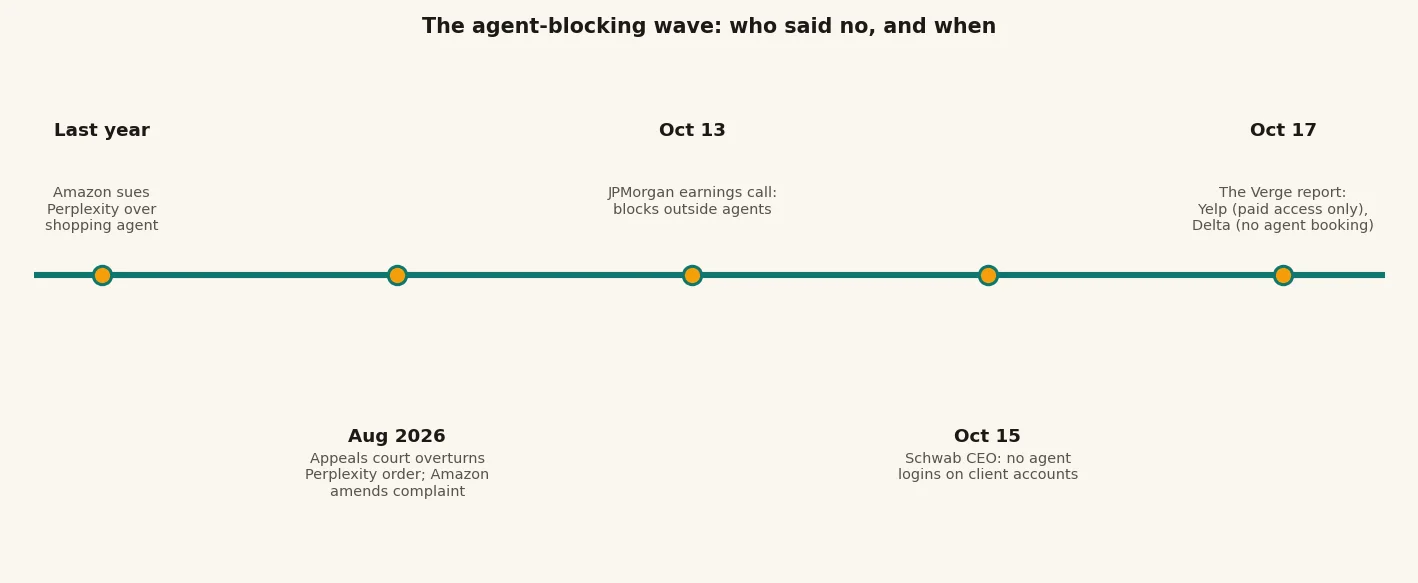
On October 17, The Verge reported that the biggest consumer websites are actively deciding which software gets through the door — and AI agents are not on the guest list:
- Yelp only allows agents that pay for its data licensing program (confirmed to TechCrunch).
- Delta Air Lines blocks agents from booking tickets on behalf of travelers. Its wording is softer — it says it has no current partnership or integration for agent booking and is "continuing to evaluate" — but the practical effect is the same.
- JPMorgan Chase blocks outside AI agents from touching customer accounts. Jamie Dimon said it plainly on the October 13 earnings call: outside agents are "just too risky for clients and for JPMorgan."
- Charles Schwab blocks agents that try to log in with a client's credentials or through browser automation. CEO Rick Wurster told investors on October 15: "There's one way we think is not safe, and that's just an agent coming to our site and trying to log in on behalf of a client. We are not going to allow that."
There are quieter reversals too. Users report that Cars.com and Amtrak used to work with their assistants and stopped — though neither company has confirmed that is deliberate policy.
The legal fight behind it
Amazon has been fighting this battle the longest. It banned Perplexity's shopping agent last year and sued the startup. A judge ordered Perplexity to stop; an appeals court overturned that ruling in August, and Amazon then filed an amended complaint. Perplexity's read is blunt: agents don't look at ads. Amazon's counter: companies acting on behalf of customers should respect site policies. Meta's Muse later hit the same wall, with Amazon telling Meta that the agent's continued access violates its policies.
Meta's response frames it as lost business: "Turning away a personal agent means turning away the customer behind it." The company says it would rather strike deals with businesses than fight them — and it has, with retailers including Gap, Sephora, and Best Buy. Shopify has opened its network of storefronts to AI agents outright.
Why banks say no first
Banks have the clearest reason to refuse. An assistant holding your password can move money, and nobody has settled who owns the risk when something breaks. Schwab's chief executive put it this way: the client cannot control the agent, and the broker cannot control it either. Until someone owns that liability, account access stays closed.
There is also the friction nobody planned for: even where agents are welcome, anti-bot systems trip them up. Login screens, CAPTCHAs, and device checks treat automated browsers as hostile by default. Agents that look like browsers still fail the tests that real browsers pass. So the open web your agent can actually use is smaller than the open web you can browse — by design, and by accident.
What this changes for you
Expect agents to stall at the login screen and the checkout counter. Agents can still summarize pages and compare prices, but buying the shoes or moving the money needs a human in the loop. Plan your workflows that way, and any agent that promises otherwise deserves a skeptical look.
Running an agent locally does not exempt you. This is the part local-AI users should get right: the block happens at the site, not at the model. Your self-hosted agent hitting Delta's booking page from your own machine runs into the same wall as a cloud agent. But the local setup changes the equation in two real ways:
- Your data stays with you. A local agent reading pages on your machine does not ship your browsing, passwords, or purchase history to a third-party cloud. The banks' core worry — an outside agent holding your credentials — is a cloud-architecture problem. You still cannot log in where the site forbids it, but nothing leaves your network trying.
- You control the session. A local agent can do the research half of the job (compare flights, read menus, draft the message) and hand you the last step. That is the honest shape of the agentic web right now: the agent does the homework, you sign the form.
Use official paths, not workarounds. Where agents are welcome, it is through negotiated doors: Shopify's agent-enabled storefronts, Yelp's paid licensing program, Meta's retailer deals. For your own automation, that means preferring real APIs, MCP integrations, and licensed data access over screen-scraping a site that has told agents to stay out. The agentic web is becoming gated and licensed — budget "agent access" the way you budget API keys, because that is where this is heading.
Design for permission, not evasion. If you build agents — for yourself or for others — assume more sites will join this list. Rate-limit politely, use official endpoints, and surface blocks honestly instead of routing around them. The companies saying no this month are doing it deliberately and publicly; fighting that with cleverer bots is a losing posture.
What to watch
The Verge's Chris Canal quote from EquiStamp sums up the stakes: one of the central claims about agents is that they will permeate every aspect of our lives, and if companies actively prevent that, agents simply do fewer useful things. Every blocked site narrows what the assistants can honestly claim to do.
Two numbers will tell you where this lands. First, how many sites move from quiet blocking to explicit paid agent access like Yelp's — a toll booth is at least a negotiable door. Second, how many open their own official agent endpoints like Shopify's. For readers running agents at home, the second list matters most: those are the doors your local agent can walk through legitimately, with your data staying yours.
Sources
- Websites Are Shutting Out AI Agents, and Banks Are Leading the Charge, MyListingo, October 18, 2026
- AI agents blocked: what still works, RR Tech Pulse, October 2026
- Websites are closing their doors to AI agents (summarizing The Verge's October 17, 2026 report by Emma Roth), The Tech Street Now
- Delta, JPMorgan, and Schwab blocking AI agents is no glitch, GZOO, October 18, 2026
- AI Agents Face Bank Blocks Over 'Security Concerns', My Monday AI, October 17, 2026