
Ripple-65B Preview: a 65B open model that out-codes 500B giants
Ricursive's 65B open-weight coder claims the top US open-weight score on Terminal-Bench 2.1 — but stock Ollama and llama.cpp can't load it yet.
On November 4, 2026, a small chip-design startup called Ricursive Intelligence released Ripple-65B Preview, a 65-billion-parameter open-weight model built for agentic coding. Its headline claim is striking: 80.52 on Terminal-Bench 2.1, a test of how well an AI agent gets real work done in a terminal — ahead of open-weight rivals up to 15 times its size. The twist for local AI fans is that the model is small enough to run on a desktop-class machine, yet the tools most people use to run models at home cannot load it yet. Here is what Ripple is, what its numbers actually say, and what it would take to run it yourself.
What Ripple-65B is
Ripple is a dense model, which means all 65 billion of its parameters are active for every token. That is the opposite of the mixture-of-experts design used by most of its rivals, where only a fraction of the parameters wake up per token. Ricursive trained it from scratch on 12 trillion tokens of mostly English text and code, and it supports up to 1 million tokens of context. The release includes three checkpoints under the Apache 2.0 licence, which allows commercial use: an instruction-tuned model in BF16, a smaller NVFP4 version, and a BF16 base model.
The company behind it is worth knowing. Ricursive was founded by Anna Goldie and Azalia Mirhoseini, the researchers behind Google's AlphaChip system for AI-designed chips. Ripple is a general-purpose version of the private model that powers Ricursive's own chip-design platform. The team was tiny — it grew from one person to five during development — and Ricursive says the full research and development cost was $32 million, which it claims is about one-tenth of what the previous open-weight leader on agentic coding spent. That cost figure covers everything from early experiments to the final training runs, and it is Ricursive's own estimate, not an audited number.
How it scores — and whose numbers these are
Every score below comes from Ricursive's own model card. No independent lab has rerun them yet, and Ricursive itself warns that agentic benchmark scores shift with the test harness. Read the chart as a vendor scoreboard, not a verdict.
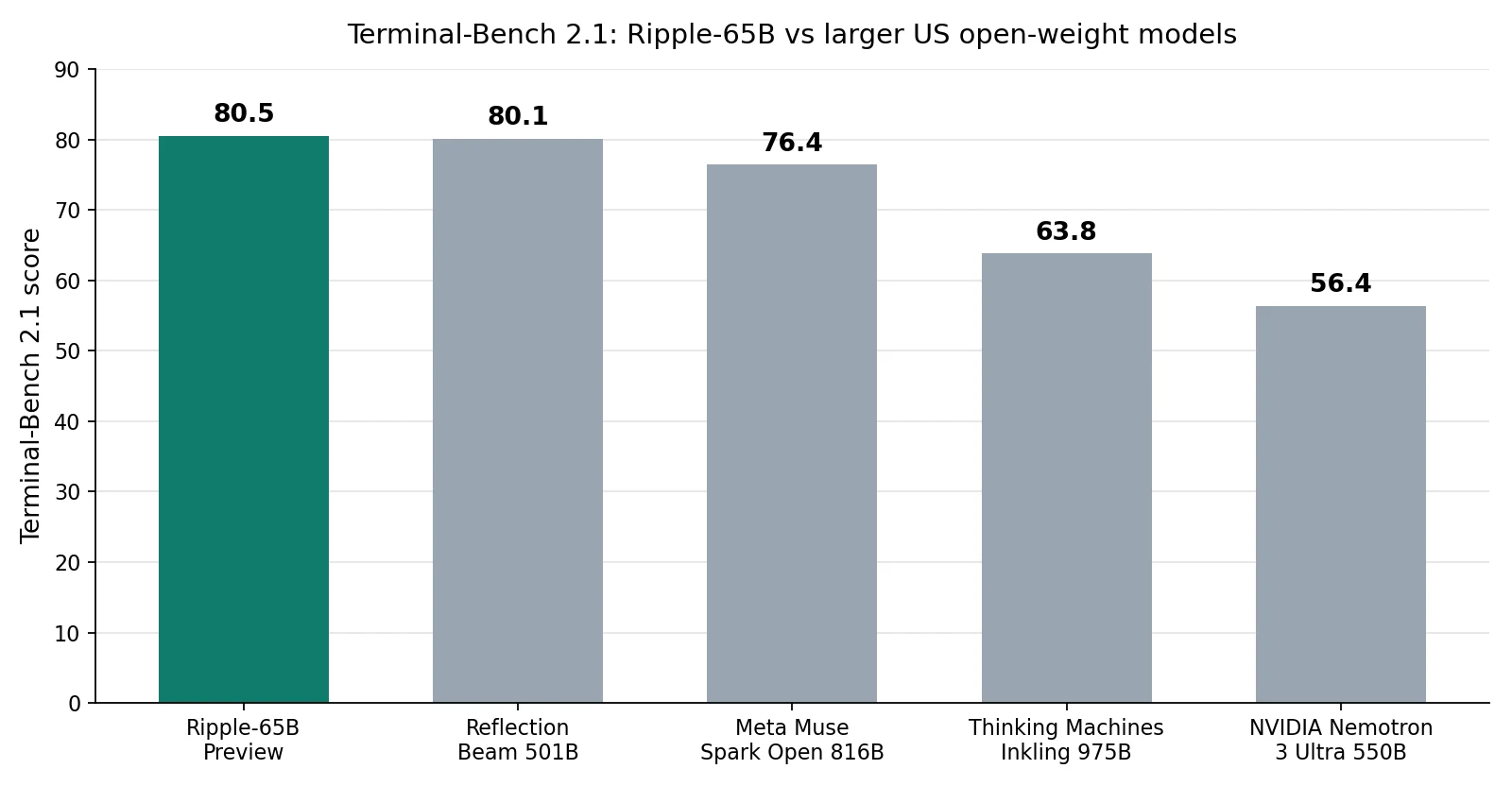
On Terminal-Bench 2.1, Ripple scores 80.5, just ahead of Reflection's Beam at 80.1 and Meta's Muse Spark Open at 76.4. The margin over Beam is 0.4 points — a lead, not a blowout. On SWE-bench Pro v2.0 Hard, a test of difficult software engineering tasks, Ripple leads its own table at 79.1, well ahead of Beam at 76.5 and Muse Spark Open at 52.3.
The same table shows where Ripple is weaker. On SWE-bench Verified it scores 76.5, behind Beam at 81.6. On SciCode, a science-coding test, it scores 39.4 — the lowest of the five models in Ricursive's table. On DeepSWE 1.1 it scores 44.3 against 60.0 for Muse Spark Open, and on MCP Atlas, a tool-calling test, it scores 71.67 against 89.2 for Muse Spark Open. The pattern is consistent: Ripple is strong at terminal-based coding work and weaker at science, long-horizon software engineering, and tool use.
One more detail from the model card is worth noting. When Ricursive reran Terminal-Bench 2.1 with the official Terminus 2 harness, most rivals dropped — Beam fell from 80.1 to 70.8 — while Ripple held at 80.5. That is a point in Ripple's favour, but it also shows how much these scores depend on the exact test setup.
Can you run it at home?
Not comfortably yet, and the size is only half the story. The full BF16 checkpoint is about 129.6 GB, which is more memory than a 128 GB machine holds. The official NVFP4 checkpoint is about 57.2 GB, and Ricursive says it targets machines like NVIDIA's DGX Spark, a compact AI computer with 128 GB of unified memory. A community 4-bit GGUF build is about 39 GB, small enough for a high-end gaming PC — but that is an unofficial upload, not checked by Ricursive.
The bigger blocker is software support. Ripple uses a new architecture, and stock llama.cpp, Ollama, and LM Studio cannot load it yet. Support is in llama.cpp pull request #31692, which was still open on November 5. Community GGUF files exist, but they need a patched llama.cpp build, and each uploader's files match a different patch. The Hugging Face pages still show a one-line ollama run snippet — ignore it for now.
If you want to try Ripple today, the practical route is the API. It is live on OpenRouter at $0.20 per million input tokens and $0.60 per million output tokens, though OpenRouter currently caps context at 16,384 tokens — far below the 1 million the model card advertises. Together AI and GMI Cloud also list it, with Fireworks to follow. That is the way to test the coding claims yourself before committing to a 57 GB download and a patched engine.
What it costs to run — the memory math
The numbers below are simple arithmetic from the checkpoint sizes Ricursive publishes, not measurements:
- BF16 (full precision): about 130 GB — needs a data-centre GPU setup or a 256 GB Mac Studio-class machine.
- NVFP4 (official, 4-bit): about 57 GB — fits a 128 GB DGX Spark with room for context, or a 96 GB Mac.
- Community GGUF Q4 (unofficial): about 39 GB — fits a 48 GB GPU or a 64 GB unified-memory Mac, once an engine supports it.
Ricursive reports 250 tokens per second on two B200 GPUs at batch size 8, before quantisation. Community reports put the GGUF build at about 40 tokens per second on a single 96 GB GH200, but that is one community measurement, not a vendor figure.
The takeaway
Ripple-65B is the most interesting small open model in weeks: a 65B dense model that matches or beats 500B-plus rivals on terminal coding, built by a five-person team for a claimed $32 million, under a licence that allows commercial use. The honest limits are just as clear. Every benchmark is self-reported, the lead over Beam is narrow, and the model is weaker on science and tool use. Most importantly for local users, the weights are out but the tooling is not — stock Ollama and llama.cpp cannot load Ripple yet. Try it through the API now, and watch for llama.cpp support to land before planning a local install. If you want to check what your own machine can actually run today, start at /check.
Sources
- Introducing Ripple-65B Preview, a Frontier Open-Weight Model, Ricursive Intelligence (November 4, 2026)
- Ripple-65B Preview model card, Hugging Face
- Ricursive AI Releases Ripple-65B Preview, MarkTechPost (November 4, 2026)
- Ex-Googlers' new Apache 2.0 model Ripple-65B Preview claims the U.S. open coding lead, VentureBeat (November 5, 2026)
- How to Run Ripple-65B Locally (Ollama and Stock llama.cpp Won't Load It), dev.to (November 5, 2026)
- Ripple-65B Preview: The Open Coding Model That Punches Up, michaelleung.info (November 5, 2026)