
Tencent's Hy4 can see and use your computer — but its weights aren't out yet
Tencent released Hy4 on November 4 with vision and computer use for the first time, but the open weights are still a promise, not a download.
On November 4, 2026, Tencent released Hy4, the full version of the flagship model its Hunyuan team previewed in August. It is the first Hy model that can see images and operate a computer: reading charts, clicking through apps, and working across the command line and the screen. It is also the latest in a wave of giant open-weight models that arrive with a catch. The weights are promised, not published. Here is what Hy4 actually is, what it can do, and what it means for running AI on your own machine.

What is new in Hy4
Two firsts define this release. Vision is one: Hy4 can process fine-grained image detail, analyse complex charts, and reason through visual maths problems. Tencent's demo finds a roof fitting about 2 metres across in a 2.8-billion-pixel aerial photo. Computer use is the other: the model can combine the command line and graphical interfaces to carry out long tasks across several apps. Tencent trained it specifically for professional software such as Blender and CAD tools, and for game engines including Unreal, Unity, and Godot.
Under the hood, Hy4 is a mixture-of-experts model: many specialist networks, with only a few waking up for each token. The August preview listed 770 billion total parameters with 49 billion active per token, and the full release page does not restate those counts, so treat them as preview figures until the model card for the full release appears. The context window is 1 million tokens, according to OpenRouter, which lists 1,048,576 tokens of context and up to 65,536 output tokens.
Tencent pitches Hy4 at real work: coding, office documents, finance, and scientific research. It is live now through Tencent Cloud TokenHub and OpenRouter as tencent/hy4, and inside Tencent's own apps: WorkBuddy, CodeBuddy, Yuanbao, and ima. The API costs $0.834 per million input tokens and $2.501 per million output tokens, with OpenRouter currently showing 50% off and Tencent Cloud discounting 50% through December 31, 2026.
How it scores — and whose numbers these are
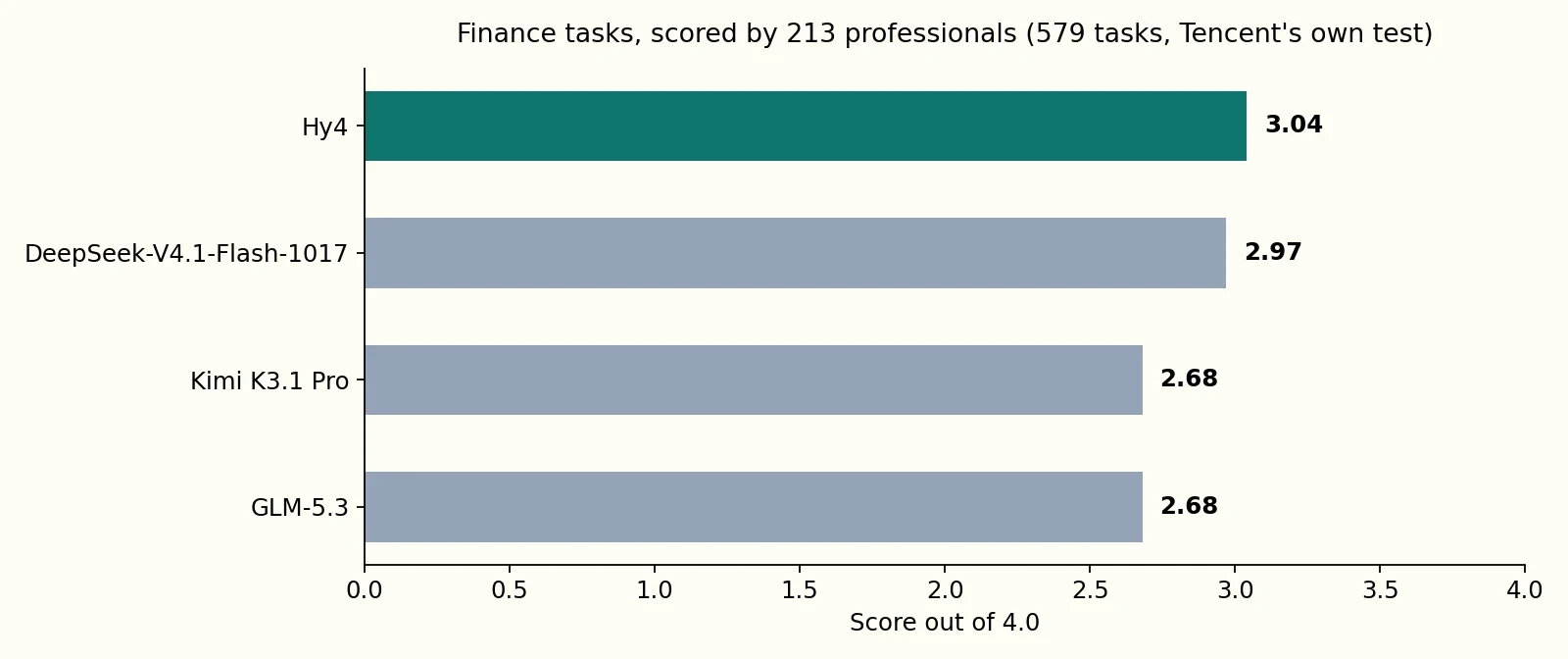
Tencent's own tests put Hy4 first among open-weight models on finance work. In a crowd test of 579 real finance tasks, scored by 213 finance professionals, Hy4 averaged 3.04 out of 4, ahead of DeepSeek-V4.1-Flash-1017 at 2.97, Kimi K3.1 Pro at 2.68, and GLM-5.3 at 2.68.
On coding-agent tests the gap to the best closed models is still wide. Hy4 scores 44.4 on Terminal-Bench 4.0, against 66.4 for Claude Opus 5.5 and 55.5 for GPT-6.1 Sol. On OSWorld 2.1, a computer-use test, it scores 78.9 on the partial-credit measure. And on Tencent's internal search test, the hallucination rate fell from 15.76% for the preview to 5.45%.
Every number in this section is Tencent's own, measured on its own harness. No independent lab has rerun them yet, and the finance chart above is a vendor scoreboard, not a verdict. To Tencent's credit, the release page is honest about the limits: it says Hy4 still trails the top closed models on hard maths and long-horizon coding, and its own internal FrontierMath test shows the gap plainly — Hy4 at 13.0 against 97.5 for GPT-6.1 Sol and 91.3 for Claude Opus 5.5.
Can you run it at home?
Not yet, and not the full model when the weights land. At 770 billion total parameters, even a 4-bit version of the weights would need about 385 GB of memory — 770 billion numbers at half a byte each. Only 49 billion parameters are active per token, which keeps the per-token compute in check, but you still have to hold all 770 billion somewhere. No home PC or single workstation does that.
The weights are also not out. Tencent's release page says only that it plans to open-source them, with support from the vLLM and SGLang communities and the startup Inferact, and that a system card with fuller safety results will come at the same time. No date, no licence. The August preview is on Hugging Face under Apache 2.0, but that is the preview, not this release.
The version to watch is Hy4 Flash, a cheaper and faster variant Tencent says is coming soon. If it is much smaller than the full model, it could be the first Hy4 you can actually run. The usual path also applies: community quantisations and distilled versions are how earlier giant open models eventually became runnable at home — not by shrinking the original, but by training smaller models that imitate it. If a distilled Hy4 appears at 30 billion parameters or below, that is the version worth watching for local use. If you want to check what your own machine can actually run today, start at /check.
What you can do today
The practical route is the API, not the weights. On OpenRouter, tencent/hy4 takes image input, supports tool calling and structured output, and sits at the discounted price while the launch offer lasts. That is the way to test the vision and computer-use claims yourself — for example, handing it a chart to read or a multi-step desktop task — without waiting on a download that does not exist yet.
The takeaway
Hy4 is a strong release with real new capabilities: vision and computer use are genuinely useful additions, and Tencent's own numbers put it at the top of the open-weight pack on office and finance work. But "open-weight" is a promise until the files exist. Use the API if you want its capability today, watch for the weights and the Flash variant, and do not plan a local install until either one appears.
Sources
- Introducing Hy4, Tencent Hunyuan (November 4, 2026)
- Tencent Releases and Open-Sources Tencent Hy4 preview, Tencent
- Tencent Hy4: First Hy Model With Vision and Computer Use, AICoder (November 4, 2026)
- Tencent Hy4 is out: it can use a computer but still trails Claude, madrobot (November 4, 2026)
- Tencent Releases 770B Open-Weight Hy4 With Computer-Use Skills, af.net (November 4, 2026)
- Tencent launches Hy4 in bid to break into AI's top tier of open-weight models, Longbridge (November 4, 2026)