
Qwen-Image-2.1-Turbo: 8-step image generation and editing on your own GPU
Qwen-Image-2.1-Turbo generates and edits images in 8 steps instead of 40 — a 12 GB card can run it, but the research-only license is the real catch.
Image models are slow on consumer GPUs. The best open ones refine a picture through dozens of denoising passes, so each image costs you minutes of GPU time. That changed yesterday.
On October 9, 2026, Alibaba's Qwen team released Qwen-Image-2.1-Turbo: an accelerated checkpoint of its Qwen-Image-2.1 image model that produces finished images in 8 denoising steps instead of the base model's 40. Same 7B visual-generation architecture, same features — roughly five times fewer passes through the model per image.

What Turbo actually changes
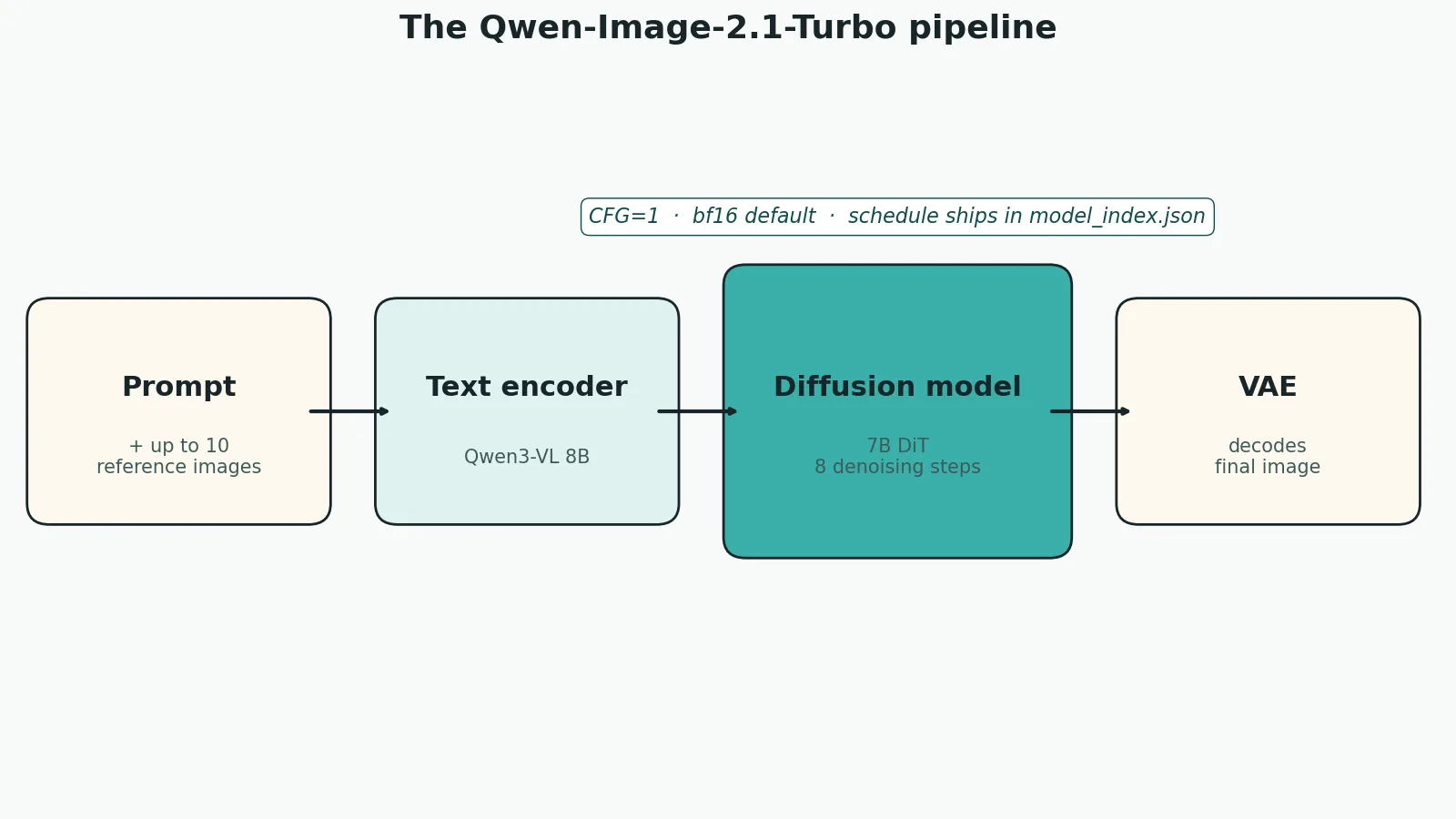
An image diffusion model starts from noise and sharpens it step by step. Cut the steps from 40 to 8 and you cut the compute per image roughly fivefold. Three details from the model card make this specific:
- CFG = 1 by default. Classifier-free guidance normally runs the model twice per step; Turbo runs once.
- The 8-step schedule ships inside the checkpoint. It is saved in the checkpoint's
model_index.json, so it works without manual scheduler setup. Setting the step count alone does not override it — only an explicitsigmasargument does. - Prefix KV caching reuses the text and reference-image context across steps, cutting repeated work when you edit with reference images.
Feature-wise nothing was removed: text-to-image, image editing, transparent RGBA generation, up to 10 reference images, portrait and typography work, UI layout, and 2K output (aspect ratios up to 2752x1536 for 16:9). These are the team's listed capabilities — independent quality comparisons against the base model have not appeared yet.
This follows an interesting community arc: in late September, Viggle released an unofficial 6-step distilled LoRA for the base model claiming about 5x end-to-end speedup. Turbo is the official checkpoint — no LoRA adapter needed.
Can your GPU run it? Honest VRAM math
The headline number, "7B," understates the pipeline. The full setup is the 7B diffusion transformer plus a Qwen3-VL 8B text encoder plus a VAE. The bf16 diffusion weights alone are 14.2 GB, and the complete pipeline in bf16 is a heavy lift — a third-party site estimated roughly 37 GB of working memory with overhead, though that is their calculation, not Qwen's, and Qwen publishes no official VRAM minimum.
The practical path is the community GGUF quants. Two community repos give concrete, tested numbers:
| Quant tier | File size | Recommended VRAM | Notes |
|---|---|---|---|
| Q8_0 | 7.59 GB | 16 GB+ | Near-lossless master quant |
| Q6_K | 5.88 GB | 12–16 GB | Tested: 11.2 GB peak at 1024x1024 on an RTX 3060 12GB |
| Q5_K_M | 5.01 GB | 10–12 GB | Best quality-to-size balance |
| Q4_K_M | 4.19 GB | 8–12 GB | Suggested for RTX 3060/4060, Tesla T4 |
| Q4_K_S | 4.06 GB | 8 GB | Slightly smaller 4-bit build |
| Q3_K_M | 3.19 GB | 6–8 GB | Ultra-low VRAM tier |
The file sizes and VRAM brackets are the community quant publishers' figures, and the 11.2 GB peak figure was measured on an RTX 3060 12GB — tested hardware, not estimates. On 12 GB cards, the quant authors recommend keeping the text encoder in system RAM (--backend te=cpu). For 2K output or the full bf16 pipeline, a 24 GB card (RTX 3090/4090-class) is the comfortable tier.
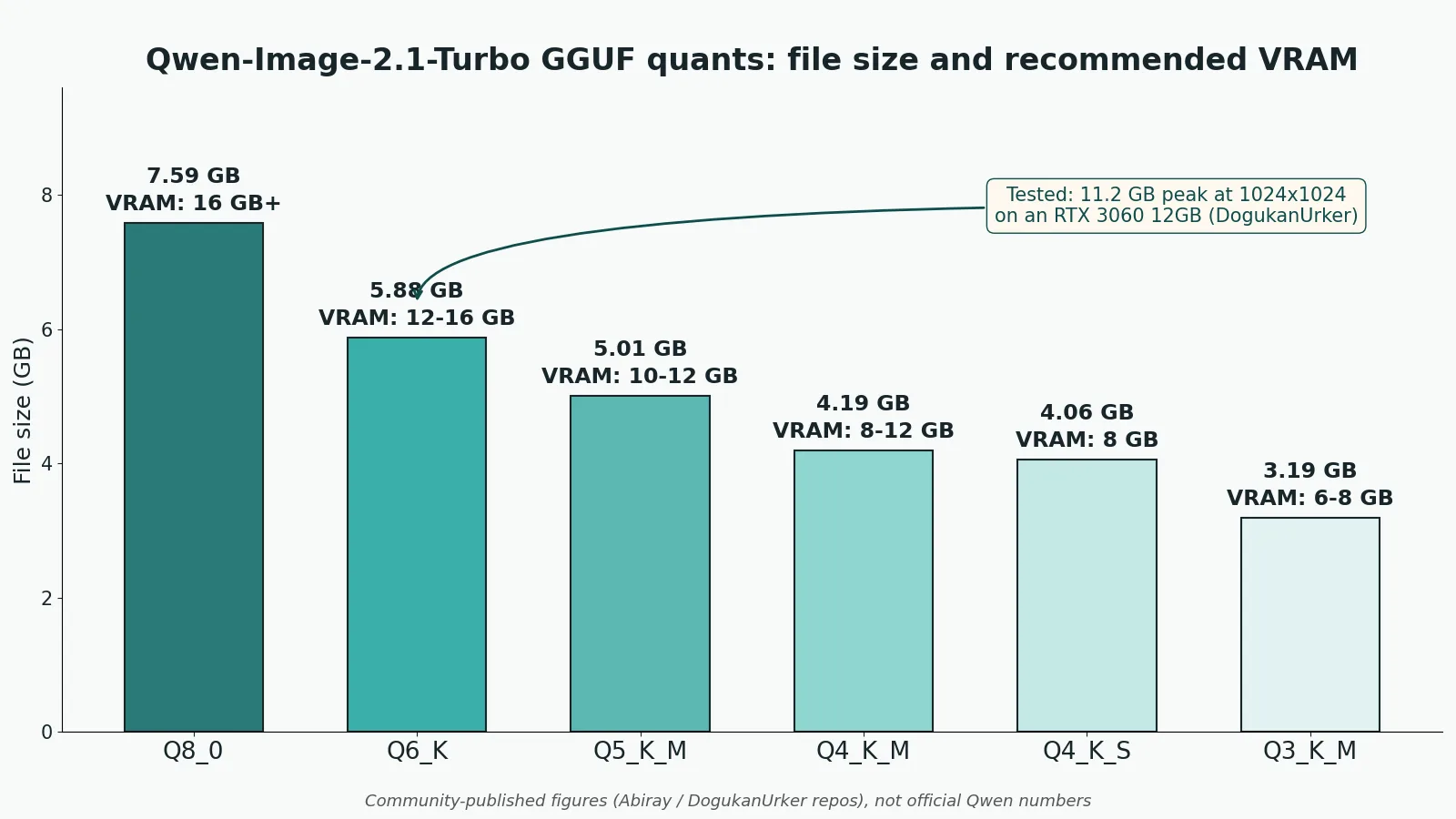
The honest summary: the hardware requirement did not shrink — the wait did. You need roughly the same VRAM as before, but every image takes about one-fifth the time. Not sure what your card can handle? Run your GPU through /check.
How to run it
Three paths, all working now:
Diffusers (Python). Install a CUDA PyTorch build, then the latest Diffusers from source (it needs the pipeline-configured sigma support) plus transformers>=5.17.0:
from diffusers import QwenImage21Pipeline
import torch

pipe = QwenImage21Pipeline.from_pretrained(
    "Qwen/Qwen-Image-2.1-Turbo",
    dtype=torch.bfloat16,
).to("cuda")
ComfyUI. Day-one native support: drop the turbo diffusion weights into ComfyUI/models/diffusion_models/, alongside the Qwen-Image-2.1 VAE and a Qwen3-VL 8B text encoder. Community workflows already exist for both text-to-image and image editing — the settings change is just 8 steps, cfg 1, sampler er_sde, scheduler linear_quadratic. The GGUF path works via ComfyUI-GGUF (update it and run pip install -U "gguf>=0.13.0").
stable-diffusion.cpp. For the CLI route, pass the turbo schedule from the official model_index.json via --sigmas, with --steps 8 and --cfg-scale 1.0.
The license catch
This is the part to read before you build anything on it. Qwen-Image-2.1-Turbo is released under the Qwen Research License Agreement, which limits use to research and evaluation. Commercial use requires a separate license from Alibaba. The same license covers the base Qwen-Image-2.1 released September 20, 2026.
This fits a clear pattern in Qwen's licensing arc: Qwen3 went fully Apache 2.0 in 2025, but the image tier sits behind the research-only gate. If your goal is hobby or research work — personal art, experiments, prompt iteration — you are fine running it locally. If you want to sell what it makes or put it in a product, the license is the wall, not the hardware.
The takeaway
Turbo answers this site's core question directly: does this change what I can do with AI on my own machine? Yes, in a specific way. If you own a 12 GB NVIDIA card and were priced out of Qwen-Image-2.1's 40-step runs, you can now do image generation and editing locally, privately, with no API bill — as long as "research and evaluation" covers what you are doing. The ceiling moved from time to legalese. Pick your use case first, then pick your quant tier.
Sources
- Qwen-Image-2.1-Turbo model card (primary source)
- AI Weekly: Qwen ships Image-2.1-Turbo as 8-step 7B research-license model
- MarkTechPost: Alibaba Qwen releases Qwen-Image-2.1-Turbo, an 8-step 7B image model (Oct 9)
- RuntimeWire: Alibaba's Qwen releases an eight-step image model with downloadable weights (Oct 9)
- DogukanUrker: Qwen-Image-2.1-Turbo GGUF quants (community VRAM figures, tested on RTX 3060 12GB)
- Abiray: Qwen-Image-2.1 turbo GGUF quantization ladder
- Viggle: Qwen-Image-2.1-viggle-turbo model card (earlier unofficial 6-step LoRA)
- TheLocalLab: free official Qwen-Image-2.1 Turbo ComfyUI workflows (sampler settings)
- MarkTechPost: The story of Qwen (license arc, Sept 2026 image-license shift)