
Ecosia dropped Mistral for open-weight models — and cut its AI costs in half
Ecosia replaced Mistral with open-weight models like Qwen, GLM, and Kimi — the same weights you can run yourself — halving its AI costs while improving quality.
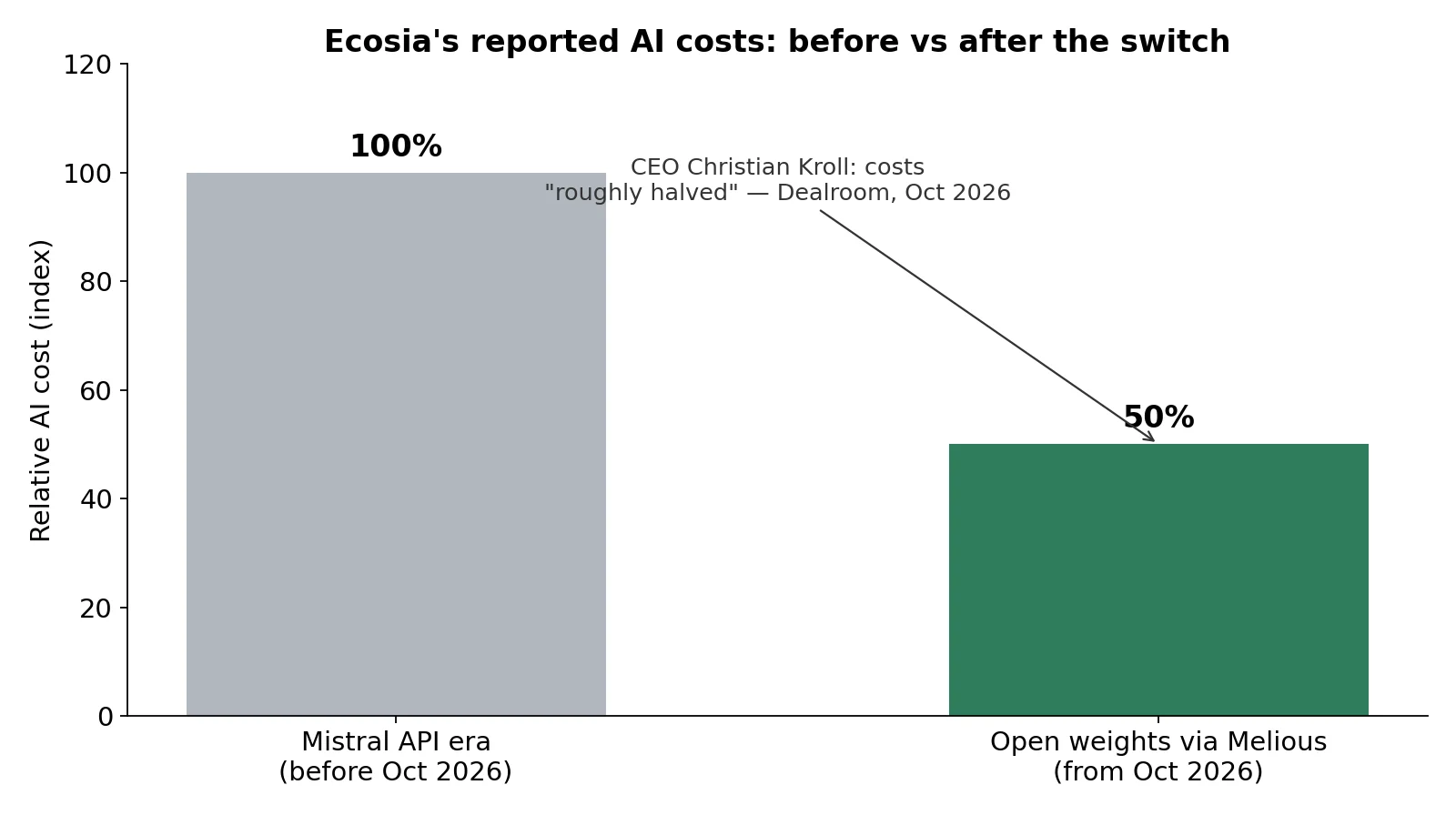
A Berlin search engine just made the year's most telling AI move for open-source fans. Ecosia — the search engine that donates 100% of its ad profits to planting trees and climate action — has dropped Mistral as its AI provider and switched its AI answers to open-weight models. Its CEO says the switch roughly halved costs while improving quality and performance.
Why you should care: the same class of models you can download and run on your own machine is now powering a real search engine's production AI. Here is what happened, why, and what it changes for you.

What happened
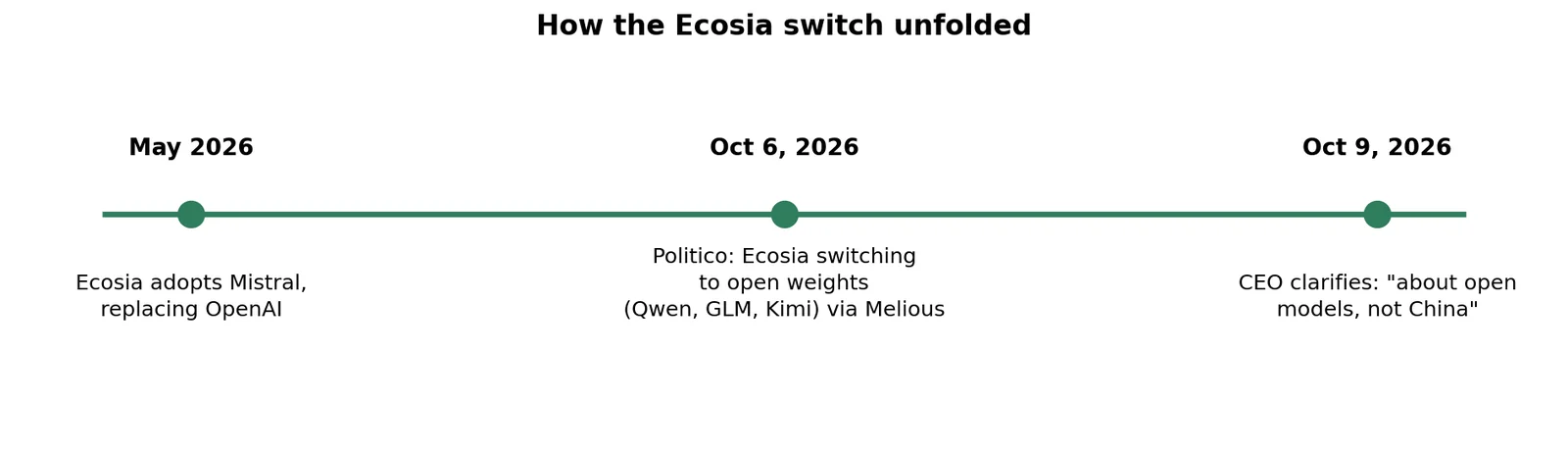
In May 2026, Ecosia swapped OpenAI for Mistral as the AI behind its search answers. Five months later, the partnership was over. Politico reported on October 6, 2026 that Ecosia was replacing Mistral with open-weight models — including Alibaba's Qwen, Z.ai's GLM, and Moonshot AI's Kimi — served through Melious, a German platform running on European infrastructure.
Why? Ecosia founder and CEO Christian Kroll told Politico he was "disappointed with the quality of Mistral," calling it "a year behind" the competition. He cited recurring technical problems — overloaded servers, with Ecosia a "too large" customer for Mistral to serve reliably. And the money: the switch roughly halved Ecosia's AI costs while improving quality and performance, per Kroll.
The timing is sharp. Days after the story broke, Mistral's new flagship landed: Large 4, a 1.05-trillion-parameter model, released as a public preview on October 6. Mistral co-founder Guillaume Lample invited Ecosia to test it; CEO Arthur Mensch replied on X that Mistral serves those open models too.
It's not about China — it's about open weights
The Politico story framed the switch around Chinese models, so Kroll clarified on October 9: the decision is "not a move towards Chinese technology, but rather a shift towards more affordable, energy-efficient open AI models." The models run through Melious on European infrastructure powered by low-carbon energy — Europe's data centers, even if some of the weights were trained in China.
This is the sovereignty argument in its modern form: control over where models run, whose servers process your data, and what you pay — not just who trained the weights. Kroll even questioned whether Mistral is "truly sovereign," pointing to its international investors and the nuclear-heavy French energy mix.
To answer the obvious worry — Chinese models censoring topics like Taiwan — Kroll said Ecosia keeps the ability to route queries about sensitive subjects through alternative models, and is working to strip political bias from its answers.
Why open weights won
Three structural reasons, and they all transfer to your setup:
- Cost. Paying for an API means paying per token forever. Hosting open weights means paying for the compute — which can be half as much, or less, at scale. The same math is why heavy ChatGPT users sometimes save money going local.
- Choice and routing. Ecosia doesn't rely on one model anymore — it gets several through Melious and can pick per query. That routing idea is the same principle behind local multi-model setups: a fast small model for simple questions, a bigger one when it matters.
- Control. The models run on European, low-carbon infrastructure Ecosia chose. Open weights can be audited, swapped, and kept in-house. No vendor lock-in on pricing or policy.
What this changes for you
Here's the part that matters for local AI: the models Ecosia now trusts with production search answers — Qwen, GLM, Kimi — are open-weight families with publicly available weights. The same generation of models you can pull into Ollama or LM Studio is now considered good enough to answer real users' questions at scale, at lower cost and higher quality than a commercial provider's flagship.
Three honest takeaways:
- "Open models are inferior" is dead. When a production service switches for quality reasons — not just cost — the capability-gap argument is finished. The remaining gap is convenience and scale, not raw quality.
- Ecosia isn't running these on laptops. Melious hosts the models on server GPUs. Open weights winning production doesn't mean your laptop can do everything — but it does mean the weights themselves are production-grade. The limitation is your hardware, not the models.
- Routing beats monoliths. Ecosia routes queries across models. You can do the same at home: check /check to see which open models your hardware can run, then match the model to the task.
The practical move: if you haven't tried the current Qwen, GLM, or Kimi open releases locally, this week is a good time. They're no longer the budget alternative — they're the models a search engine chose on merit.
Sources
- Ecosia drops Mistral for open-weight models, citing quality, capacity and sovereignty, Dealroom News
- EXCLUSIVE: Ecosia founder clarifies move away from Mistral — It's about open models, not China, EU-Startups
- Ecosia switches from Mistral to open-weight AI models including Qwen, GLM and Kimi, TechNode
- Ecosia Drops Mistral to Adopt Open-Source AI Infrastructure, n24
- Ecosia dumps Mistral for open-source Chinese models, cutting costs in half, AI Startups News
- Ecosia drops Mistral, eyes Chinese open-weight AI models, Cybernews
- Mistral Large 4: Specs, Pricing, Benchmarks and Weights Date, Developers Digest