
Microsoft Decision-1: a 9B decision model at $0.042 per million tokens
Microsoft's Decision-1 returns yes/no and routing scores at $0.042 per million input tokens — built on the open-weight Qwen3.5-9B you can run locally.
Most chat models write paragraphs. Most software does not need paragraphs — it needs a yes or no, a category, or a score. That gap is where a new model category is forming: decision models that take text in and return probabilities out, with no generated text to parse. On October 9, 2026, Microsoft joined the category with Microsoft-Decision-1, a decision-scoring model priced at $0.042 per million input tokens with free output — a direct undercut of OpenAI's competing decision API at $0.10 per million.

What Decision-1 does
A decision model reads your input once and scores a fixed set of options: yes/no, multiple choice, or a rating scale. It returns a calibrated probability for each option, and nothing else. "Calibrated" is the key word — the confidence number is meant to be trustworthy, so your code can decide automatically below a threshold and hand off to a human or a bigger model above one. No output tokens are generated, which is why output is free.
Microsoft positions it for routing incoming queries, classification, verification, and as the control layer in agentic systems — the cheap, fast steps in a pipeline where a chat model is overkill. Its context window is 32,768 tokens, and it handles text only.
The numbers Microsoft claims
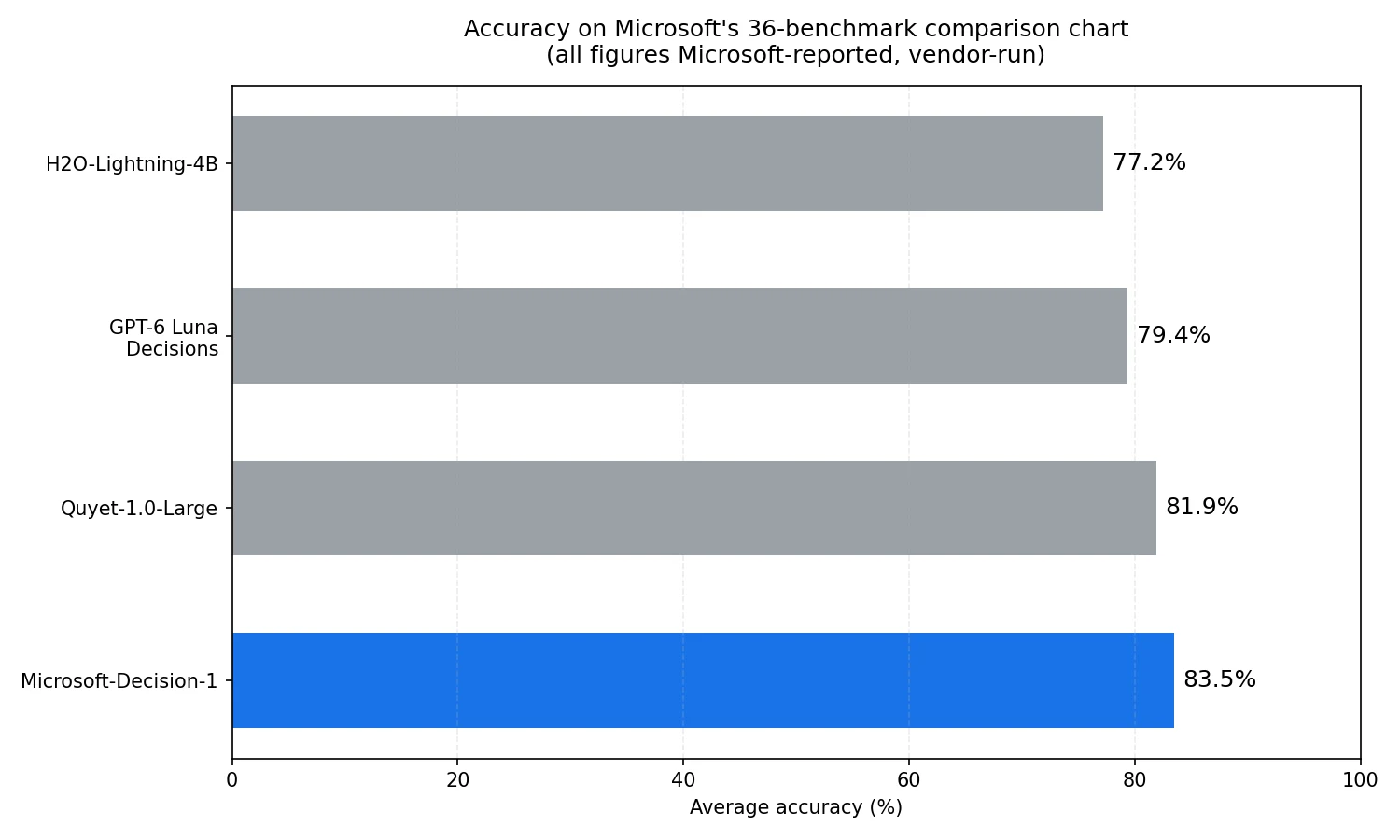
Microsoft tested Decision-1 across 36 benchmarks and nearly 150,000 questions, reporting 83.5% average accuracy and 85 ms median latency. Its own comparison chart puts the competition behind it:
Microsoft also reports internal results: Xbox Research used it to label more than 10,000 feedback items at quality competitive with GPT-6 Sol, running over 14 times faster and costing 200 times less. The Copilot team found it competitive with GPT-5.6 Luna at 100 times the speed, and Microsoft Discovery reports scoring 46 times more consistent than an LLM-based approach with fourfold faster replanning.
A note of honesty: every one of these benchmarks was run by Microsoft, and the latency comparison is already disputed — H2O.ai says the JevBench adjusted figures Microsoft used for competitor latencies overstate its model's time (it claims a measured 29 ms, not 210 ms), and Decision-1 itself does not appear on the JevBench board. Treat the chart as a vendor's best case, not an independent test.
Why it matters for running AI yourself
Here is the part that matters for this site: Decision-1 is post-trained from Qwen3.5-9B, Alibaba's open-weight model released under the Apache 2.0 license. You cannot download Microsoft's exact checkpoint — Decision-1 is a closed, hosted-only API on Microsoft Foundry and OpenRouter. But the base model it was built on is open, and the same decision-scoring recipe is already available locally.
Nimble 9B from Bespoke Labs is an Apache 2.0 model fine-tuned from the same Qwen3.5-9B base for decision scoring, and it speaks the same /v1/systemone typed-decision API that Ollama 0.35 added. Nimble's model page reports 75.7% mean accuracy across 13 public decision datasets, and Ollama's announcement cites 91 ms per decision on a MacBook Pro M5 Max — both vendor numbers, but the same order of magnitude as Microsoft's 85 ms. A 9B model at Q4 quantization fits in roughly 6 GB, so it runs comfortably on a 16 GB laptop at zero marginal cost per decision.
The cost math shows why local is worth considering. At $0.042 per million input tokens, one dollar buys about 23.8 million tokens. Classifying 10,000 support tickets at roughly 500 tokens each is 5 million tokens — about $0.21 via the API, or free on your own machine.
The takeaway
Decision models are becoming a commodity: Microsoft, OpenAI, Cloudflare, H2O.ai, and TypeSafe are all racing to own the cheap decision layer for agents. Microsoft's move undercuts the API market — but because it was built on open weights, the underlying capability does not belong to any cloud. If you want calibrated yes/no scores on your own hardware today, a Qwen3.5-9B-based decision model already runs there.
Sources
- Microsoft AI Releases Microsoft-Decision-1: A Qwen3.5-9B Decision-Scoring Model, MarkTechPost
- Microsoft's Decision-1 model enters the fast-growing AI decision model race, THE DECODER
- Microsoft Ships Decision-1, a Qwen3.5-9B Classifier Model Priced at $0.042/M Input and Free Output, AI Weekly
- Microsoft launches Decision-1 model in Foundry, TestingCatalog
- Alibaba's small, open source Qwen3.5-9B beats OpenAI's gpt-oss-120B and can run on standard laptops, VentureBeat
- Decision models are a new category, and Microsoft just joined it, DEV Community
- Evaluating a decision model: Nimble 9B and its base model Qwen3.5-9B, DEV Genius