
Ollama can now talk back: local speech with Phonon, plus decision models that answer in probabilities
Ollama 0.40.9 and later can read text aloud on your own machine with Phonon, and its d3 models return decisions instead of paragraphs.
Your local AI setup just gained two things it used to lack: a voice and a verdict. Ollama's recent 0.40.x releases add Phonon, a speech model that reads text aloud on your own machine, and d3, a family of decision models that answer with classifications and probabilities instead of paragraphs. Neither needs a cloud account. Both run through the same Ollama you may already have installed.

A voice for your local models: Phonon
The simplest way to try it is one command:
ollama run phonon "Hello from Ollama."
Ollama's docs say to start with version 0.40.9 or later, and its release notes introduce speech on macOS. When you run that command, the audio plays through your computer's speakers as it is generated, so playback starts before the whole passage is finished. If you pipe a chat model's reply into it, the answer starts playing after its first sentence or two. Redirect the output instead, and ollama run writes a WAV file — useful on a server with no speakers attached.
Phonon is a small, focused model. It uses Gradium's 31M English checkpoint, and it ships with Gradium's English voices, including Zoey, Easton, and Freya. Without a voice choice it speaks with the checkpoint's own default voice, and ollama show phonon lists every voice available. Apps can also stream audio through the OpenAI-compatible /v1/audio/speech endpoint, so existing tools that speak to OpenAI's speech API can point at your local machine instead.
The practical limits are worth knowing before you build on it:
- It only speaks English. The checkpoint is an English one, so do not assume it handles other languages well.
- One request covers up to 4,096 characters. The terminal command splits longer text at paragraph and sentence breaks for you, but API callers must chunk their own input.
- It only generates speech. Chat, completion, and embedding requests sent to a speech model return a
400error. Phonon is not a chatbot with a voice; it is a voice for text you already have. - Numbers are spelled out. Prices, symbols, and email addresses are read in words, so
$4.59becomes "4 dollars and 59 cents". Dates written as digits are read as written, so write dates out in full for natural-sounding speech.
The default audio format is a WAV file at 16-bit, mono, 24 kHz, with a raw PCM option for streaming setups. That is not studio quality, but it is plenty for narration, reading a local document aloud while you work, or giving a home assistant a voice that never sends your text to a cloud speech service.
A verdict instead of a paragraph: d3
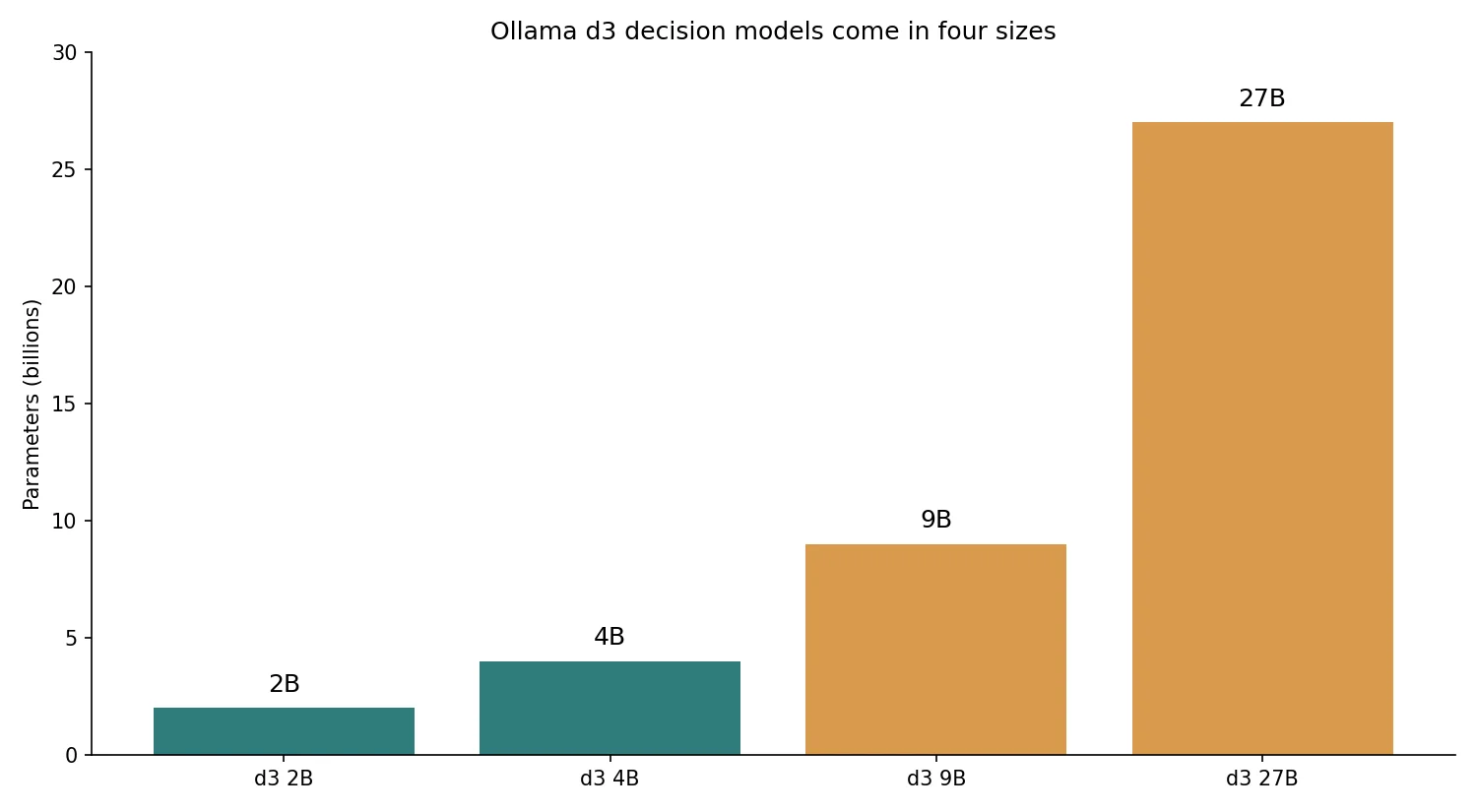
The same release run added d3, which brings vLLM Semantic Router's decision models to Ollama. Give a d3 model text, structured state, or an image, and ask it to classify it, answer a yes-or-no question, or score options with probabilities. The family comes in four sizes: 2B, 4B, 9B, and 27B.
ollama run d3 "A customer says their card was charged twice." --ask "Is this a billing issue?"
This is a different kind of answer from what a chat model gives you, and that is the point. A chat model explains; a decision model commits. If you are routing support tickets, triaging files, or gating an agent's next step, a probability you can threshold beats a paragraph you have to parse. Decision models are not new to Ollama — version 0.35 added them, and Cloudflare's Clef brought the same idea to local machines earlier this month — but d3 widens the choice, from a 2B model you can test on a laptop to a 27B model for heavier workloads.
A probability is still not a verdict on its own. A score of 0.62 is not a yes, and a model that classifies well on your test set can still fail on a weird real ticket. Use d3 as a first pass with a threshold you chose, and spot-check the borderline cases yourself. That is how a decision model earns trust: measured on your data, not on a benchmark chart.
Also in this release run: a smaller Nemotron
Version 0.40.10 added NVIDIA's Nemotron 3.5 Bolt E4B, a smaller Gemma 4-based vision-language model for fast local conversations, image understanding, and tool use. Ollama's notes put its context window at 128K tokens, and it includes a DFlash draft for speculative decoding — the technique that lets a small draft model guess ahead so the main model can verify faster. It is the kind of small, quick model that pairs naturally with Phonon: short, speech-friendly answers, spoken by your own machine.
Before you update
Three quick checks. First, confirm your version with ollama -v and update to 0.40.9 or later if you are behind; the speech docs assume that version. Second, keep your Ollama server on your own machine. Speech makes it tempting to run Ollama on a shared server so everyone can hear it — do not expose it to a network without reading yesterday's one-minute security check first. Third, remember that spoken output is audible output: do not read private documents aloud in a shared room.
The bottom line
Ollama spent months becoming a good place to chat with local models. With Phonon and d3, it is becoming a good place to build with them: one model that speaks, and one that decides. Try Phonon for narration and spoken answers, try a small d3 model for a routing job you currently do by hand, and judge both on your own text. The voice is English-only and the decisions need thresholds, but both run entirely on hardware you control — and that is the whole point of local AI.
Sources
- Ollama release notes, Ollama, October 2026
- Speech - Ollama docs, Ollama, updated October 23, 2026