
Cloudflare's Clef is now on Ollama: run multimodal decisions locally
Cloudflare's 27B Clef decision model landed on Ollama — score support tickets, receipts, and photos on your own machine with one command.
Two weeks ago I covered the launch of decision models: models that return a choice, a probability, or a score instead of chatty prose. This week the biggest one of the bunch got a lot easier to use: Cloudflare's 27B Clef landed on Ollama on October 19, so you can now run it locally with a single ollama pull — or through Ollama's cloud with no download.

What Clef is, and what's actually new
Clef is a decision model, not a chatbot. You hand it a state (text, JSON, or images) plus a schema of typed questions, and it scores every possible answer in a single forward pass. The questions come in three shapes: choice (pick one of your labels), noul (yes-or-no as a probability), and score (rate against your own rubric). Under the hood it is a 27B model fine-tuned from Qwen3.8-27B, released under Apache 2.0 with weights on Hugging Face for self-hosting.
That release happened on October 1 — I covered it then. What changed on October 19 is distribution: Clef now ships on Ollama's model library, which means three things for you:
- Run it locally:
ollama pull clef(requires Ollama 0.35.1 or later). Your tickets, receipts, and screenshots never leave your machine. - Same API as everything else: it uses Ollama's
/v1/systemoneendpoint, so code you already wrote against nimble, tev1, or the hosted Jev API works with Clef as a drop-in. - Cloud option without setup:
ollama run clef:cloud --ask "Is a refund being requested?" < ticket.txtroutes through Ollama's cloud on a paid plan or usage credits — no 20 GB download, and the page says cloud runs use zero data retention.
Speed and accuracy, with real numbers
Ollama's library page publishes a benchmark table for Clef against its smaller sibling Clef-flash (9B) and TypeSafe's hosted Jev. These are vendor-reported numbers — Cloudflare's own Decision Index data, not independent replications — but the pattern is consistent: Clef beats or matches Jev on most of the suite.
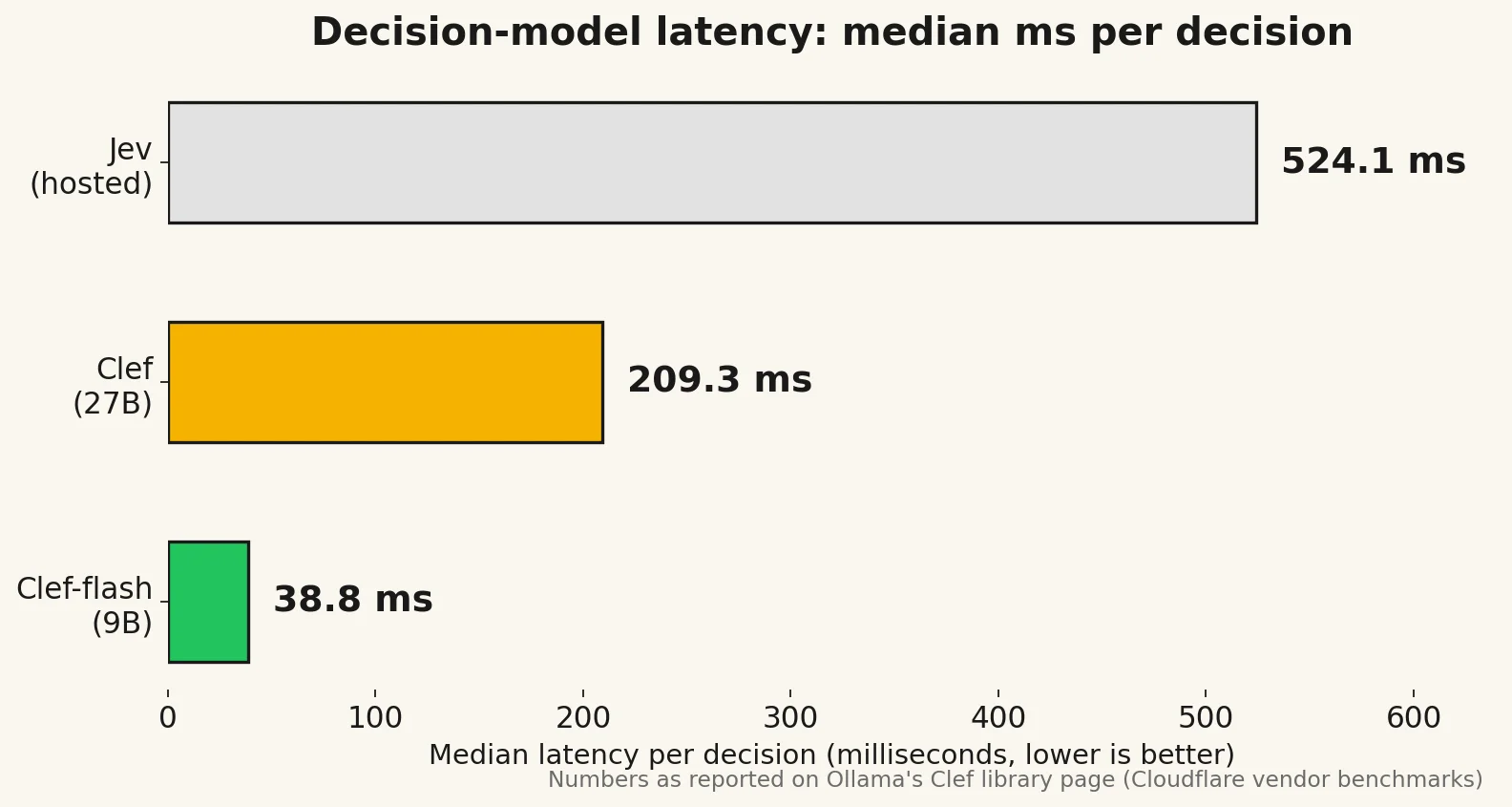
The latency numbers are the most dramatic. Median time per decision: Clef-flash at 38.8 ms, Clef at 209.3 ms, Jev at 524.1 ms — Clef answers in roughly a fifth of the time Jev needs.
On classification accuracy, Clef's headline wins over Jev include BFCL (98.5 vs 95.8), API-Bank (91.9 vs 88.2), BANKING77 (94.2 vs 79.7), and CLINC150+OOS (97.4 vs 89.3). But honest models lose some: Jev keeps the edge on ANLI (74.8 vs 69.8) and on the agent-trace-observability workflow (71.6 vs 68.5). Notably, the smaller Clef-flash often matches or beats Clef on raw benchmarks (BFCL 98.8, API-Bank 93.1) at a fraction of the latency — if you need speed over image support, flash is the interesting tier.
Also new in the Ollama release: Clef reads images, not just text. Feed it a receipt photo or a screenshot and ask things like "Is this a restaurant receipt?" or "Does the receipt include alcohol?" — the images are scored together with the text in the same pass. The context window is 64K, double Jev's 32K.
What you can build with it
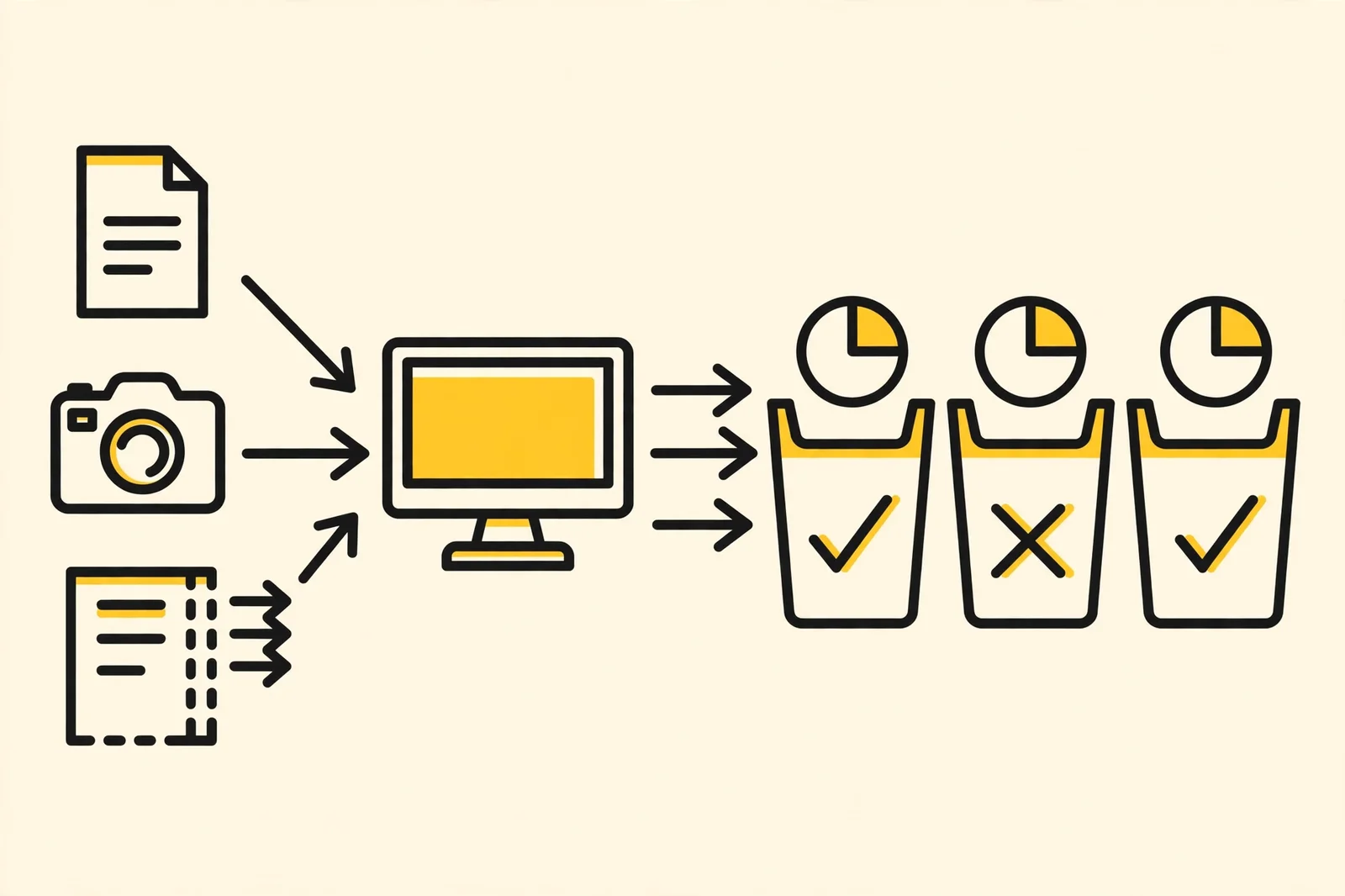
The realistic local use cases, straight from Ollama's page:
- Route support requests: define the destinations, get back the chosen team plus each team's probability.
- Check conditions: ask a yes-or-no question and get a number, e.g. "is this ticket asking for a refund?" → 99%.
- Read documents: give it a receipt photo and the fields you want, get back a field-by-field decision with probabilities.
- Gate agent tool calls: pipe a proposed tool call into Clef and ask "could this cause harm?" before it runs — 93% on the demo example.
You can do all of this from the CLI with --ask, --choice, and --level flags, or through the /v1/systemone API in Python and JavaScript. A full API example is on the Ollama library page.
What it takes to run locally
Clef is a 27B model, so it is not a laptop featherweight. Community estimates for its Qwen3.8-27B base put the minimum around 19 GB of RAM, so plan for roughly 20 GB of free memory for a 4-bit build — a solid gaming PC, an Apple Silicon Mac with 24 GB+ of unified memory, or a home server handles it. If your machine is lighter, Clef-flash (9B) is the smaller, faster variant on the same library page, or run the cloud build and skip the download entirely.
One caveat worth repeating from the Ollama docs: the confidence value Clef returns measures how concentrated the probabilities are — it is not the chance the answer is right. And on messy real-world documents, nobody has published results yet; pressure-test it on your own ugly scans before wiring it into anything that approves or denies something automatically.
The one takeaway
Until October 19, Cloudflare's best decision model lived behind Cloudflare's infrastructure. Now ollama pull clef puts a multimodal, Apache-2.0-licensed decision model on your own machine — drop-in compatible with the Jev/System One API most decision pipelines already use. For local agents that need to triage, approve, and gate rather than chat, that is a genuine upgrade in what your own hardware can do. Check whether your machine qualifies with /check, or compare memory math in /hardware-for-model.
Sources
- Clef: 27B decision model from Cloudflare, Ollama library — model details, API docs, benchmark table
- Cloudflare's Clef model now available on Ollama Cloud, AI Daily Post, October 20, 2026 — release coverage
- State of open-source local LLMs: October 2026, LLMCheck — community minimum-memory estimates including Qwen3.8-27B at 19 GB