
Nvidia may buy Reflection AI: what it means for Beam's open weights
Early talks could deepen Nvidia's $800M stake or end in a buyout. Beam's promised Apache 2.0 weights are what local users should watch.
Five days after Reflection AI unveiled Beam, its first open-weight model, reports say Nvidia is in early talks to put more money into the company — or buy it outright. Nothing is agreed yet, and both companies declined to comment or did not respond. For readers here, the deal talk matters for one practical reason: Beam's weights have not been released yet, and who owns Reflection could shape whether that release stays on track.
🎬 Prefer to watch? Here's the video version of this article.
What was reported on October 10
Reuters, citing a Financial Times report from October 10, says the talks are at an early stage. The outcome could take several forms. One is a larger investment. Another is a full acquisition. A third is an acqui-hire, where Nvidia would hire staff and license the technology instead of buying the whole company — a route the report says could avoid a lengthy regulatory review.
An agreement could come in the coming weeks, according to the report, but the talks could also fall apart. That uncertainty is the headline, not a done deal.
Nvidia is not a new backer here. The report says Nvidia has already invested $800 million in Reflection. The startup was founded in 2024 by former Google DeepMind researchers Misha Laskin and Ioannis Antonoglou. In April, its chief executive told CNBC it was raising fresh capital at a $25 billion pre-money valuation.
Why Beam matters in the first place
We covered Beam when it was announced on October 5 in our earlier post. In short: Beam is a text-only mixture-of-experts model. That means only part of the model is active for each token, which keeps the cost of running it lower than its total size suggests.
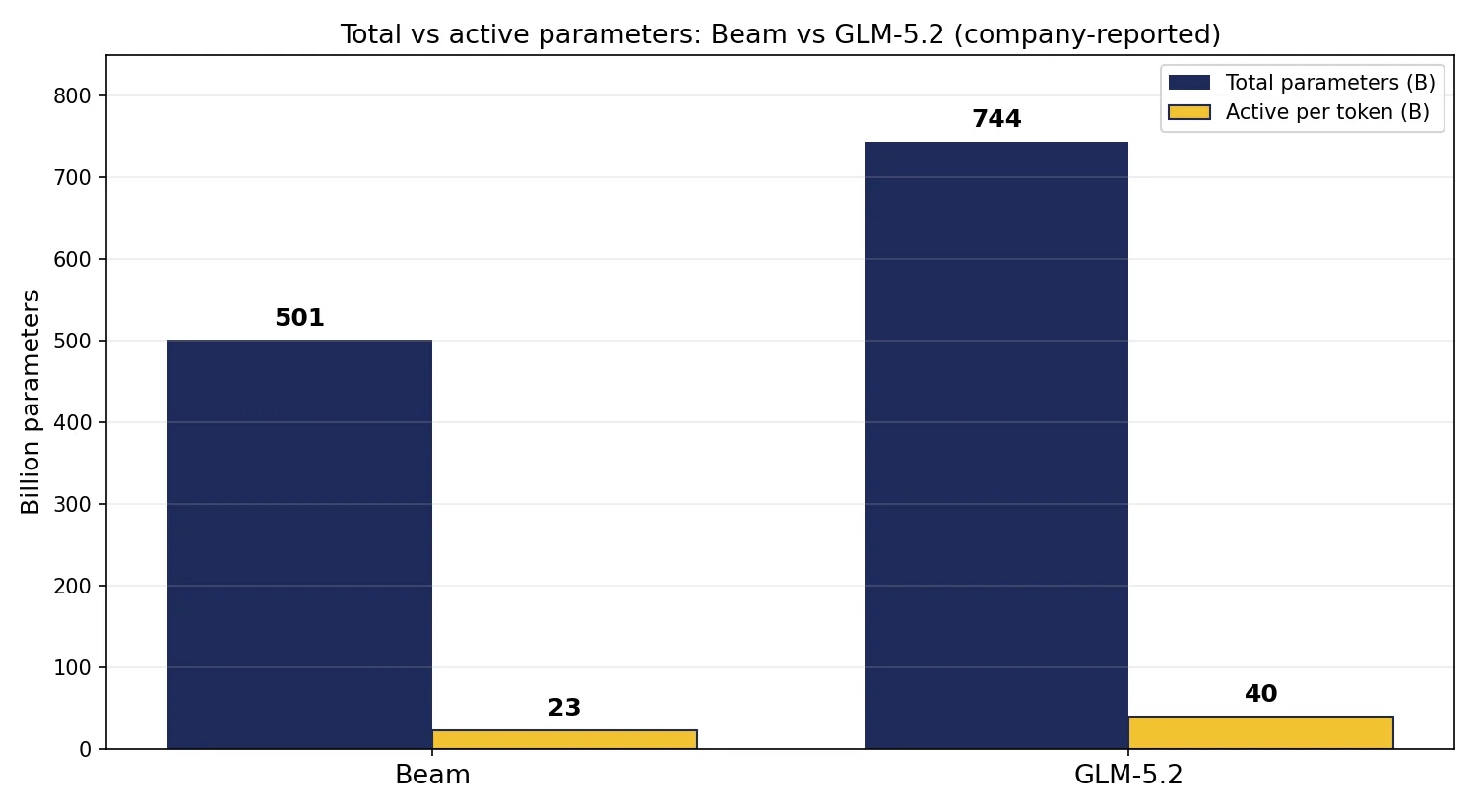
Reflection lists 501 billion total parameters and 23 billion active per token, with a 1 million-token context window. It says the model matches Z.ai's GLM-5.2 on advanced reasoning while using roughly one-quarter to one-third as much inference compute. Those are Reflection's own numbers, not independent tests, and its own table puts some rival models ahead on several tests.
Reflection said it will release Beam's weights later in October under the Apache 2.0 license, along with a technical report and model card. An early version is available through a waitlist while final red-teaming and evaluations finish. Apache 2.0 matters because it is a permissive license: if the weights ship under it, people can download, run, and build on them on their own infrastructure.
Can you run Beam on your own machine?
Not on a normal laptop or desktop, even if the weights ship on time. A 501 billion-parameter model must have all of its parameters in memory, even though only 23 billion are active per token. That points to a multi-GPU server, not a home PC. Use our hardware checker to see what sizes do fit your machine today.
Where a release like this helps home users is usually indirect and slower. Once weights are public, the community can make smaller quantized builds, and labs can distill the ideas into smaller models that do fit. None of that is guaranteed, and none of it exists for Beam yet. Today, Beam is a server-class model you would access early through a waitlist, not a download you can run tonight.
Three ways this could play out for open weights
First, a larger investment with no change in control. That is the simplest path for the current plan: more compute and cash, and the October weights release stays the test to watch.
Second, a full acquisition by Nvidia. Nvidia sells the GPUs that open-weight models run on, so keeping weights free can still fit its business. But ownership would give Nvidia the final say on future releases, licenses, and timing. A promise made by an independent startup is not the same as a policy inside a much larger company.
Third, an acqui-hire and license deal. In that shape, the team and technology move, but the company as an independent model publisher may not continue in the same form. That is the outcome where the promised release deserves the closest scrutiny, because there may be no separate Reflection left to ship it.
None of these outcomes is confirmed. The honest position today is: talks reported, no deal announced, no comment from either side in the Reuters report.
What to watch next
Watch for the weights, not the headlines. The concrete checks are simple:
- Do Beam's weights appear in October, as Reflection said?
- Are they listed under Apache 2.0, as promised?
- Is there a model card and technical report with them?
If those three land, the ownership story matters much less for users, because a permissive release cannot easily be taken back. If the release slips while deal talks continue, that delay is the signal to pay attention to.
The takeaway
Do not plan your setup around Beam yet, and do not treat a possible Nvidia deal as either good or bad news for open weights today. The only fact that will settle it is a public, Apache 2.0 weights release. Until then, if you want a strong open model you can actually run at home, pick from the models that already ship — and check the fit first on /check.
Sources
- Nvidia in talks to invest further in Reflection AI or buy it, FT reports, Reuters
- Introducing Beam, Reflection AI
- Reflection unveils Beam open-weight AI model, AI Stock Wire