
Kolibri-1: what a 78-billion-parameter open model really costs to run
Aleph Alpha released 78.1B open weights under Apache 2.0. Only 3.46B parameters work per token — but the whole model still has to fit in your memory.
Yesterday, Aleph Alpha — a German AI company — released the full weights of Kolibri-1, a 78.1-billion-parameter model, under the Apache 2.0 license. Anyone can download them. But "open weights" and "runs on your PC" are not the same thing, and Kolibri-1 is a perfect example of why.
🎬 Prefer to watch? Here's the video version of this article.

What Kolibri-1 is
Kolibri-1 is an English-German Mixture-of-Experts (MoE) language model, released on October 3, 2026 — Germany's Unity Day — as a statement about European-built AI. The weights are on Hugging Face under Apache 2.0, so you can download, run, and modify the model without asking anyone's permission.
The headline numbers, straight from the model's own card:
- 78.1 billion total parameters, but only 3.46 billion active per token (about 4.4%)
- Context window up to 1,048,576 tokens (a million-token context, reached via a serving override above its 262,144-token training length)
- Four reasoning-effort settings — none, low, medium, high — plus tool calling
- Trained on roughly 24 trillion tokens (about 20 trillion in pre-training) on 768 NVIDIA B200 GPUs over 21 days
On Aleph Alpha's own benchmarks: English overall score 75.5 and German overall 70.8, 96.9 on AIME 2025, 85.9 on LiveCodeBench v6, and 84.3 on GPQA Diamond in English. Those are vendor-run numbers on the company's own harnesses — worth knowing, not worth worshipping.
The part that matters for your machine
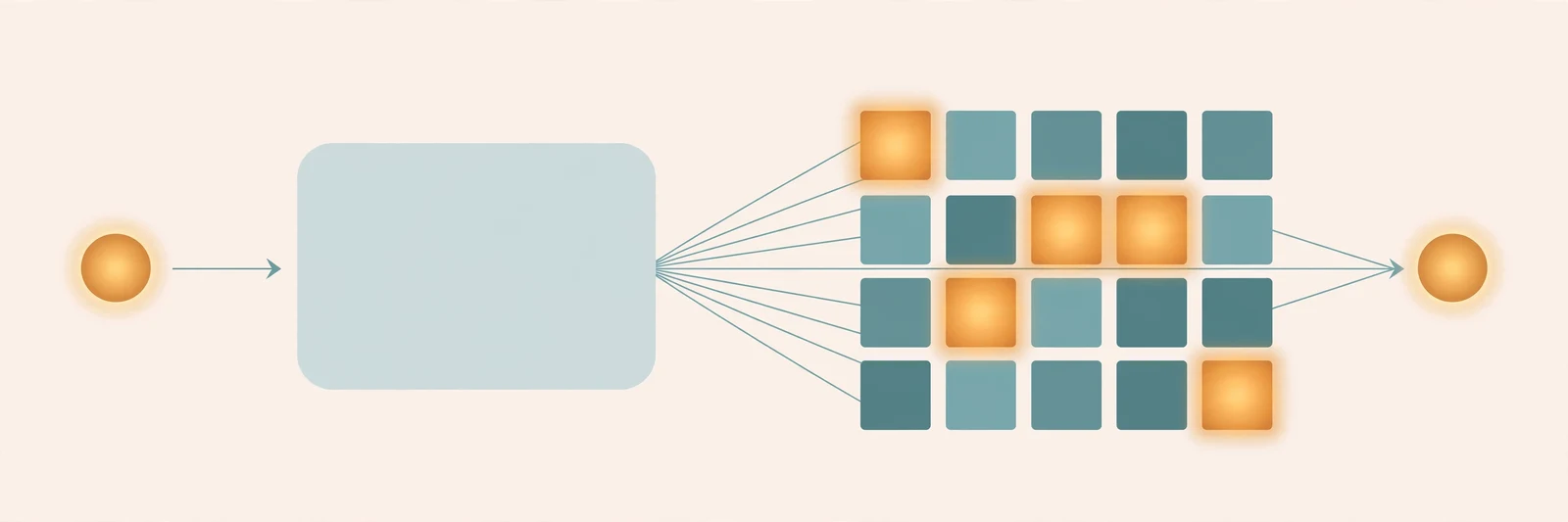
"Active parameters" is the most misunderstood number in modern AI. Here's the deal: Kolibri-1 stores 78.1 billion parameters, and every single one has to sit in memory during inference. But for each token it generates, the router wakes up only 6 of 384 experts (plus one shared expert) — just 3.46 billion parameters actually do the math.
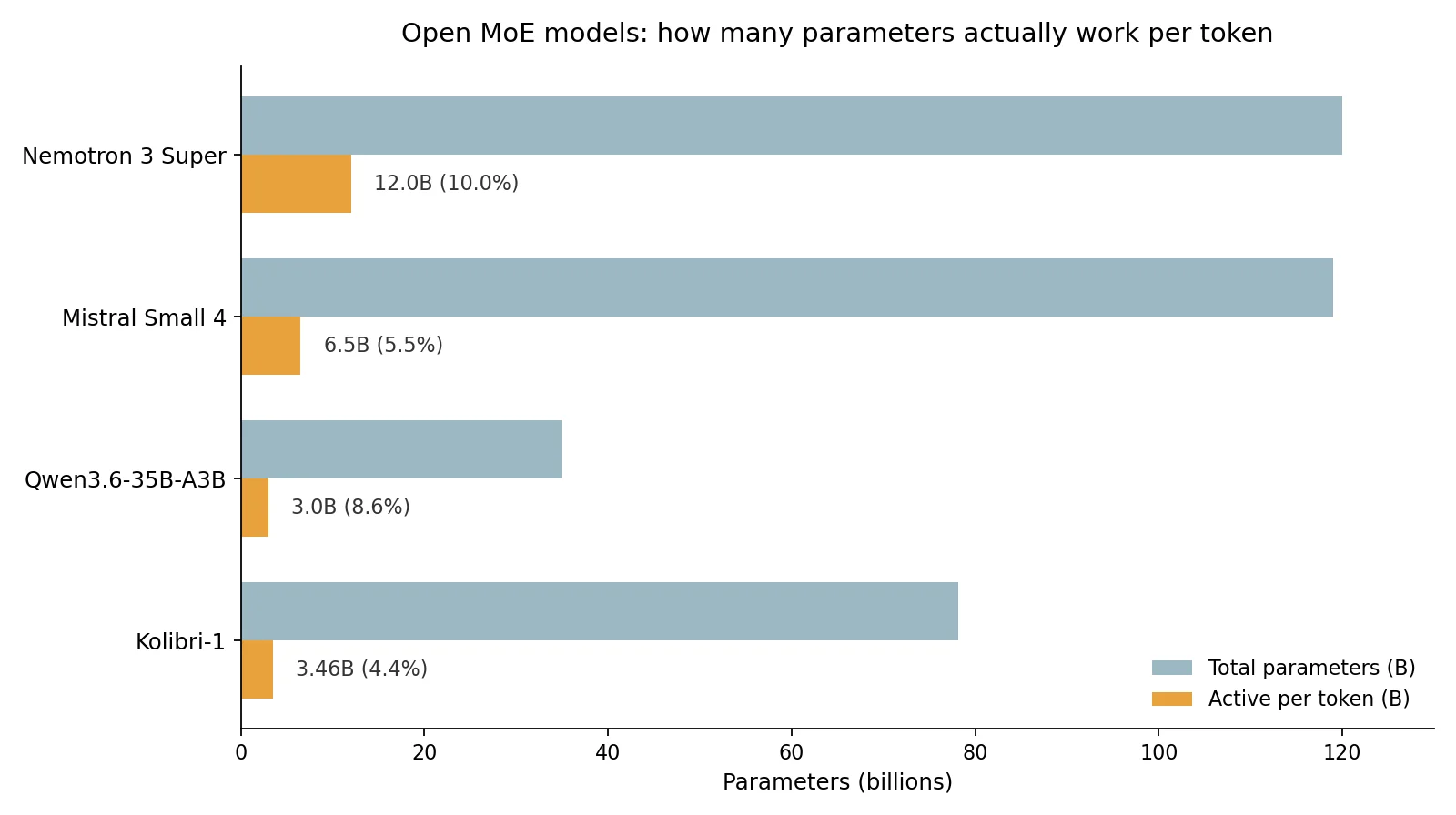
That split is why the chart above looks so lopsided, and it is the whole economic argument for Mixture-of-Experts: the download is huge, but the cost per token is small. This is why open MoE models keep showing up in the "runs fast on modest hardware" conversation. The catch is on the left side of the chart, not the right: you need somewhere to put the whole 78 billion first.
The memory math
Aleph Alpha ships Kolibri-1 in FP8 precision. The weights take up about 78 GB of memory. The model card's minimum serving setup is:
- Two NVIDIA A100 80 GB cards, or
- Two NVIDIA H100 SXM5 cards, or
- One H200, or
- One B200 or B300
Read that list again. These are data-center GPUs. A 24 GB RTX 4090 — a very serious home GPU — cannot hold the model at its published precision. Even if someone publishes a 4-bit quant later (roughly halving the footprint), you would still need on the order of 40 GB of memory, which means two high-end consumer cards or one 48 GB workstation card.
One early community report described running it on a single RTX Pro 6000 — a 96 GB workstation card — at around 170 tokens per second in FP8. That's a single unverified report, not a benchmark, but it points in the right direction: this model lives on servers and workstations, not laptops.
So what does this change for you?
Honestly? For most home users, nothing today. Kolibri-1 is not a "download it on your laptop" release. There is no official GGUF build yet, no Ollama one-liner, and its serving path is vLLM with a Kolibri-specific plugin — enterprise tooling, not weekend-project tooling.
But the release still matters for three reasons:
- The Apache 2.0 license is the real news. Unlike some "open" releases with research-only or commercial-use restrictions, Apache 2.0 means you can actually build on this — including commercially. Quantized community builds and broader engine support usually follow when the license is clean.
- It proves the MoE recipe keeps scaling. 3.46B active parameters hitting 96.9 on AIME 2025 is a serious quality-per-watt statement. The models that eventually distill down to your 16 GB laptop will be built on lessons from models like this.
- Long context is getting cheaper. The 1M-token window is reached cheaply because 40 of the 50 layers only attend to a 512-token sliding window; just 10 layers process the full context. That trick — most layers look locally, a few look globally — is likely to show up in future models you can run.
If you read German and English and have access to a server with 80+ GB of GPU memory, this is a genuinely interesting bilingual model with Apache 2.0 freedom. Everyone else should file it under "watch, don't download."
The takeaway
Kolibri-1 is a milestone for open, European-built AI — and a reminder that open weights are a starting point, not a guarantee. Always check the memory math before the download button: 78 billion parameters need 78 gigabytes, no matter how few of them wake up per token. Before you get excited about any new model, run it through the Check my computer tool — it will tell you what your own hardware can actually hold.
Sources
- Aleph Alpha release announcement (October 3, 2026), via TestingCatalog: 78.1B total / 3.46B active params, Apache 2.0 license, 1,048,576-token context, 384 experts with 6 active per token, 50 layers (10 full attention, 40 with 512-token sliding window), trained on 768 B200 GPUs for 21 days on ~24T tokens, Merlin-Arthur abstention training (44% abstention vs 14.8% for Kolibri Origin)
- MarkTechPost (October 4, 2026): benchmark comparison table — Kolibri-1 78.1B/3.46B vs Qwen3.6-35B-A3B (~35B/3B), Nemotron 3 Super (120B/12B), Mistral Small 4 (119B/6.5B); serving config 1× B200/B300/H200 or 2× H100 SXM5 via vLLM with Kolibri parsers
- Startup Fortune (October 3, 2026): ~78 GB FP8 weight footprint, minimum 2× A100 80GB; single-GPU community report (RTX Pro 6000, FP8, ~170 tokens/sec — unverified)
- AIWeekly (October 3, 2026): benchmark scores — AIME 2025 96.9, LiveCodeBench v6 85.9, GPQA Diamond 84.3 (EN), SWE-Bench Verified 66.4, English overall 75.5 / German overall 70.8
- AlexTech.ai (October 3, 2026): 1M-token serving context, FP8 weights, 2× A100 80GB minimum, vLLM + aleph-alpha-inference deployment requirement