
NVIDIA's $4,999 DGX Spark 64GB: what a cheaper local-AI box actually buys you
NVIDIA's cheaper local-AI desktop arrives October 23 — plus free speed boosts for the GPU you already own.
NVIDIA is betting that the future of AI sits on your desk, not in someone else's data center. This week it backed that bet with cheaper hardware: a 64GB DGX Spark desktop starting at $4,999, on sale Friday, October 23.

What the 64GB DGX Spark is
It is a small desktop box built around NVIDIA's GB10 Grace Blackwell superchip with 64GB of unified memory — one pool shared by the CPU and the GPU. Unified memory matters because it removes the usual VRAM limit: a big model no longer has to squeeze into a separate, smaller graphics-card memory.
The 64GB box keeps the same chip, DGX OS, and NVIDIA AI software stack as the 128GB model. NVIDIA says a single unit runs models with up to 100 billion parameters entirely on the device. Out of the box it supports Ollama, vLLM, llama.cpp, LM Studio, and PyTorch with CUDA, and NVIDIA names models like Gemma4 26B, Qwen3.8-27B, Meta Muse Glimmer, and Nemotron3.5 Lightning.
Two 64GB units can be linked directly over a ConnectX-7 network cable to pool 128GB of unified memory, reaching models up to 200 billion parameters. NVIDIA's own internal test on Qwen 3.8 27B showed the pair delivering up to 1.7x the performance of a single 128GB system. A Sync Model Launcher arrives at the end of the month, promising one-click Qwen3.8 27B downloads and OpenCode configuration from a browser.
The honest catch
First, the price trend is the wrong way around. The 128GB Founders Edition launched at $3,999, rose to $4,699 in February, and now lists at $6,950 — NVIDIA cites memory supply constraints. The new 64GB box starts at $4,999, which is $1,000 more than the 128GB model originally cost.
Second, capacity decides what runs. Roughly 8GB of the 64GB goes to the system, leaving about 56GB for model weights and KV cache. That means gpt-oss 120B, which needs around 65GB, simply does not fit. And for pure inference per dollar, independent analysis points at 128GB AMD Strix Halo boxes at $2,959–$3,649 as the value pick. If you are shopping for a local-AI machine, compare carefully in /compare/hardware before buying anything.
The part that's free: faster software
Here is the news that costs you nothing. NVIDIA's updated llama.cpp backend delivers up to 1.9x higher throughput on a GeForce RTX 5090, and vLLM shows up to 1.4x gains on two-DGX-Spark clusters. Because these are engine-level optimizations, they reach you through apps like Ollama and LM Studio — an update, not a purchase.
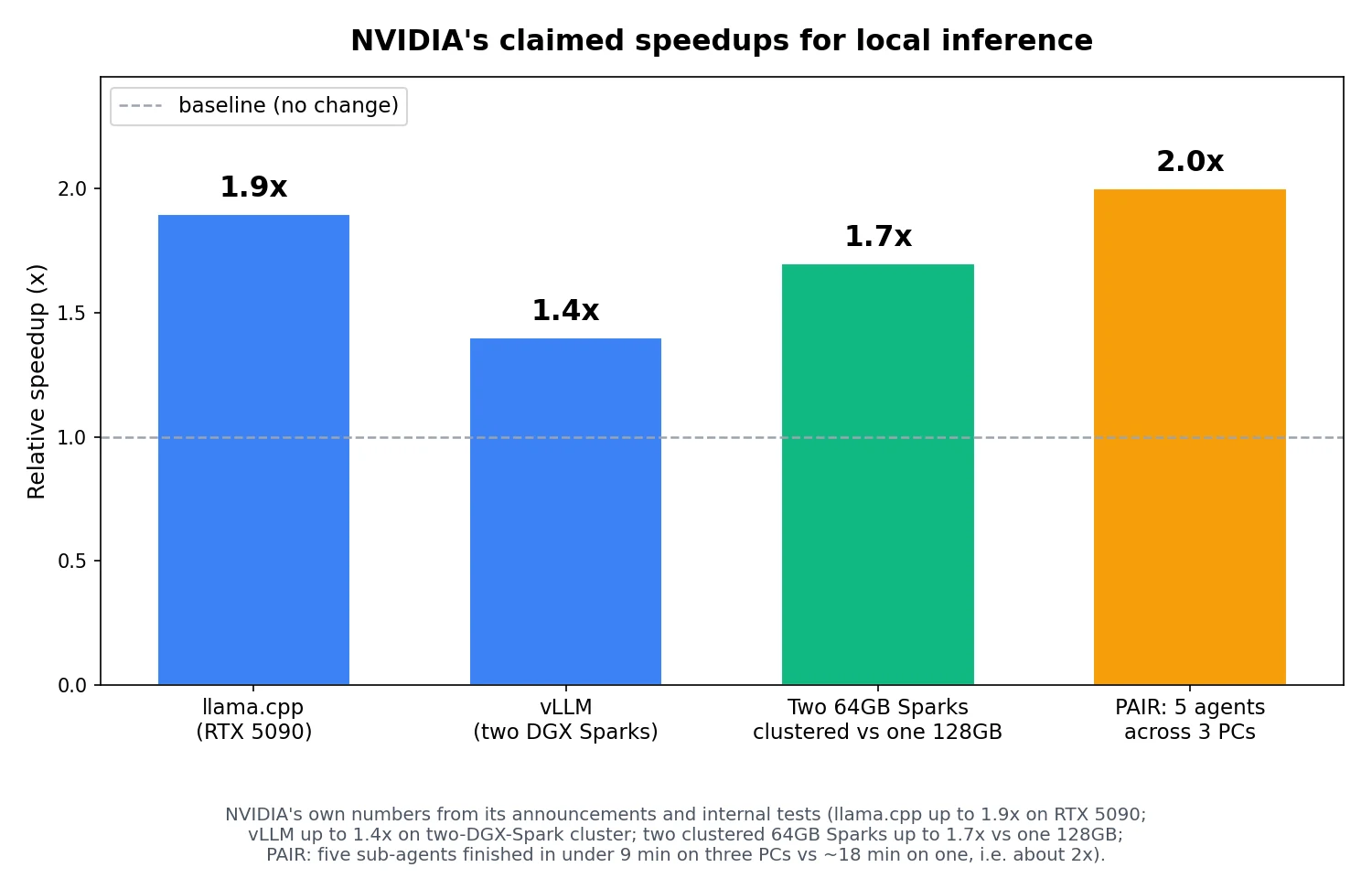
All four figures are NVIDIA's own claimed numbers, not independent tests — treat them as the ceiling, not a promise for your setup.
PAIR: your other PCs can help
The third announcement is a free, open-source beta called PAIR (Personal AI Router). It discovers compatible PCs on your local network and spreads AI inference work across them. Important detail: it does not fuse several GPUs into one bigger machine. It distributes independent inference requests across devices — which is exactly what helps when an AI agent splits a job into parallel sub-tasks.
It works with Ollama and LM Studio on Windows, macOS, and Linux, and supports GeForce RTX 20-series cards and newer, Apple M4 chips and later, and DGX Spark. In NVIDIA's test, five sub-agents working simultaneously took about 18 minutes on one device but finished in under 9 minutes across three machines.
This lands alongside the wider October hardware push: RTX Spark Windows PCs arriving this month from Acer, ASUS, Dell, HP, Lenovo, Microsoft, and MSI — compact machines built around local AI agents, creators, and gaming on one architecture.
The takeaway
Do not start by buying. If you already own an NVIDIA RTX card, the free move is updating your stack — llama.cpp, Ollama, or LM Studio — and taking the software speedup. If your home has two or three capable PCs, PAIR can put them to work together at no cost.
The 64GB DGX Spark is a real product for a real audience: people who want a dedicated CUDA dev box for models up to about 100B parameters, with a two-box path to 128GB. Just know what you are buying — and what it cannot hold — before you spend $5,000. Run your workload through /check first.
Sources
- NVIDIA DGX Spark 64GB Arrives Oct. 23 From $4,999 — Technobezz, Oct 2, 2026: pricing, partners, clustering, Sync Model Launcher, RTX Spark October window
- NVIDIA DGX Spark 64GB: $4,999, October 23, Clusters to 128GB — StorageReview, Oct 2, 2026: ConnectX-7 clustering details, 1.7x claim, Qwen 3.8 27B test
- NVIDIA DGX Spark gets a $4,999 64GB configuration — GadgetBond, Oct 3, 2026: runtime support (Ollama, vLLM, llama.cpp, LM Studio), 100B parameter claim
- NVIDIA DGX Spark drops to 64GB memory but costs more than the original 128GB version — VideoCardz, Oct 2, 2026: price history, $4,699 February raise
- Nvidia Launches 64GB DGX Spark at $4,999 as 128GB Hits $6,950 — AI Weekly, Oct 3, 2026: $6,950 current 128GB price, memory-supply cause, cluster math
- DGX Spark 64GB vs 128GB vs Strix Halo in 2026 — RunAIHome, Oct 3, 2026: gpt-oss 120B not fitting, Strix Halo value comparison
- NVIDIA Launches 64GB DGX Spark Desktop AI System for $4,999 — Guru3D, Oct 2, 2026: ~56GB usable after system reserve, NVFP4 support, named models
- Nvidia Unveils PAIR Tool and Local AI Strategy at IFA 2026 — Hello Entrepreneurs, Sep 2026: PAIR details and five-sub-agent test, llama.cpp 1.9x and vLLM 1.4x claims