
Grok Voice 3.0 already upgraded your voice agent — pin the version before you trust it
xAI switched the grok-voice-latest alias to Grok Voice 3.0 on October 14, so agents on that alias changed version with no deploy — pin it and retest.
On October 14, 2026, xAI released Grok Voice 3.0, its third-generation speech-to-speech model for voice agents. Speech-to-speech means the model hears audio and answers in audio directly, instead of chaining a transcriber, a text model, and a separate voice generator. That matters on a phone call, where a pause or a talked-over reply breaks the conversation in a way a slow chat reply does not.

What actually changed
Grok Voice 3.0 is available through xAI's Voice Agent API at $0.08 per minute, or $4.80 per hour. That is the same price as Grok Voice 2.0, so the upgrade costs nothing extra at the same call volume. It is also an API-only, closed-weight model. There are no weights to download, and you cannot run it on your own machine. That is the first thing to be clear about: this is a hosted voice upgrade, not a local AI release.
The headline result comes from Artificial Analysis, an independent benchmarking firm. Its Speech-to-Speech Index puts Grok Voice 3.0 first at 86.9, ahead of OpenAI's GPT-Live-1 (Astra, Medium) at 83.2, Google's Gemini 3.8 Live (Extended Thinking, High) at 82.6, and Grok Voice 2.0 at 81.3. The index combines speech reasoning, agent task work, listener preference, and task success from blind head-to-head calls.
The scores, with the honest caveats
The improvement over Grok Voice 2.0 is real but uneven, and the table xAI published shows both sides. Big Bench Audio speech reasoning rose from 97.2% to 98.5%. Task success rose slightly, from 94.6% to 94.8%. Full Duplex Bench, which measures how naturally a model handles pauses, turn-taking, and interruptions, rose from 95.1% to 97.0%.
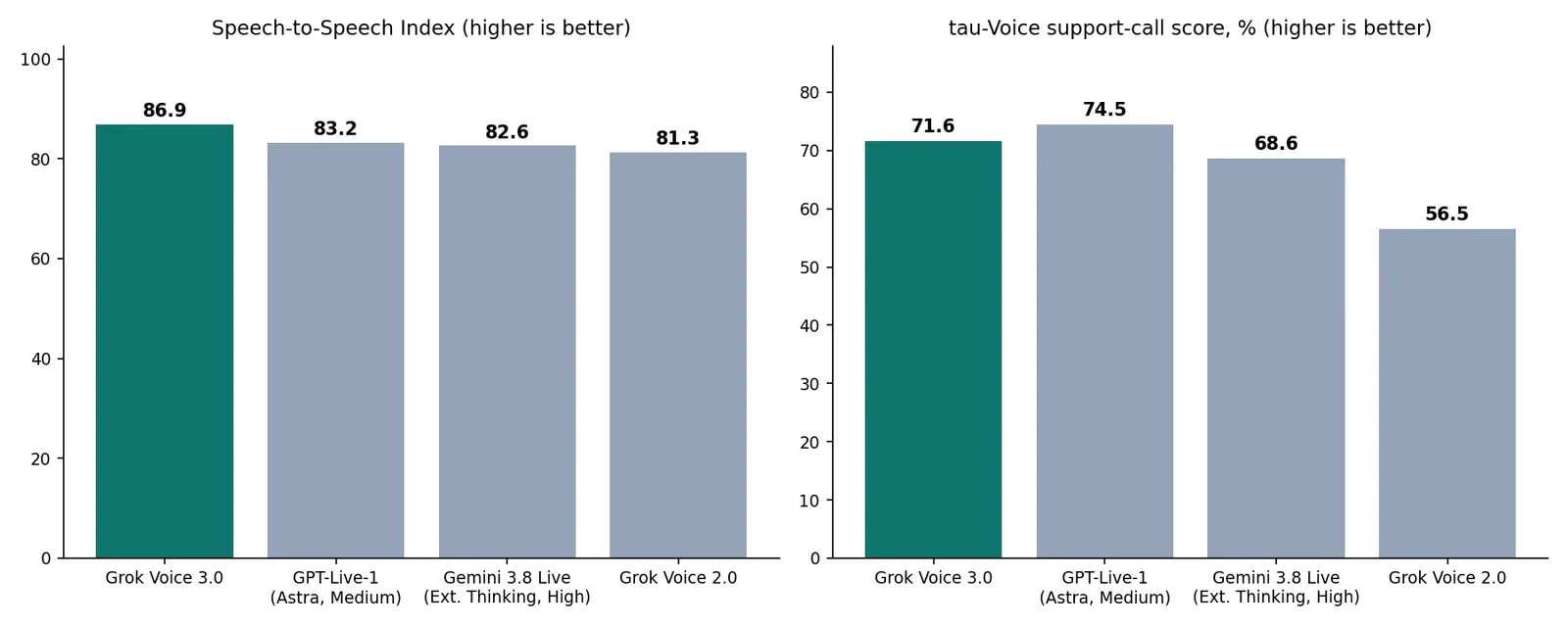
The most useful number is tau-Voice, a test built from simulated customer-support calls with varied accents, background noise, and interruptions. Grok Voice 3.0 scored 71.6%, up sharply from 56.5% on version 2.0. But it still trails GPT-Live-1 (Astra, Medium) at 74.5%. So the model that tops the overall index does not top every test inside it. If your use case is support calls, tau-Voice is the number to weigh most, not the headline rank.
Latency needs the same care. xAI describes latency as under one second and 40% lower than GPT-Live-1 on tau-Voice. Independent measurement puts first audio at 0.81 seconds for Grok Voice 3.0, against 1.34 seconds for GPT-Live-1, so the comparison with OpenAI holds up. But 0.81 seconds is slower than Grok Voice 2.0's 0.70 seconds. Upgrading made the model smarter on support calls and slightly slower to start speaking. Both facts can be true at once.
Two more figures in the announcement are vendor-reported, not independently measured, so treat them differently from the benchmark scores. xAI says Grok Voice 3.0 scored 74% on ServiceNow's EVA-Bench for enterprise voice agents, the highest accuracy score there. It also says Starlink call centers answer 20,000 customer calls a day with Grok Voice, with roughly 70% resolved without a human, and that Tesla vehicles handle millions of Grok Voice conversations a day. Those deployment numbers are plausible for a model already inside Tesla and Starlink, but they are xAI's own claims, not an outside audit.
The part that matters most: your agent may already be on 3.0
xAI moved the grok-voice-latest alias to Grok Voice 3.0 on launch day. Agents using that alias were switched automatically, with no code change and no deploy to review. If you built and tested a voice agent on Grok Voice 2.0 and never pinned a version, you have been running 3.0 since October 14, whether you noticed or not.
That is the practical risk. A model that completes more support tasks may also escalate differently, yield the turn differently, or call tools differently. Prompts tuned against 2.0 can behave differently on 3.0, and the change arrived without a changelog entry in your own repo. The fix is simple, and it applies to every hosted model alias, not just this one:
- Search your code for the alias:
grep -rn "grok-voice-latest" . - Pin the versioned model ID,
grok-voice-3.0, instead of the alias, so the next alias move does not change your agent again. - Keep a small set of recorded or scripted test calls covering your real flows: a happy path, an interruption, a caller who changes their mind, and a request that should escalate to a human.
- Run those calls against both versions with the same session settings, and compare task completion, escalations, and minutes per call. At a flat $0.08 per minute, minutes per call is your cost signal.
- Log the model ID on every session, so you can tell later which version handled a call that went wrong.
What this means if you want voice on your own machine
Nothing about Grok Voice 3.0 helps you run voice locally, because there is nothing to download. If keeping calls on your own hardware matters more than topping a benchmark, the local side of this story is elsewhere: Mistral's Voxtral 3 stack, covered here on October 20, is built to live on your own servers, and Ollama's Phonon speech support, covered on October 25, now lets a local model talk back on a Mac. Those are the options to compare if privacy or offline use is the deciding factor. Grok Voice 3.0 is the option to compare if you want a hosted voice agent and are willing to accept that its version can move under you.
The bottom line
Grok Voice 3.0 is a stronger voice agent at the same price, with a first-place overall index score, a large jump on support-call tasks, and one test where it still trails its main rival. The upgrade itself is not the news most builders should act on. The alias switch is. Check whether you are on grok-voice-latest, pin grok-voice-3.0, and re-run your test calls. A model upgrade you did not choose is still a change you own.
Sources
- Introducing Grok Voice 3.0, xAI, October 14, 2026
- Grok Voice 3.0 from SpaceXSI outscores OpenAI and Google on speech-to-speech index, SiliconANGLE, October 14, 2026
- Meet Grok Voice 3.0: SpaceXAI Voice Agent Model Ranks #1 on Artificial Analysis, MarkTechPost, October 14, 2026