
Nanbeige4.3-33B: a 33B open agent model built to teach a smaller one
Nanbeige's new 33B open model claims strong agent scores, but its real point is the smaller model it is meant to teach.
Nanbeige LLM Lab released Nanbeige4.3-33B on Hugging Face on October 25, 2026. It is a 33-billion-parameter dense model, built for agent work: multi-step coding jobs and office-style tasks where the model uses tools, edits files, and fills in documents. It is licensed under Apache 2.0, so you can use it commercially and build on it. The part that matters most for local AI is not the size. It is the plan: Nanbeige calls this model the flagship teacher for its Nanbeige4.3 series, and the student it will train is a much smaller Nanbeige4.3-3B.

What the model actually is
Nanbeige4.3-33B is dense, which means all 33 billion parameters run on every token. There is no expert routing to cut the active cost, unlike the mixture-of-experts models covered here recently. It works in English and Chinese, and its context window is 524,288 tokens, or about 512K. That is a very long window on paper. In practice, a long window only helps if you have the memory for it, and this model is honest about that cost: the model card's own server recipes use 4-way tensor parallelism across multiple GPUs, with SGLang and vLLM.
Reasoning is on by default. The chat template has an enable_thinking switch, and a preserve_thinking switch that keeps earlier reasoning in multi-turn conversations. Nanbeige recommends keeping that second switch on for tool use and coding agents, and off for plain chat. That is sensible advice: reasoning helps hard tasks, but it makes answers longer and slower, and keeping old reasoning around grows the conversation fast.
The scores, with the warning label attached
The model card compares Nanbeige4.3-33B with Qwen3.8-27B, Muse-Glimmer-30B, and Gemma4-31B, all run at their highest thinking effort. Nanbeige says its model leads on 17 of 20 rows. The headline numbers are 80.9 on Terminal-Bench 2.1 against 73.0 for Qwen3.8-27B, and 65.5 on DeepSWE against 42.5. On office-style work, it reports 54.2 on Automation Bench against 38.3.
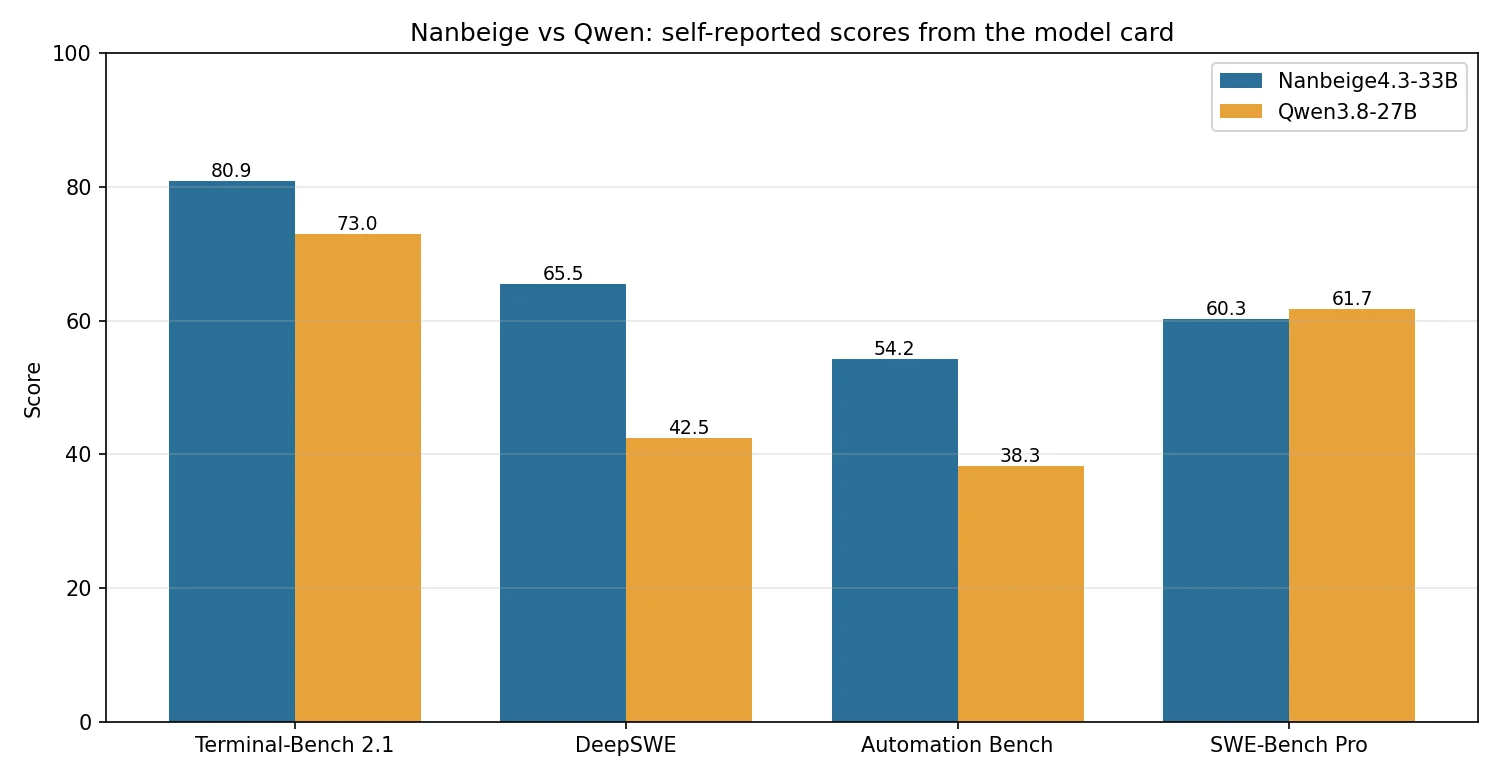
It is not a sweep, and the card shows the losses too. Qwen3.8-27B leads on SWE-Bench Pro, 61.7 to 60.3, and on GDPval, 86.4 to 84.8. Gemma4-31B leads on GPQA Diamond, 91.3 to 89.5. Treat all of these as self-reported until someone outside Nanbeige reproduces them. Independent checks matter here more than usual, because at least one outside write-up notes that some competitor figures in Nanbeige's table differ from what those labs publish themselves. A scoreboard written by the winner is a starting point, not a verdict.
Can you run it on your own machine?
Here is the honest answer: not easily, and not at full quality on a normal home PC. The full BF16 weights are about 66 GB, which already rules out a single consumer card. The card's recipes assume a multi-GPU server. A 4-bit quantization would shrink the weights to roughly 20 GB, which could fit on a single 24 GB card, but no official quantization is part of this release, and the long context window would still eat memory fast. At 512K tokens, the conversation history alone can dwarf the weights.
So for most readers, this model is not a download-and-chat release. It is a server model, a hosted-model candidate, or a base for fine-tuning. Nanbeige also released Nanbeige4.3-33B-Base, the unpolished version, for people who want to post-train it themselves. That, plus the Apache 2.0 license, is where the real local value sits: anyone can build on it, including teams that will distill it down.
Why a teacher model matters more than another 33B release
Distillation is the process of training a small model to imitate a large one. If it works well, the skills of a 33B teacher can land in a 3B student that runs on a laptop. That is the pattern to watch: the teacher proves what is possible, and the student is what most people actually run. Nanbeige has not given a date for the 3B model, so do not wait for it. But when it arrives, judge it the same way: on your tasks, on your hardware, not on the teacher's scoreboard.
If you have a multi-GPU server, this is worth testing for agent coding work, especially where a long context and tool use matter. If you have a single consumer GPU, the practical move is to wait for the distilled student or a community quantization, and keep an eye on independent benchmark reproductions in the meantime. A strong teacher with an open license is good news either way. It just is not yet a model for every desk.
The bottom line
Nanbeige4.3-33B is a capable, openly licensed agent model with strong self-reported scores and a clear purpose: teach a smaller model. Run it if you have server hardware. Otherwise, watch for the 3B student. That is the release most local AI users will actually feel.
Sources
- Nanbeige/Nanbeige4.3-33B, Nanbeige LLM Lab, Hugging Face model card, October 2026
- Nanbeige Releases Nanbeige4.3-33B, a 33B Open Agentic Coding Model, MarkTechPost, October 25, 2026
- Nanbeige4.3-33B Released as an AI Teacher, AI News, October 26, 2026