
GPT-6.1 Terra: OpenAI's cheaper model that can use your computer
OpenAI's GPT-6.1 Terra, launched October 26, looks at your screen and clicks through apps at half the API price of its predecessor.
OpenAI launched GPT-6.1 Terra on October 26, 2026. It is a mid-priced model built for a job most chatbots do not do: operating a computer. Instead of only answering questions, it looks at what is on screen, understands it, and takes action across apps — filling out forms, reading invoices into accounting software, interpreting technical drawings, and drafting documents. It is available now to Plus, Pro, Enterprise, and Edu users in ChatGPT Work and Codex, and to developers through the API as gpt-6.1-terra.

What "computer use" actually means
Computer use is different from chatting. A chat model reads your words and writes back. A computer-use model takes the screen itself as input — a screenshot of an app, a form, a drawing — and produces clicks and keystrokes, the way a person would when switching between programs. OpenAI's example is mundane on purpose: read an incoming invoice and type the details into accounting software. That is the kind of repetitive, screen-bound work where an agent earns its keep, and where a mistake costs real money if nobody checks it.
Terra is not OpenAI's most capable model. The company still points users to GPT-6.1 Sol or GPT-6 Astra for in-depth research or complex coding. Terra's job is high-volume everyday work, where speed and cost per task matter more than peak capability.
The price and speed numbers
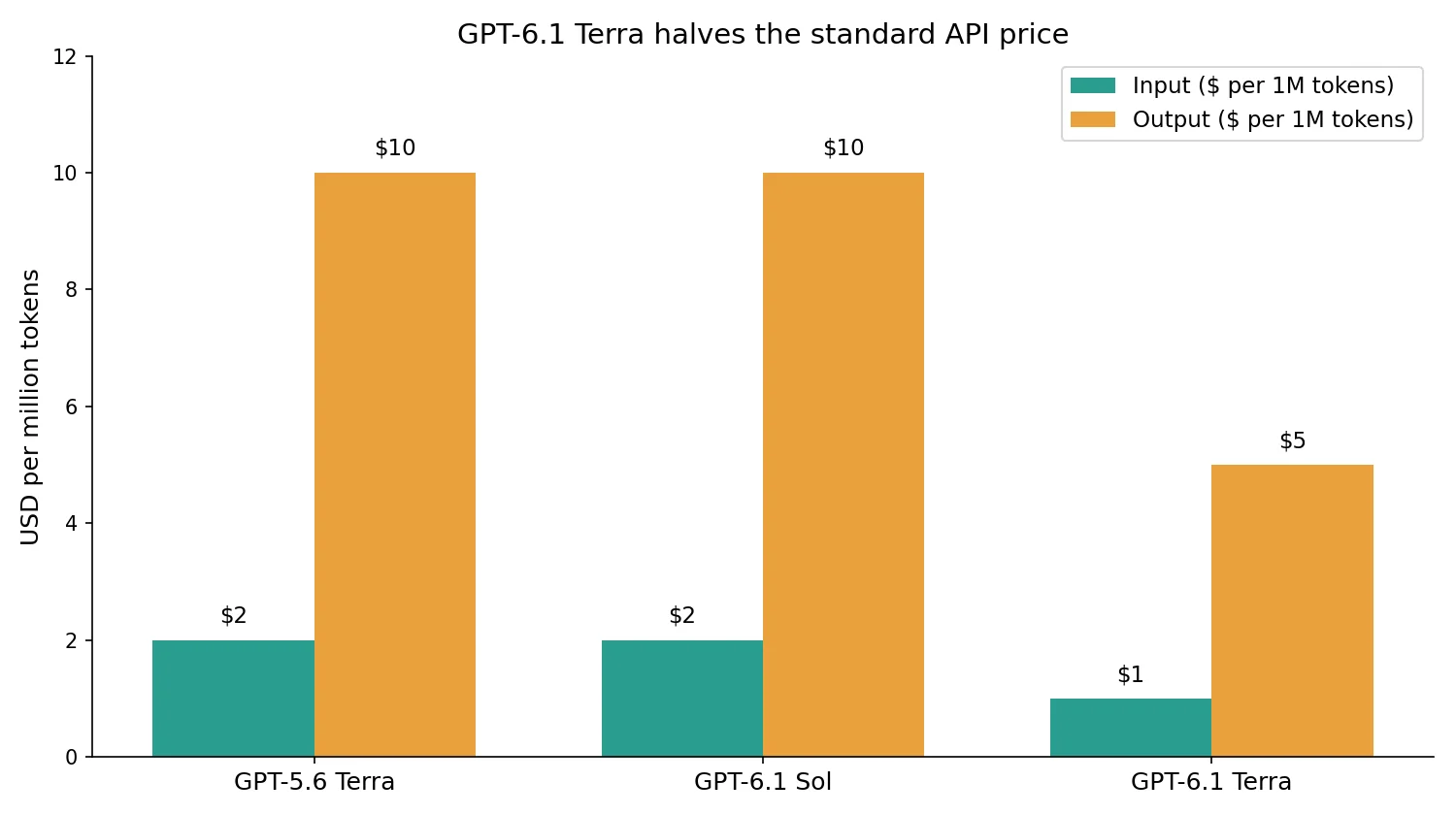
The headline is price. Standard API rates are $1 per million input tokens, $0.05 per million cached input tokens, and $5 per million output tokens. OpenAI says that is 50% lower than both GPT-5.6 Terra and GPT-6.1 Sol, which puts both predecessors at $2 per million input tokens and $10 per million output tokens.
On OpenAI's own benchmarks, the cheaper model is also faster and more accurate than the one it replaces. On Agents' Last Exam, a test of professional software tasks, Terra scored 15 percentage points higher than GPT-5.6 Terra at medium reasoning effort, at about one-third of the cost per task. OpenAI says it matches GPT-6 Astra at one-tenth the price per token, and finishes tasks more than three times faster on average than both Astra and Sol. On Terminal-Bench 4.0, a coding-agent test, Terra solved 50.3% of tasks at maximum reasoning effort, up from 21.5% for GPT-5.6 Terra. On an internal set of prompts designed to trigger factual errors, the error rate at low reasoning effort fell from 53.6% to 16.7%, and to 4.3% at maximum effort. The context window is 1.05 million tokens, with up to 128,000 output tokens.
Every one of those benchmark figures is OpenAI's own. No independent reproductions are out yet, and vendor benchmarks tend to flatter the vendor's model. Treat the direction — cheaper and better than its predecessor — as plausible, and the exact margins as provisional.
What this changes for you
First, the honest limit: Terra is closed weights running on OpenAI's servers. You cannot download it, run it on your own machine, or inspect what it does with your screen. A model that clicks through your apps sees everything on those screens — documents, messages, passwords in plain view. That is a real privacy trade-off, and it is the opposite of the local-AI approach this blog usually covers. If the work involves sensitive data, a cloud computer-use agent should not be your first choice, no matter how cheap the tokens are.
Second, the comparison that matters for local AI. No open model you can run at home today does reliable, general computer use at this level. Local agents are good at chat, coding help, document search, and structured decisions — the decision models covered here recently, like d3-ultra, answer in probabilities rather than paragraphs. But handing a local model your desktop and trusting it to click correctly is still ahead of us. Terra's price drop does not change that gap; it changes the cloud side of the equation. Screen automation that was too expensive to run at volume last week is now half the price, which means more of it will be built, and more of your apps will be operated by agents you do not control.
The practical takeaway is narrow. If you automate screen work through the API, Terra is the new default to test: same class of task as Sol, half the token price, faster completion. Test it on your own workflows before trusting it, keep a human reviewing anything that moves money or sends messages, and do not give it a screen full of data you would not hand to a stranger. If you run AI locally for privacy, nothing here replaces that — but it is a useful reminder of where the frontier is moving, and what local models still need to catch up on.
If you are sizing a machine for the local side of this — chat, coding help, and document work on your own hardware — start with /check.
Sources
- GPT-6.1 Terra: delivering fast and capable computer use at a lower price, OpenAI Developer Community, October 26, 2026
- OpenAI launches GPT-6.1 Terra with 3x faster AI agents, 50 percent lower pricing, BleepingComputer, October 2026
- OpenAI Launches GPT-6.1 Terra, Halving GPT-6.1 Sol's API Price for Agent Work, MarkTechPost, October 26, 2026