
vLLM's d3-ultra: a 27B open decision model that answers in probabilities, not paragraphs
d3-ultra reads text, images, and video once and answers many questions with a probability for each, under an Apache 2.0 license.
vLLM Semantic Router released d3-ultra on October 26, 2026. It is a 27-billion-parameter decision model, not a chatbot. You give it an input — text, JSON, an image, or a video — plus the questions you want answered, and it returns a probability for every answer. It does not write a paragraph. That difference is the whole point: when an agent needs to route a ticket, approve a step, or classify a document, a number it can act on is often more useful than fluent text.

What a decision model actually does
A normal chat model generates words one at a time. A decision model works differently. You define the allowed answers in advance: pick one of several options, answer yes or no, give a score, or point to a place in a picture. The model reads the input once and answers every question from that single read. Because nothing is generated, the result is structured data your code can use directly, with a confidence value attached.
d3-ultra's numbers are straightforward. It has 26.09 billion parameters, including a 0.46-billion-parameter vision encoder. It accepts text or JSON, plus images and videos, several per request. Each question can use up to 131,072 tokens of context. The weights are licensed under Apache 2.0, which allows commercial use and building on top of the model.
What is new here: boxes and video tracking
d3-ultra adds two decision types that its earlier siblings did not have in this form. The first is Box: ask where something is in plain words, and it returns one box plus a confidence value. A confidence near zero means the thing is not there — the model card's own examples include a dog that is not in a painting, and a flag that is not in a Moon photo. That "not found" answer matters, because a box with no confidence would be easy to misread as a hit.
The second is Track: follow a target through a whole video, with the probability that it is visible at each point. You can also ask for a box at a single moment in a video. The free API serves both, which means you can test video questions before you install anything.
The speed claim is specific, and worth quoting exactly because it shows why "ask once" matters. On one AMD Instinct MI325X server GPU, the model card reports 304 milliseconds for one question about a photo, and 2.16 seconds for 255 questions about the same photo. Each extra question adds about 7.3 milliseconds. That is the benefit of reading once: the tenth question costs almost nothing compared with the first.
The scores, with the warning label attached
On the team's own SR-Text test, d3-ultra scores 87.2, ahead of GLiDE V1.2 at 85.1, d1-ultra at 83.4, d3-turbo at 83.1, the earlier d3 at 81.4, and Jev 1.14 at 73.1. On SR-Box, which tests pointing at things in images across ten domains, d3-ultra scores 58.2%, just behind d3-turbo at 60.0% and ahead of Jev 1.14 at 45.7%. The team notes that d3-turbo remains its strongest Box model on natural images, while d3-ultra leads on charts.
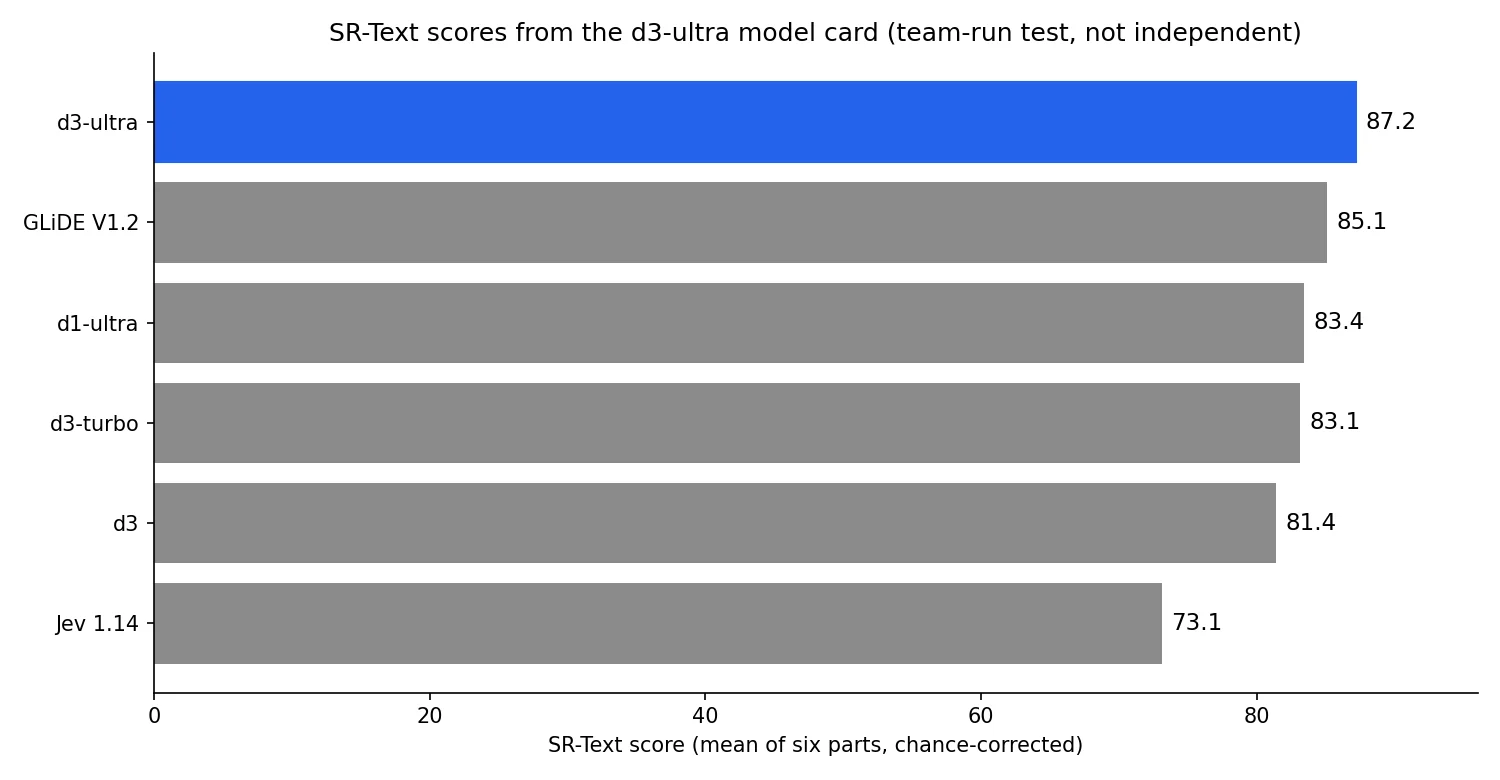
Treat these as the team's own results, not an independent verdict. Both question sets are private and unpublished, so no outside lab can rerun them exactly. The Jev Decision Index, a separate public board, lists d3-ultra second of 229 models on its text board at 70.18, up 3.03 points over d3 — a useful cross-check, but still one board, not a consensus. The honest read: d3-ultra looks like a real step up from d3, especially on text decisions, and the Box results show it is not the best choice for every pointing task. Its own sibling beats it there.
Can you run it on your own machine?
Here is the practical split. A 26-billion-parameter model is server hardware, not a laptop model. The model card's own serving numbers use a datacenter GPU, and no consumer-card recipe is part of this release. If you have a multi-GPU server, the route is vllm-sr serve with this model, or the Transformers path with transformers==5.17.0 and trust_remote_code=True from the model card's quickstart.
For everyone else, the sensible first step is the free API at decision.vllm-sr.ai, or the official demo space on Hugging Face. Try it with your own documents and images first. Decision models live or die on your data: a model that scores well on a team's private test can still misroute your tickets if your categories are fuzzy. Write clear options, keep a human in the loop for low-confidence answers, and only move to self-hosting once the free tier proves the model earns its place in your workflow. If you are sizing a machine for any of this, start with /check.
from transformers import AutoModel

model = AutoModel.from_pretrained("vllm-sr/d3-ultra", trust_remote_code=True)
print(model.system_one(
    state="Ticket: the invoice total is wrong after the plan change.",
    questions={
        "route": {"type": "choice", "instructions": "Which team handles this?",
                  "criteria": {"billing": "Billing", "tech": "Technical support"}},
        "urgent": {"type": "noul", "instructions": "Is the customer asking for an urgent fix?"},
    },
))
The bottom line
d3-ultra is not a model you chat with. It is a component: one read of a document, photo, or video, many structured answers, each with a probability you can threshold, log, and audit. The Apache 2.0 license means anyone can build on it, and the free API means you can test it before buying hardware. Start there, measure it on your own questions, and let the confidence numbers — not the headline score — decide whether it belongs in your agent.
Sources
- vllm-sr/d3-ultra, vLLM Semantic Router Team, Hugging Face model card, October 2026
- vLLM Semantic Router Releases d3-ultra: A 27B Open Multimodal Decision Model, MarkTechPost, October 26, 2026
- Opened October 26, Decision Index 0.4.1 Full score for d3-ultra is 70.18, second of 229, Jev News, October 2026