
FLUX 3 Image Klein: a 5.6B open-weight image model for your 8GB GPU
Black Forest Labs' 5.6B image model generates and edits photos at up to 4K, and the INT8 build fits on an 8GB gaming GPU. Here's the honest memory math.
Image models used to hand you one of two bills: an API charge for every picture, or a 24GB graphics card on your desk. On October 15, Black Forest Labs released FLUX 3 Image Klein, a 5.6-billion-parameter open-weight image model whose INT8 build is designed to run on consumer GPUs with as little as 8GB of VRAM. That puts near-frontier image generation and editing on the machine a gaming laptop already has.

What it is
FLUX 3 Image Klein is the compact open-weight member of Black Forest Labs' FLUX 3 family. One checkpoint covers three jobs that used to mean three different tools:
- Text-to-image generation, with native output up to 4K resolution.
- Image editing — BFL's claim is that unedited regions are preserved exactly, not approximately repainted.
- Multi-reference generation with up to 10 reference images — keep a character or a product consistent across images without retraining.
It also supports bounding-box control: you draw a box to say where an element goes, or to confine an edit to one region. Anyone who has fought a model that kept moving a logo knows why that matters more than another benchmark point.
The release ships two checkpoints: a base model for fine-tuning and research, and a step-distilled model for fast generation. NVIDIA helped build quantized versions in FP8, INT8 and NVFP4 alongside it.

The memory math: what fits on your GPU
BFL reports the generator weights take 11.2 GB in BF16 and 5.6 GB in FP8. The INT8 build is the one aimed at consumer cards: BFL says it runs through ComfyUI or Diffusers on GeForce RTX cards with 8GB of VRAM.
One honest caveat before you download. The 5.6B figure covers the image generator only, not the text encoder that reads your prompt. Hugging Face's own tests found the full pipeline used roughly 16 GB with FP8 weights and about 21 GB in BF16 on data-center GPUs. Getting it onto an 8GB card means using the INT8 build plus memory-saving tricks — Hugging Face suggests running the text encoder separately, for example.
So the fair version of the claim: 8GB is the floor with the INT8 build and careful setup, not plug-and-play on default settings. A card with 12–16GB will have a much easier time.
How fast it is
All speed numbers below are vendor-reported, measured with the distilled model at 16 steps on a 1-megapixel image:
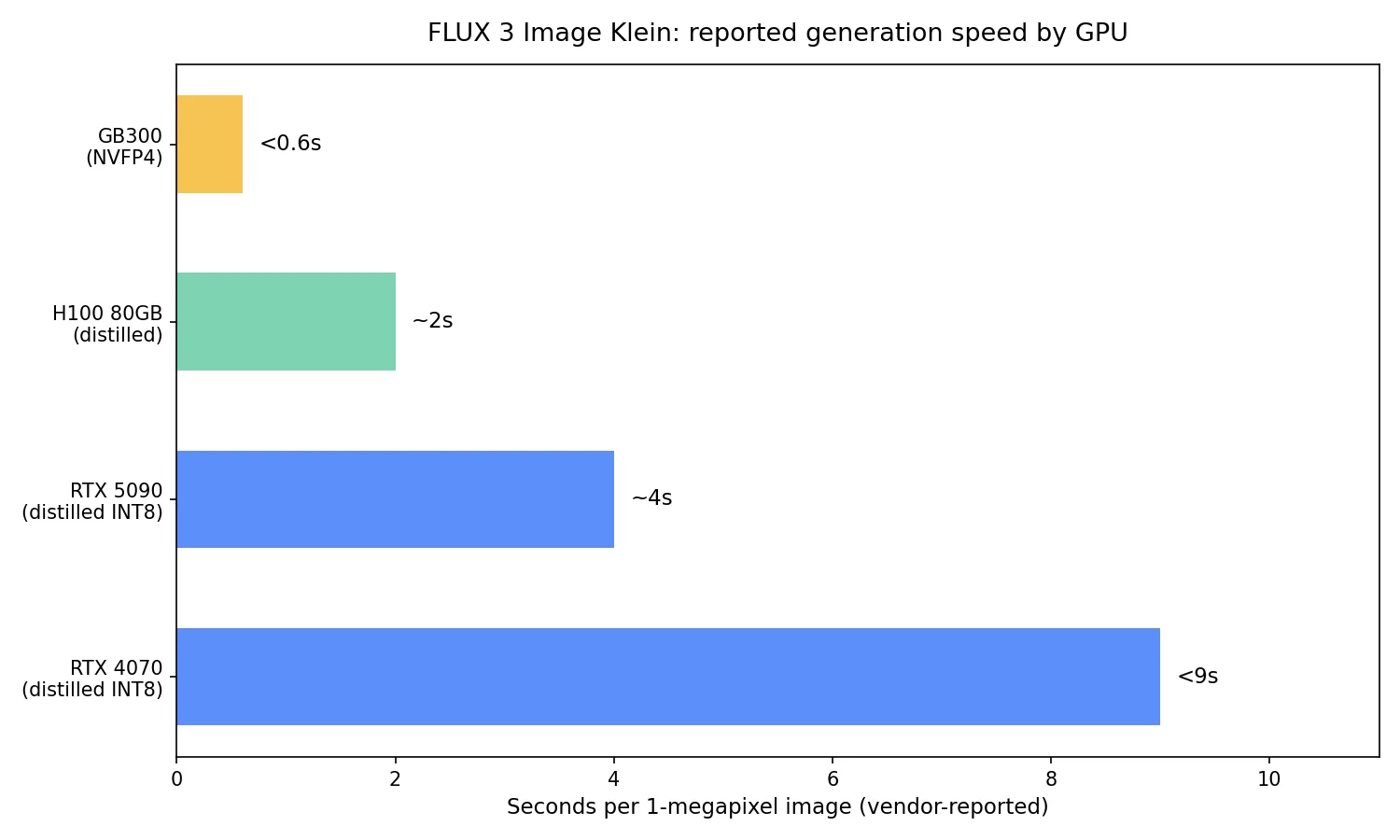
Under 9 seconds per image on an RTX 4070 is a usable local pace — you can iterate on a prompt without a queue or a meter running. BFL's Hugging Face Diffusers announcement separately measured about 2 seconds for a 1024×1024 image on an H100 with the distilled checkpoint.
The license: read the revenue line
The weights ship under the FLUX Kommunity License: free for commercial use by individuals and businesses with annual revenue under $5 million, plus research and non-commercial use. Companies above that line need a paid self-hosted license or must use the API.
That is more permissive than many image-model licenses, but note one wrinkle reported in launch coverage: BFL's model page also says running Klein in a product needs a commercial license. Check the model card terms before you ship anything customer-facing.
API or your own machine?
If you'd rather not run it, the BFL API serves the distilled model at $0.009 per 1K-resolution image — about 110 images for a dollar. It is also available in BFL's Playground and on Hugging Face Spaces.
For tinkerers, LoRA fine-tuning works from day one through Diffusers, Ostris's AI Toolkit, and NVIDIA's NeMo AutoModel — and the base checkpoint exists specifically for that. Community fine-tunes usually land within weeks of a launch like this.
What I can't confirm yet
Independent tests had not landed at writing time. The quality claims are BFL's own: Klein scores the highest Elo ratings among open models in their internal testing, beating some closed models including Ideogram V4.5, and gains 91 Elo points over FLUX.2 klein (the 9B predecessor) with 38% fewer parameters. Treat those as the vendor's claims until third-party testing exists. Klein is also the second FLUX 3 open release after FLUX 3 Action (a 7B robot-control model), and BFL says more releases are coming.
Takeaway
Klein is the most practical kind of image-model news for local-AI users: not a bigger model, but a smaller one doing nearly the same job. If your card has 8–16GB of VRAM, an INT8 build running locally in ComfyUI is now the cheapest way to get bounding-box editing, 10-reference composition and near-4K output — no API bill, no files leaving your machine. Want to know if your setup qualifies? Try /check for your hardware, and /learn if quantization math is new to you.
Sources
- Black Forest Labs' open-weights image model FLUX 3 Image Klein runs on consumer GPUs with just 8 GB of VRAM, The Decoder — release overview, INT8 8GB claim, Elo claims, license
- Black Forest Labs Releases FLUX 3 Image Klein With 5.6B Parameters, Technobezz — weight sizes, GPU timings, quantized builds, API pricing
- New 5.6B-Parameter FLUX 3 Image Klein Debuts as Open-Weights Release, Unite.AI — features, availability, LoRA support, licensing terms
- FLUX 3 Image Klein brings near-frontier image AI to home graphics cards, TechCityAuthority — generator-vs-pipeline memory caveat, API math
- FLUX.3 Image Klein arrives in Diffusers with NVFP4 and FP8 weights, Glonce (Hugging Face blog coverage) — Diffusers support, H100 timing methodology
- FLUX 3 Image Klein: Open-Weight Image AI on an 8GB GPU, Digital Applied — specs, license revenue threshold
- Black Forest Labs releases FLUX 3 Image Klein with free commercial use for small businesses, CryptoBriefing — license details, capabilities