
DeepSeek V4.1-Flash-1017: faster open-weight agent updates, and what it costs to run one
DeepSeek's updated Flash model scores 77 on DeepSWE with MIT-licensed weights — but it's a server-class 748B model, not a home-PC one.
DeepSeek released V4.1-Flash-1017 today, October 17 — a "minor update" to the V4.1 Flash model it launched in September, with open weights under the MIT license on Hugging Face. The headline: DeepSeek's own benchmark table shows higher scores on all 11 tests it reports, while the model finishes tasks faster and writes shorter answers. For anyone building agents on a budget, the most interesting part is the cost: an independent pilot measured completed agentic tasks at about a cent and a half each — roughly a quarter of what the cheapest Claude and GPT options cost on the same workload.

What the numbers actually say
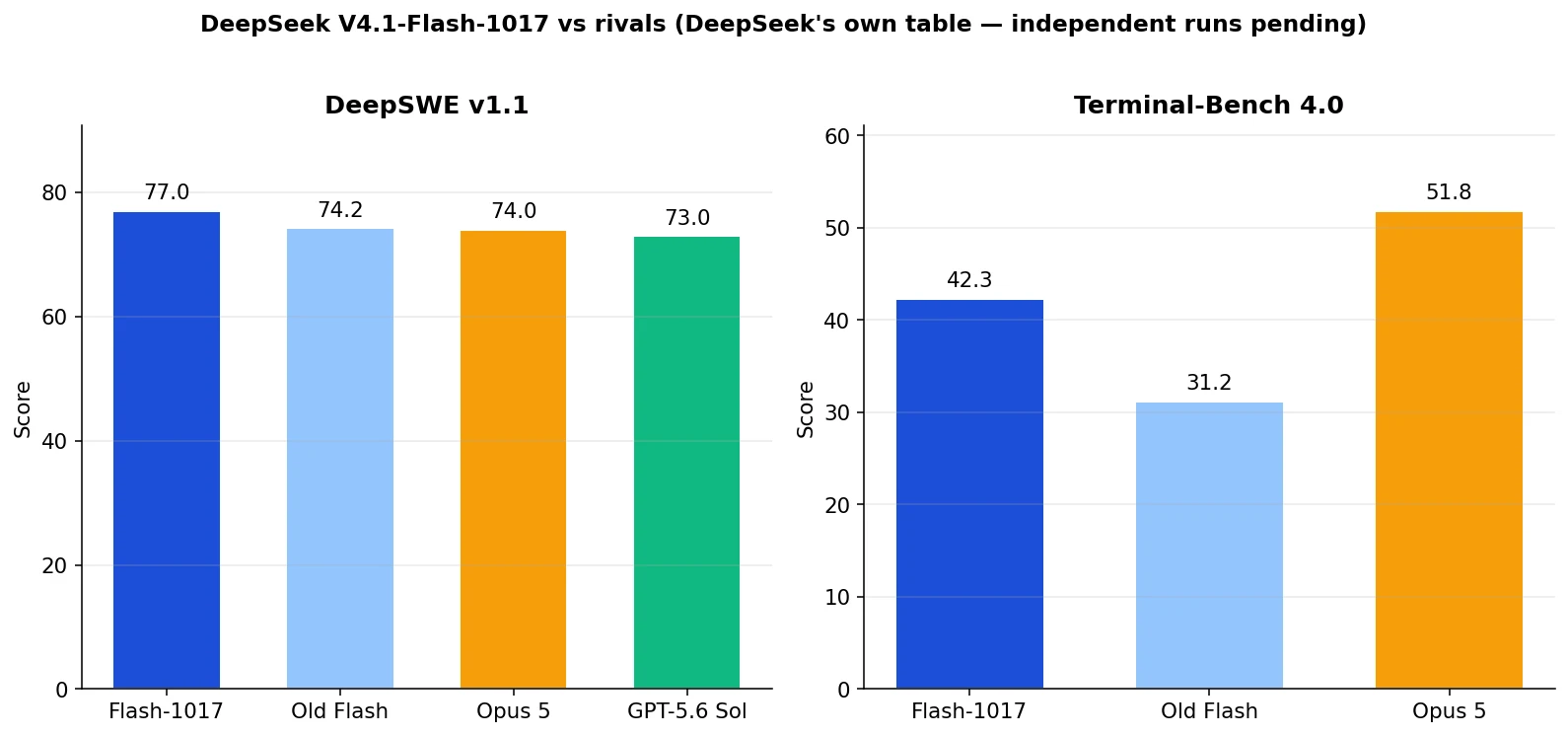
DeepSeek's model card reports the new checkpoint's scores against the September Flash, plus Claude Opus 5 and GPT-5.6 Sol on the same harnesses. Two benchmarks matter most for agent work:
- DeepSWE v1.1 (does the model actually fix software bugs?): 77.0, up from 74.2 on the old Flash — and ahead of Opus 5's 74.0 and GPT-5.6 Sol's 73.0 in DeepSeek's table.
- Terminal-Bench 4.0 (can it work in a real terminal?): 42.3, up from 31.2 — an 11.1-point jump. Opus 5 still leads here at 51.8.
On raw reasoning, Opus 5 keeps its edge: Humanity's Last Exam comes in at 42.6 for Flash-1017 against 56.3 for Opus. And one caution that belongs in the first paragraph, not the footnotes: every score above is DeepSeek's own, run on harnesses it chose. None has been independently reproduced yet. Treat the rankings as directional until third-party runs land.
The release pairs the update with two developer extras: a public Search API and Fetch API ($0.75 per 1,000 successful requests each — a fraction of Brave's $5 and Exa's $4 per 1k, though the features differ), and deepseek-recipe, a small Rust library for converting prompts and parsing outputs.
The cost angle: a cent and a half per completed task
The model is already live on DeepSeek's web app and API under the existing deepseek-flash name, and API prices did not change: $0.30 per million input tokens and $1.20 per million output tokens at peak, halved off-peak (so $0.15/$0.60 — matching the off-peak figures OpenRouter lists), with cached input reads at $0.003 per million. OpenRouter serves the new checkpoint from about $0.10/$0.50 per million tokens.
But per-token pricing is only half the story for agents. What matters is cost per completed task — and there the shorter outputs matter as much as the price tag. An independent 56-trial pilot measured Flash-1017 completing tasks at $0.0157 versus $0.0577 for GPT-6.1 Sol and $0.0653 for Claude Sonnet 5.5. That is not a like-for-like capability match, but it tells you the shape of the market: the cheapest open tier now completes agent work at roughly a quarter of the price of the cheapest cloud alternatives.
Can you run it on your own machine? The honest math
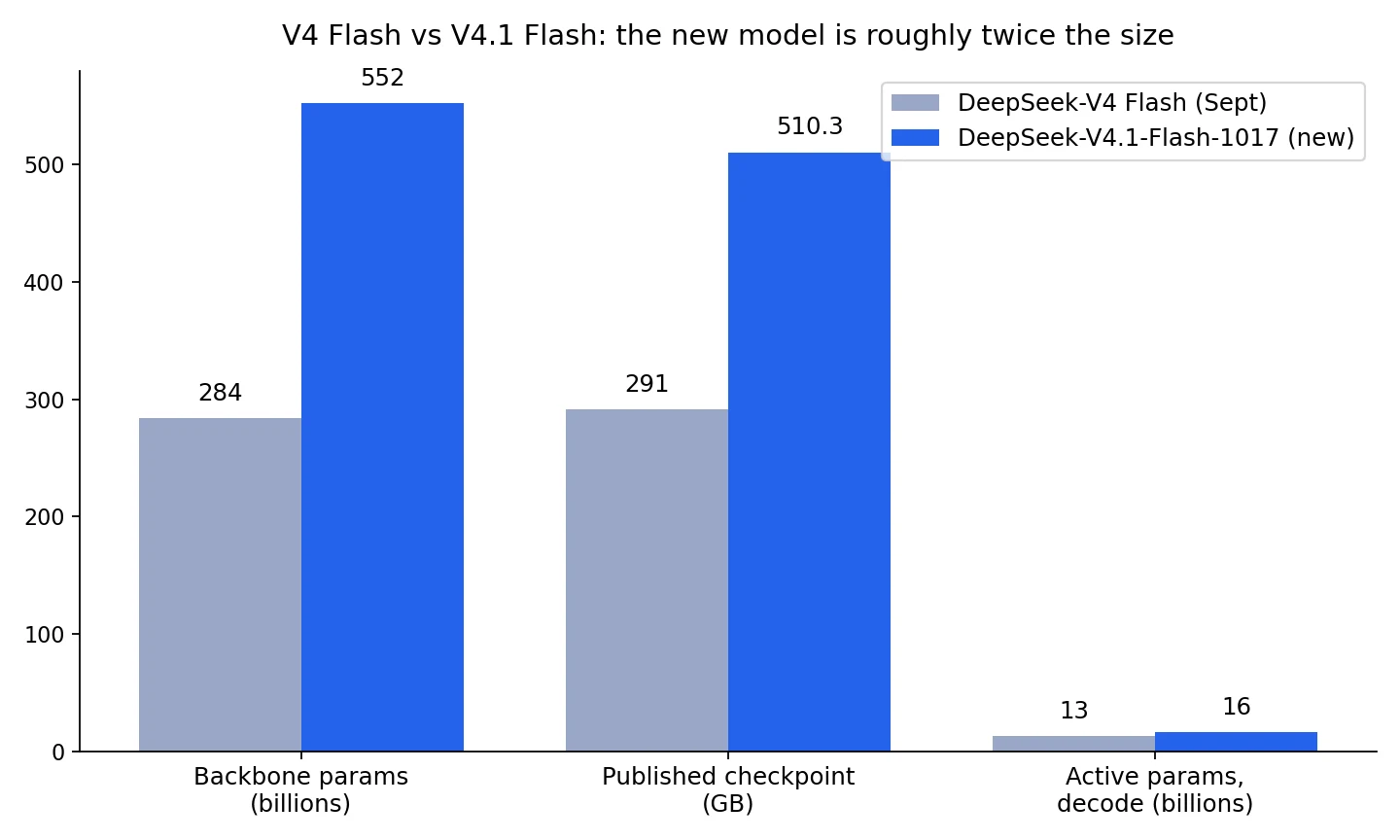
Here is the part the launch coverage often skips: this is a 748-billion-parameter model, not a 284-billion one. The smaller figures floating around belong to the older V4 Flash from September. Per DeepSeek's own model card, V4.1 Flash has a 552-billion-parameter backbone plus 196 billion parameters of Engram conditional memory (accessed sparsely), with only 8 billion active per token during prefill and 16 billion during decode. The published checkpoint is 48 safetensors shards totaling about 510 GB.
That puts it firmly in server territory. No single consumer GPU holds 510 GB, and no 128 GB box does either. The realistic local floor is an 8-GPU node (for example, eight 80 GB H100s give you 640 GB of GPU memory) or a 512 GB-class unified-memory Mac. Community quants will shrink it over time — a placeholder GGUF repo already exists — but no published community builds of the V4.1 family exist yet, so any smaller number you see is an estimate, not a measurement.
The practical read: for most people, this model stays an API model. That is not a loss — at roughly a cent and a half per completed agent task, the API is priced for exactly this. But if you are sizing hardware for open weights, use the V4.1 numbers (748B total, ~510 GB checkpoint), not the older V4 Flash figures.
Three practical takeaways
- If you run coding agents, Flash-1017 at $0.0157 per completed task is worth testing against your current default — especially for batch work where the cloud flagship is overkill. Keep it honest: verify on your own tasks before switching.
- If you run models locally, this one is not a target for your rig — size hardware against the V4.1 figures (748B total, ~510 GB checkpoint), not the smaller V4 Flash numbers. Watch for community GGUF builds of the 1017 checkpoint; nothing published yet.
- If you build agents with web search, compare DeepSeek's $0.75/1k Search API against Brave and Exa once feature-parity is clear — bundled with a one-cent model call, the total cost per agent task is getting remarkably small.
Sources
- DeepSeek-V4.1-Flash-1017 model card, Hugging Face — "minor update to DeepSeek-V4.1-Flash"; 11-benchmark table (DeepSWE 77.0, Terminal-Bench 4.0 42.3, HLE 42.6); MIT license; 1M context window; 48 safetensors shards, ~510 GB total checkpoint size (from the repo file listing).
- DeepSeek-V4.1-Flash model card, Hugging Face — 552B backbone parameters, 196B Engram conditional memory, 8B active per token during prefill / 16B during decode, 890 bytes/token KV cache; base-model table confirms V4 Flash (Sept) was 284B backbone / 13B active — those smaller figures do not apply to V4.1.
- Independent 56-trial cost pilot and Search/Fetch API pricing — $0.0157 per completed task; $0.75 per 1,000 Search/Fetch requests.
- Benchmark table vs Opus 5 and GPT-5.6 Sol, vLLM day-0 serving — pricing unchanged; 830K tok/s per GPU serving figure.
- DeepSWE v1.1 77.0 vs Opus 5 74.0 and GPT-5.6 Sol 73.0 — "Pareto improvement" framing, Search API competition.
- Score-verification caveats and cost/KV-cache memory workup — DeepSeek's own scores unverified; 42.6 HLE vs 56.3; Terminal-Bench ran on the Claude Code harness; 890 bytes/token KV cache.