
NVIDIA's Nemotron 3.5 Super VL: a 120B agent model that fits on one DGX Spark
NVIDIA's open 120B agent model reads PDFs, charts and video, and runs on a single DGX Spark — here's what it actually costs to run it yourself.
NVIDIA shipped a new flagship open-weight model on October 15: Nemotron 3.5 Super VL, a 120-billion-parameter model built for AI agents that read documents. It understands text, images, short video clips and PDFs in a single checkpoint — so one model does the work that used to need a text model, a vision model and an OCR tool chained together. And per NVIDIA's own deployment notes, the quantized version runs on one DGX Spark, NVIDIA's $4,000 desktop box.

What Super VL actually is
Super VL is a mixture-of-experts (MoE) model. All 120 billion parameters have to live in memory, but only about 12 billion are active for each token — so the compute cost per token looks closer to a 12B model. That gap matters: speed depends on the 12B you use, but your hardware has to hold the full 120B.
The architecture mixes Mamba-2 sequence layers with MoE and attention layers, plus a C-RADIO vision encoder. Inputs are text, images and video (MP4 clips up to 2 minutes); output is text. It handles charts, tables, scanned pages and multi-page PDFs natively. Context stretches up to 1 million tokens, and you can toggle the reasoning mode on or off through the chat template (enable_thinking). It also has native multi-token prediction, which is built-in speculative decoding — the same trick this site's engine-optimization posts keep recommending.
The license is OpenMDW-1.1, and NVIDIA's model card states the model is "ready for commercial or non-commercial use." NVIDIA also published the datasets, training recipes and reinforcement-learning environments alongside the weights, so teams can post-train it on their own data.
The memory math: why it fits on a DGX Spark
120 billion parameters at full BF16 precision is about 240 GB of weights — far beyond any desktop. NVIDIA instead ships a NVFP4 checkpoint, quantized from the BF16 model with quantization-aware distillation. At roughly 4 bits per parameter, the weights shrink to around 60 GB, which clears the DGX Spark's 128 GB of unified memory with room to spare for the KV cache.
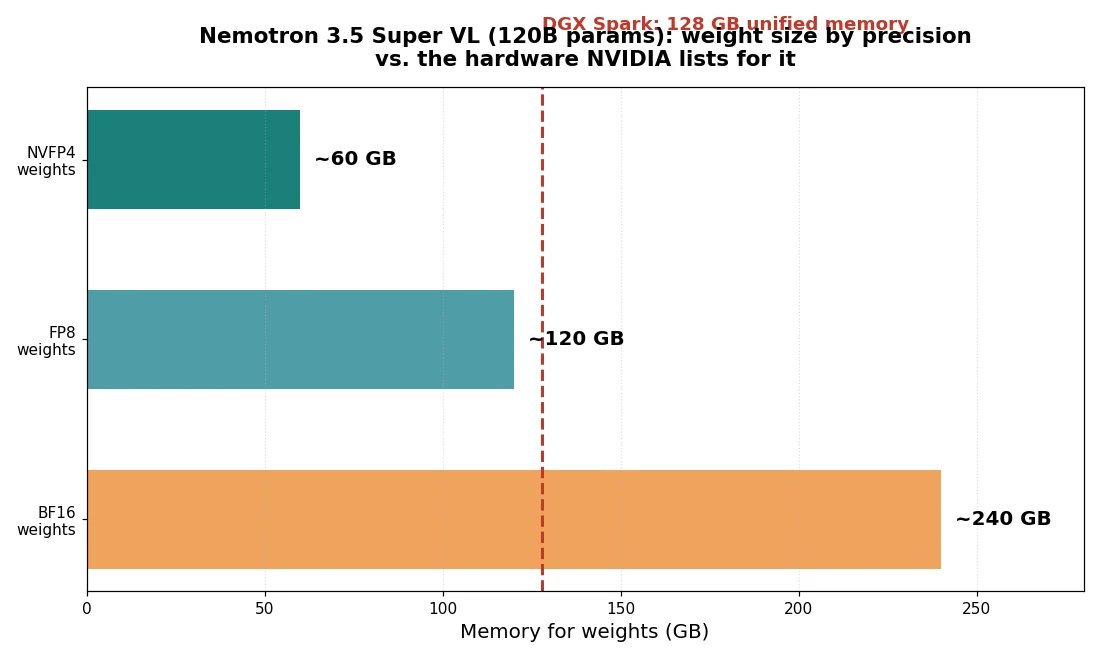
These are estimates from NVIDIA's 120B parameter count (rough bit-per-parameter math undercounts metadata, so treat them as the floor). NVIDIA's official deployment list for the NVFP4 checkpoint is:
| Setup | Memory |
|---|---|
| 1x DGX Spark | 128 GB unified |
| 1x H200 | 141 GB |
| 2x H100 | 160 GB (2x 80 GB) |
| 1x GB200 | 192 GB |
One honest footnote: the 1-million-token context won't fit anywhere near full length alongside the weights on a Spark — the KV cache at 1M tokens would need far more memory than 128 GB. Practical runs use reduced context. The 1M figure is a ceiling for data-center cards, not a home promise.
Can you run it at home?
If you have a DGX Spark, yes — NVIDIA's recipe uses vLLM with the NVFP4 checkpoint. If you don't, the news is less convenient: Super VL is CUDA/NVIDIA-only on day one. NVFP4 is an NVIDIA-tuned format; community AMD/ROCm notes classify it as NVIDIA-specific and warn it isn't readable by bitsandbytes or GGUF converters. As of launch, there is no Ollama, LM Studio or llama.cpp path for Super VL — only NVIDIA's vLLM stack.
The practical sibling to watch is Bolt 74B-A9B 24GB, released the same day and already supported by llama.cpp, Ollama, LM Studio, Unsloth and vLLM. That one fits a 24 GB consumer card (it is a 74B model squeezed into ~2 bits). And Bolt E4B 4GB lands October 23.
What NVIDIA claims — and the honest catches
NVIDIA says Super VL matches its largest reasoning model on multimodal agentic tasks at roughly one-fifth the parameter count, and claims up to 5x higher throughput than other open models in its class on the Artificial Analysis Intelligence Index. Two vendor-reported enterprise stories: Scale AI cut inference cost 40x with 5x lower latency on financial vendor processing, and Ramp got 50% higher throughput with 10x lower latency parsing receipts. Treat all of these as the vendor's numbers until independent tests land.
From the model card's own benchmark table: GPQA-Diamond at 89.90 with the NVFP4 checkpoint, but tau3-bench banking at only 17.78 — a reminder that one model can be strong at science questions and weak at banking-agent workflows. Specialized claims are narrow by definition.
What this changes for you
If you run agents over private documents — invoices, reports, contracts, scanned PDFs — Super VL is the first open checkpoint that reads and reasons over all of them in one model, and it does so on a single desktop-class machine instead of a GPU rack. Client documents never leave your box. That is the whole point for local AI: not just privacy theater, but a 120B agent that is sized for one desk.
The sensible way to try it first is the Bolt 74B 24GB build on hardware you already own, then step up to Super VL if you have (or plan to get) a Spark-class box. Check what your own machine can hold with /check.
Sources
- nvidia/NVIDIA-Nemotron-3.5-Super-VL-120B-A12B-NVFP4 model card, Hugging Face — parameters, architecture, precision, deployment list, license
- NVIDIA Releases Nemotron 3.5 Super VL and Two Bolt Models, SQ Magazine — release overview, open datasets and training recipes
- NVIDIA Releases Nemotron 3.5 Super VL, a 120B Open Multimodal Agent Model, MarkTechPost — model-card summary, benchmarks, video limits
- NVIDIA squeezes a 74B-parameter open model into 24 GB and releases a 120B agent model that reads PDFs, MACCUS — both releases, hardware table, license
- NVIDIA Announces The 120B Nemotron 3.5 Super VL Model For AI Agents, Wccftech — NVIDIA's accuracy and throughput claims
- Open source and on device: the strategy behind Nvidia's new AI models, TechTarget — open-model strategy context
- NVIDIA Launches Open Nemotron 3.5 Super VL and Edge Bolt Models, Arabian Reseller — Scale AI and Ramp early-adopter reports
- NVIDIA Releases Open Nemotron 3.5 Super VL, Announces Two Bolt Edge Models for Agents, Golden Era — Bolt 74B llama.cpp/Ollama/LM Studio support
- Precision formats (NVFP4 notes), nemotron-on-amd community notes — NVFP4 as NVIDIA-specific format, not GGUF-readable