
Hydrogen-1.0: a 753B open science model you probably cannot run at home
Deep Principle's Hydrogen-1.0 is an MIT-licensed science model, but at 753 billion parameters it stays a data-center model.
Deep Principle, a Hangzhou company that builds AI for materials research, released Hydrogen-1.0 on November 2, 2026. It is a science model for chemistry, materials science, and life sciences, and its weights are public under an MIT license. That sounds like a local AI story. It mostly is not, and the reason is size: 753 billion parameters is far beyond what a home machine can hold, even though only a fraction of the model works on each token.
What Hydrogen-1.0 is
Hydrogen-1.0 was not trained from scratch. Deep Principle took Z.ai's GLM-5.3, an open model, and post-trained it with supervised fine-tuning and reinforcement learning. The training data is the interesting part: domain knowledge in chemistry, materials, and life sciences, plus full-cycle electronic lab notebook records from the company's own laboratories, captured through its Mira system, and sequences of research decisions that include failed attempts. The idea is that a science model should learn from how experiments actually went, not only from published papers that report what worked.
The model is a mixture-of-experts design. It has 753 billion total parameters, but only about 40 billion are active per token, according to the GLM-5.3 base. That active count sets the work per token. The total count sets the storage: every parameter still has to be loaded before the model can run. It supports a context window of 1 million tokens and up to 128,000 output tokens, so it can take in long papers and long experiment records in one pass.
What the maker's scores show, and what they do not
All of the benchmark numbers below come from Deep Principle itself. No independent group has reproduced them yet, so read them as the maker's claims, not settled results.
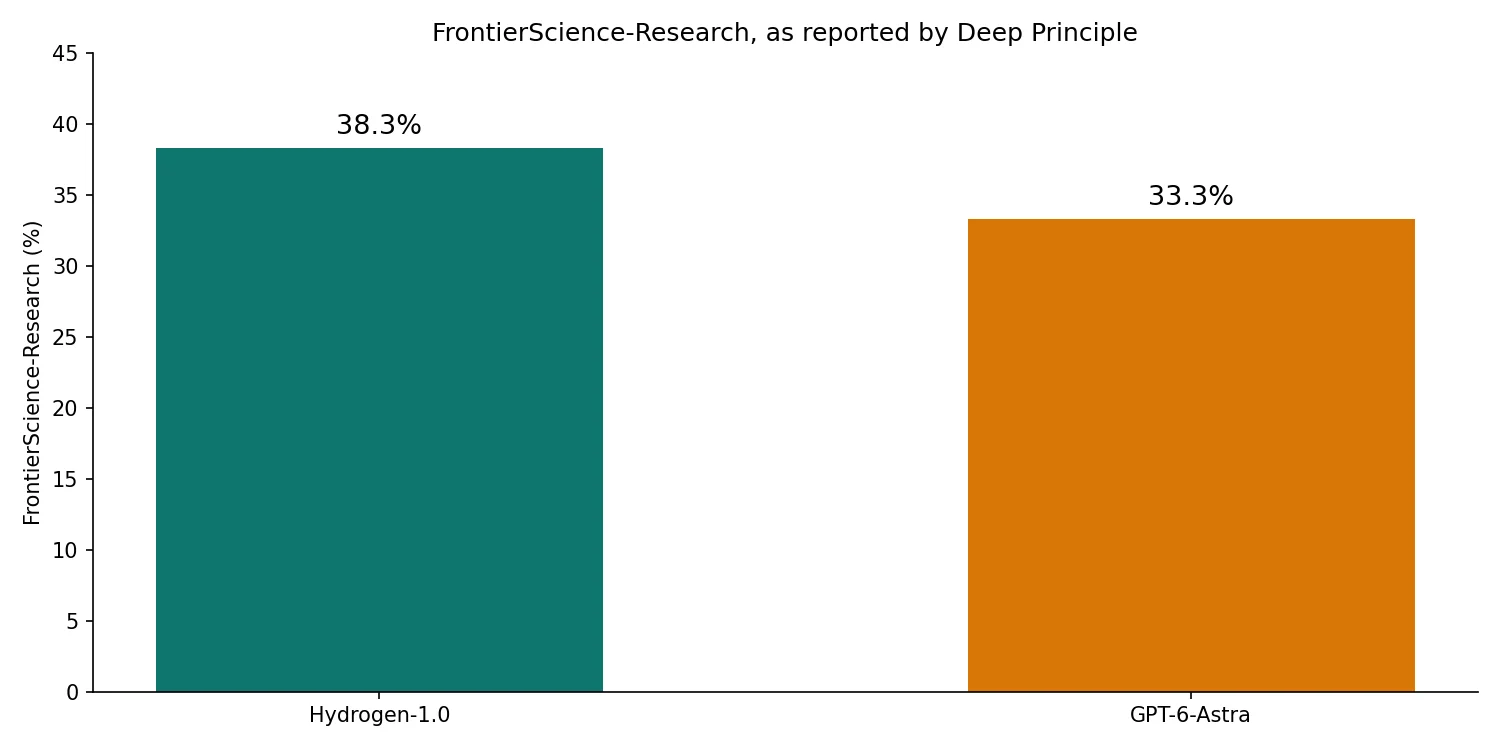
On FrontierScience-Research, Deep Principle reports 38.3% for Hydrogen-1.0 against 33.3% for OpenAI's GPT-6-Astra, measured by Deep Principle. On GPQA Diamond, it reports 93.0%, roughly matching Kimi-K3 and below the 96.0% figure OpenAI reports for GPT-6-Astra. On the company's own research-task tests, Hydrogen-1.0 leads GPT-6-Astra at its maximum thinking setting by 5.13 percentage points on scientific computing and by 4.76 points on forward reaction prediction, but trails by 3.33 points on NMR structure elucidation. In a transition-metal design task, it reached a mean best gap of 4.318 electron volts, against 3.689 for GPT-6-Astra and 3.353 for Kimi-K3.
One result is worth noting even if you distrust the rest. On 117 experiment-planning questions, Deep Principle says Hydrogen-1.0 scored above Kimi-K3, while GPT-6-Astra and Opus-5.5 were excluded because they refused more than 50% of the requests. Refusal behavior matters for lab work: a model that will not touch an experiment plan is not useful for planning, whatever its exam scores say. That claim still needs independent checking, including how the questions were chosen.
The company's demos show the kind of work it is aiming at: writing Python to build a polyethylene melt and run it through GROMACS, catching and repairing a topology error, and analyzing the corrected 40-nanosecond trajectory; growing an Ireland-Claisen reaction network of 27 structures through 30 plausible reactions; ranking 7 candidate products from a proton NMR trace; and writing a JSON protocol for a 12-vial Suzuki coupling study. Demos are not proof. The model card itself warns that outputs can contain errors in facts, calculations, or citations, and should be checked against literature, independent calculations, or experiments before any decision is made.
Why you cannot run it at home
Deep Principle tested the full-precision BF16 version with SGLang on 8 GPUs using tensor parallelism of 8. The arithmetic explains why. At 2 bytes per parameter, 753 billion parameters need about 1,500 GB just for the weights, before any memory for context or generation. A 4-bit quantized copy would still be roughly 375 GB. That is a server rack, not a laptop, a Mac, or a single gaming GPU.
There are quantized builds: NVFP4 for NVIDIA B200 and B300 GPUs, and MXFP4 for AMD Instinct MI350X and MI355X cards. Those are data-center parts too. The practical routes for most people are the hosted ones: an API through NeuroSpark, or Deep Principle's own Mira research assistant. The weights are on Hugging Face and ModelScope, but downloading them requires accepting the listing's access conditions, and the full training datasets and recipes are not included. Open weights here mean you can inspect and, with enough hardware, run the model. They do not mean the training is reproducible from scratch.
The takeaway
Hydrogen-1.0 answers the question "does this change what I can do with AI on my own machine?" with a clear no, for now. You cannot download it onto a home PC and expect it to run, and you should not plan a local setup around it. What it does change is the science-model landscape: a specialist model trained on lab notebooks, not just textbooks, is now public under a permissive license, and research groups with cluster access can test the maker's claims themselves. For everyone else, the honest move is to try it through the hosted API or Mira if you do science work, verify anything it tells you, and watch for smaller distilled versions. A distilled science model that fits on one GPU would be the version that actually changes local AI. This one is the proof that the training recipe exists, not the version you run.
Sources
- Deep Principle Releases Hydrogen-1.0: A 753B Open-Weight Model for Scientific Discovery, MarkTechPost
- Deep Principle Releases Hydrogen-1.0, an Open-Weight Scientific Model Derived from GLM-5.3, NeuralBrew
- Hydrogen-1.0: 753B open-weight chemistry and materials model under MIT license, Tokenstrom
- Hydrogen-1.0: Deep Principle's Open Science Model, TSN