
SenseNova Loop-9B: a 9B model that reuses its layers, and why stock Ollama can't run it yet
SenseTime's SenseNova Loop-9B runs 24 of its layers twice to get deeper reasoning from 9 billion parameters, but stock Ollama and llama.cpp can't load it yet.
SenseTime released SenseNova Loop-9B-Preview on October 30, 2026. It is a multimodal model that takes text and images and returns text, built for document understanding, coding, and tasks where a model calls external tools over several steps. Its headline idea is simple to state and unusual to run: instead of adding more parameters to think deeper, it runs part of itself twice.
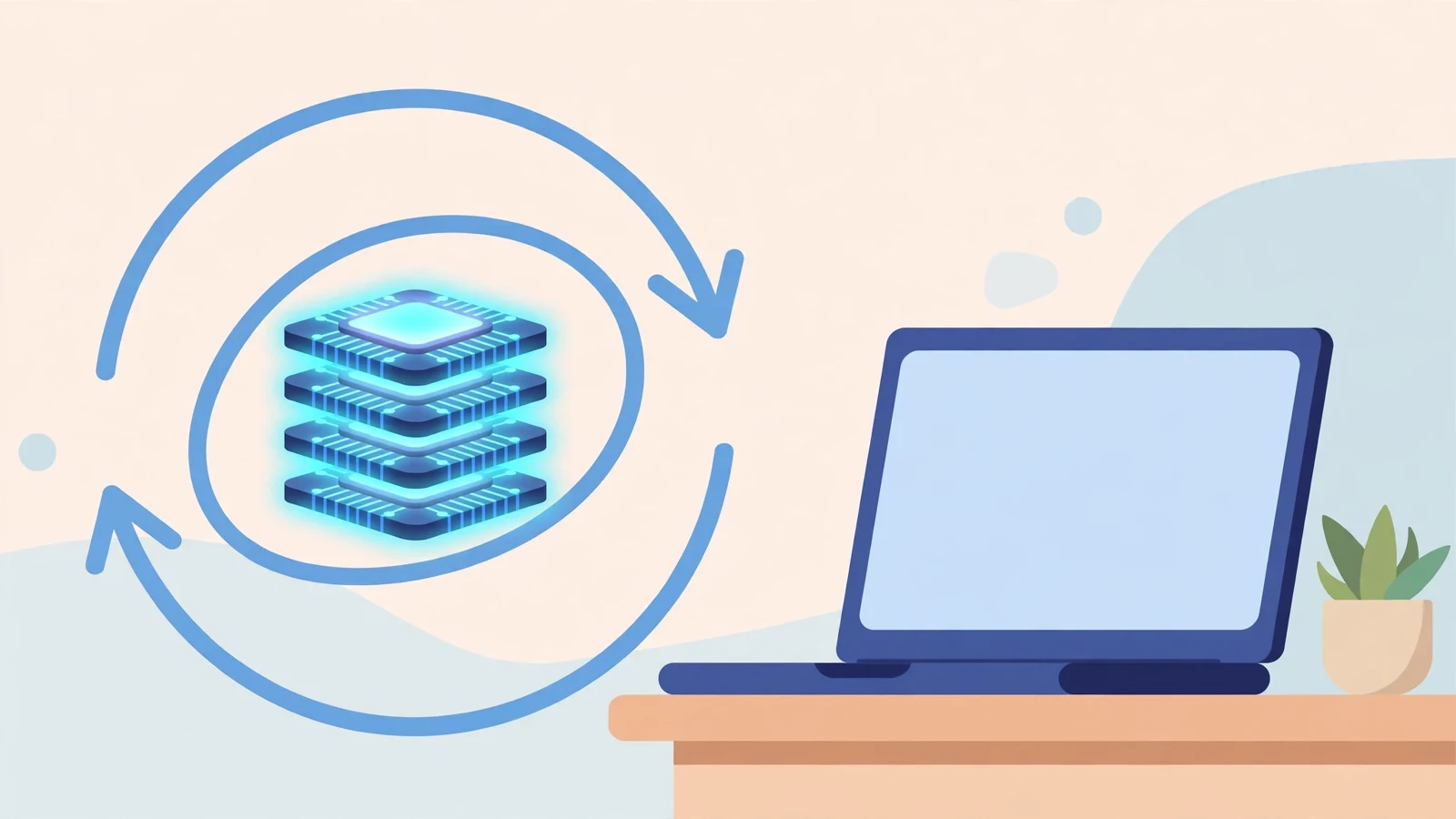
How looping works
Most models pass input through each layer once. Loop-9B has 32 distinct decoder layers, and it runs layers 4 through 27 twice in a row, using the same weights both times. The result is 56 layer computations per forward pass, while only 32 sets of layer weights are stored. SenseTime reports about 9 billion total parameters and about 14.6 billion inference parameters, which is its way of describing the extra work done by the repeated block.
Two other design choices support the loop. Inside the looped section, a method called manifold-constrained hyper-connections carries two residual streams, with learned mappings deciding how each layer reads from and mixes those streams. The decoder also mixes attention types, with three linear-attention layers followed by one full-attention layer in each group of four. Training recipes used sequences of up to 262,144 tokens, covering text, images, code, and tool-use examples.
The weights are released under the Apache 2.0 license, which is a permissive license that makes it easy for others to use, modify, and build on the model. That matters, because the interesting question here is not whether a lab can serve this model. It is whether the design can be picked up by the local tools most readers actually use.
Why it matters for local AI
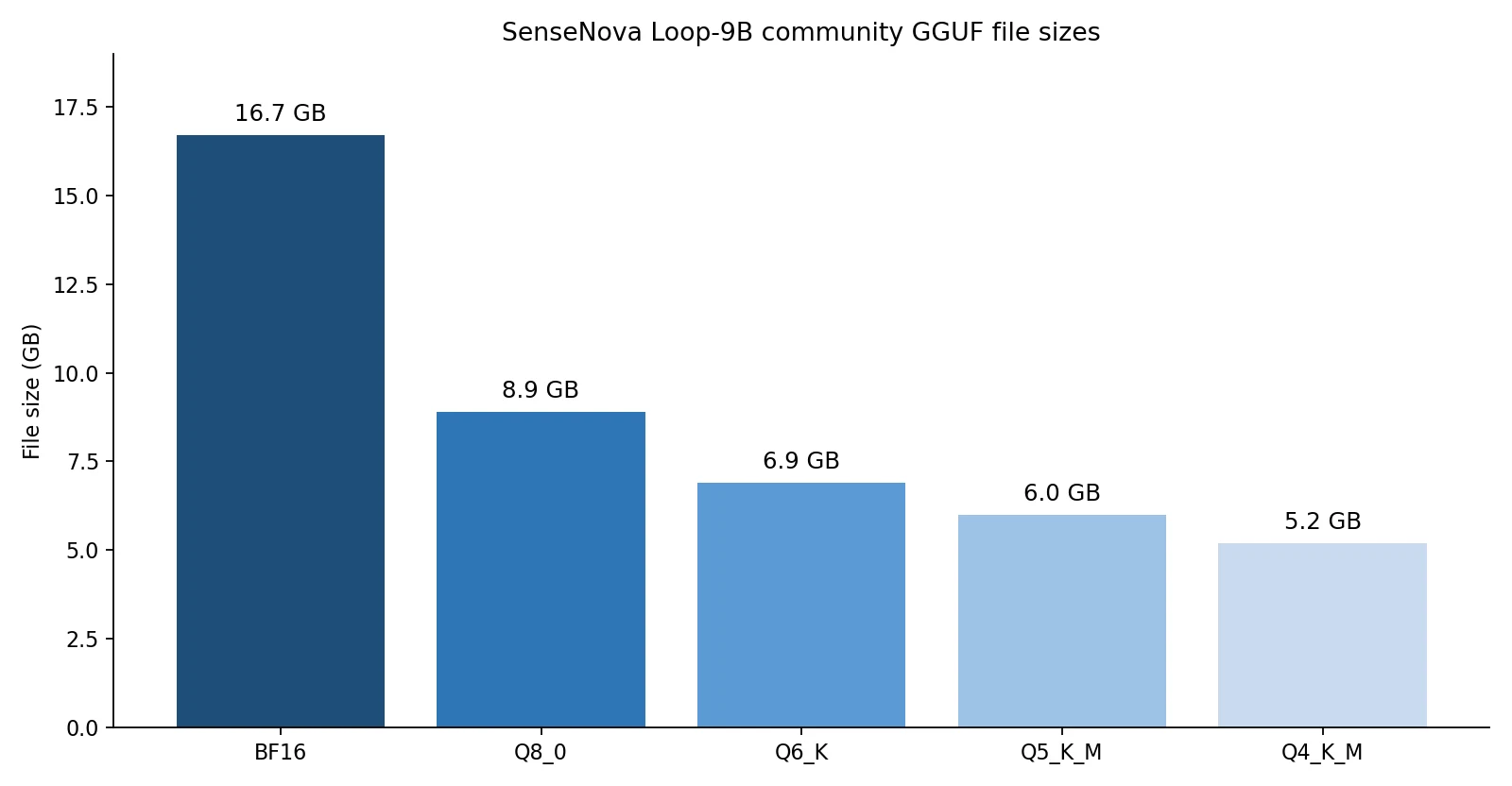
The practical promise is a smaller download doing more work. A 9 billion parameter model is in the size range that a good consumer machine can hold. The full-precision community file is 16.7 GB, and the smaller quantized files are smaller still, which is why this release caught the attention of local runners so quickly. If a looped 9B model really does work at the level SenseTime claims on complex tasks, it would be one more sign that careful architecture, not just bigger downloads, is how local models improve.
Be careful with that claim, though. SenseTime describes 27B-class results on complex tasks, but those are the company's own numbers, and the technical report is still listed as to be announced. No independent reproduction is cited in the model card yet. Treat the loop as a promising design with vendor numbers attached, not as a settled result.
The catch: stock tools can't run it yet
This is the part to check before you download anything. The official path uses Transformers with custom model code, in a checked environment of Transformers 5.18.0 and PyTorch 2.11.0 with CUDA 13.0. That is a Python and GPU setup, not a one-command Ollama download, and it is not a Mac path.
Community GGUF files already exist, published by AtomicChat, but they come with a clear warning: upstream llama.cpp, LM Studio, and Ollama do not support this architecture yet, so the files will not load on a stock build. They were made and verified with a patched llama.cpp build, with upstream support still pending. The community files are also text-only for now. The vision part, which would handle images, is a follow-up, so the multimodal half of the official model is not in those files yet.
If you do follow the patched-build route, the file sizes are friendly by local standards. The reference file is 16.7 GB, the near-lossless 8-bit file is 8.9 GB, and the smallest file is 5.2 GB, which AtomicChat says runs on 8 GB-class GPUs. The trade-off is that you are running a baseline community quant on a patched engine, not a finished, widely supported release.
The takeaway
Loop-9B does not change what you can run on your own machine today. It changes what to watch for. If upstream llama.cpp or Ollama adds support for this looped architecture, and if independent tests back up the vendor claims, a 9B download that reuses its own layers could become a useful local option for document work, coding, and tool-using agents. Until then, the honest move is to wait: note the release, note the license, and do not spend an evening fighting a patched build unless you enjoy that kind of experiment. The model to watch is the next one that loops like this and loads with the tools you already have.