
LongCat-2.5: Meituan's 1.6T agent model with a 1M-token context — and no weights yet
Meituan's LongCat-2.5 offers a 1-million-token context and cheap cached input, but its weights are still 'coming soon.'
Meituan made LongCat-2.5 generally available on its developer platform on November 2, 2026, five weeks after a preview release on September 25. It is a mixture-of-experts model built for long, multi-step agent work: coding sessions, browser tasks, and jobs that span terminals, spreadsheets, and design tools. Its headline numbers are large, its API price is low, and there is one catch that matters most for local runners: you cannot download it yet.

What LongCat-2.5 is
LongCat-2.5 has 1.6 trillion total parameters, with about 48 billion active per token. That pair of numbers is the whole design in one line. In a mixture-of-experts model, only a fraction of the model's parameters work on any given token, so the cost of each step tracks the active count, not the total. The total still matters, though: it is what you would have to store and load if you ran the model yourself.
The model is natively multimodal, taking text, images, and video as input, and it supports a context window of 1,048,576 tokens — one million tokens. Its maximum output is 128,000 tokens, which some listings write as 131,072 tokens. Those are the same number, not two different limits: 128 times 1,024 equals 131,072. A context that large can hold a big codebase, a long document set, or a multi-stage workflow in working memory at once, which is exactly what a coding agent resends on every turn.
The API also speaks both the OpenAI and Anthropic request formats, so it drops into an existing Claude Code or OpenAI-compatible setup by changing the base URL rather than rewriting a client. Meituan reports the model was trained on domestically produced Chinese accelerators, and its serving uses 4-bit weight and activation quantization to keep inference efficient.
What it costs
The LongCat pricing page lists LongCat-2.5 as the only model on its pay-as-you-go plan, at limited-time discounted rates per million tokens: $0.30 for uncached input, $0.006 for cached input, and $1.20 for output. The page gives no end date for the discount and notes that prices may change, so treat these as promotional rates, not a permanent price list. Only successful calls are billed, prepaid balance does not expire, and there is no minimum commitment.
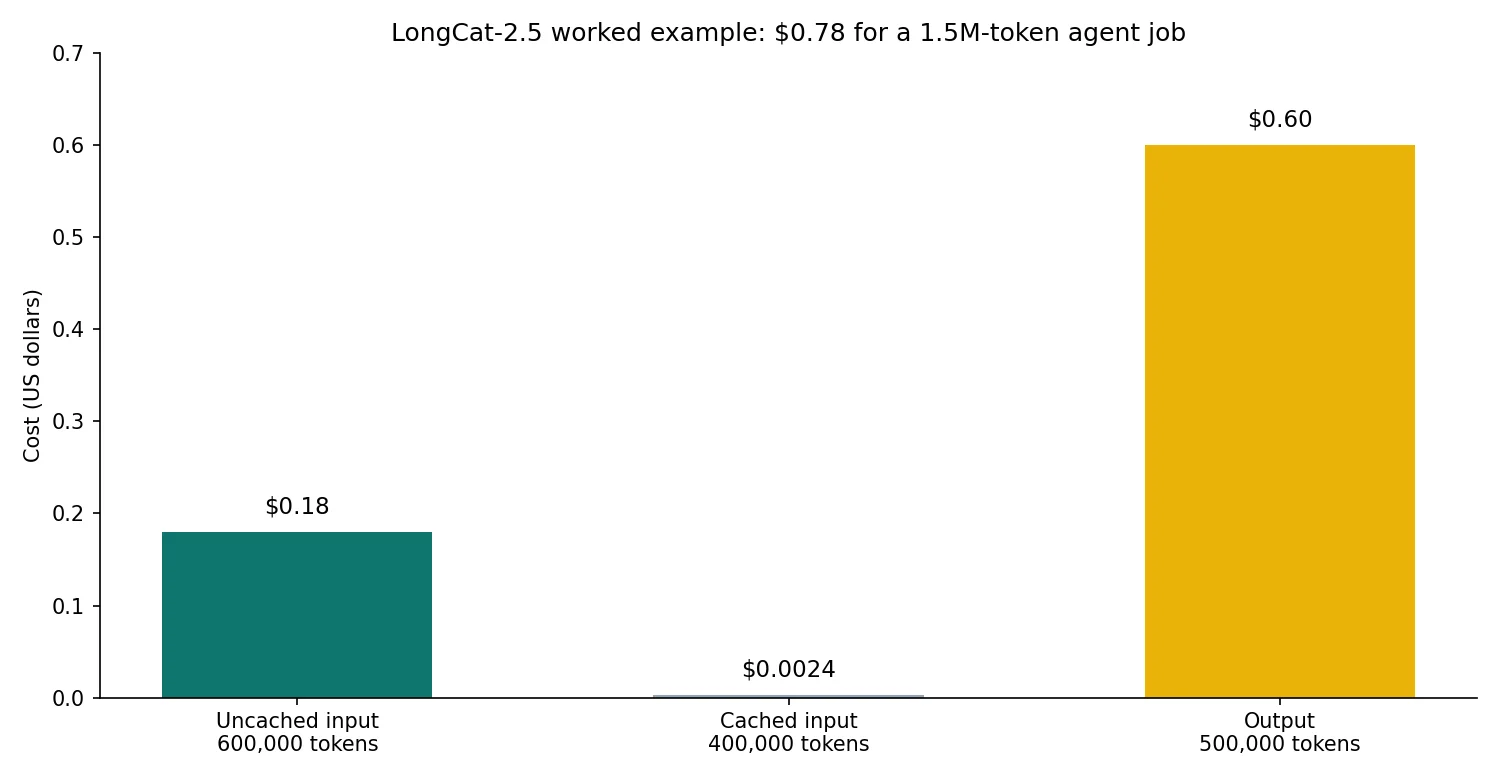
The cached-input price is the number to notice. At $0.006, cached input costs 2% of uncached input. Coding agents resend the same files and conversation history on nearly every turn, so most of a long session's input can be cached. Meituan's own worked example makes the point: a request with 600,000 uncached input tokens, 400,000 cached input tokens, and 500,000 output tokens costs $0.78 in total. Output dominates the bill, and cached input barely registers.
The catch for local runners: no weights, and a huge total
The GitHub and Hugging Face links on Meituan's announcement are marked "coming soon," and Meituan has given no timeline. Every page reviewed so far describes API and chat access only. You cannot self-host LongCat-2.5 today, and there is no download to wait for with a date attached.
Even when weights do arrive, the total parameter count sets expectations. A 1.6-trillion-parameter model is not a laptop model: at 4-bit precision, the full weights would still be on the order of 800 GB before any other memory is counted. The 48-billion active count describes the work per token, not the size of the download. If the weights follow the pattern of LongCat-2.0, which shipped with an MIT license, the realistic local audience is a GPU cluster or a rented server, not a home PC. For most readers, the honest framing is that LongCat-2.5 is a cheap cloud agent model to try through the API, not a future local install.
Two more cautions apply. First, the release's benchmark story is still vendor-side: Meituan publishes its own benchmark table, but independent tests have not caught up, and the platform changelog and pricing pages make no benchmark claims of their own. Second, the discounted price can move. An older LongCat-2.0 pricing page showed a list price of $0.75 input, $0.015 cached, and $2.95 output next to the same discount, which is a reminder that today's $0.30 and $1.20 rates are not guaranteed to last. Meituan has not said 2.5 will move to those list prices, and has not said it will not.
The takeaway
LongCat-2.5 is worth trying, not worth waiting on. If you run long coding-agent sessions, the combination of a 1-million-token context and cached input at 2% of the uncached price makes it a genuinely cheap way to test whether a long-context agent helps your workflow. Try it through the API, watch whether the weights actually appear, and do not plan a local setup around it until they do. The model to watch is not the next API price cut. It is the day the weights land, with a license and a size that a machine you own can actually hold.
Sources
- Meituan LongCat-2.5: low-cost model for coding agents, The Dev Drift
- AI News November 3 2026: LongCat 2.5, QA Bench, GDPx, AIToolsRecap
- LongCat 2.5: Meituan's new multimodal coding model, explained, eesel AI
- 1.6T Native Multimodal, $1.2 per Million Output Tokens: What Can LongCat 2.5 Actually Do?, APIYI