
Kimi K3.1 Pro's weights are out: what 2.8 trillion parameters cost to run
Moonshot published Kimi K3.1 Pro's weights on November 4 — 96 files totalling 1.56 TB — but running them needs a data-center node, not a home PC.
Moonshot AI kept its promise. On November 4, 2026, the weights for Kimi K3.1 Pro went public on Hugging Face as moonshotai/Kimi-K3.1-Pro, twelve days after the model launched on October 23. The download is 96 files totalling about 1.56 terabytes, with no access request needed. When we covered the announcement in October, the weights were a dated promise and the license was unknown. Both questions now have answers, and the answers draw a sharp line: this is a frontier-class model you can download, but almost nobody can run at home.

What landed
Kimi K3.1 Pro is a mixture-of-experts model, which means it is built from many smaller specialist networks and only wakes a few of them up for each token it generates. The model card lists 2.8 trillion total parameters, with 104 billion active per token, chosen from 896 experts (16 selected per token, plus 2 shared experts). It has 93 layers and a context window of 1,048,576 tokens — roughly a million tokens, or hundreds of long documents in one conversation. It takes text and images, with a 401-million-parameter MoonViT-V2 vision encoder handling the image side.
Two design details matter for the run cost. First, 24 of the 93 layers replace full attention with Gated DeepSeek Sparse Attention, a sparser attention design meant to make very long contexts cheaper to process. Second, the weights were trained with quantization in mind: they ship as MXFP4 weights with MXFP8 activations. Quantization means storing each number in fewer bits, which shrinks the model. Because the precision cut was built into training rather than applied afterwards, the 4-bit weights are the real thing, not a compressed afterthought. Moonshot ships deployment recipes for vLLM, SGLang, and TokenSpeed.
The license, in plain terms
The weights sit under a custom Kimi K3.1 Pro License, not Apache 2.0 or MIT. For ordinary use it reads as permissive: you may use, copy, modify, distribute, and sell. Two thresholds bite only at large scale. A business that runs a model-as-a-service offering and earns more than $20 million over any 12 months must sign a separate agreement with Moonshot before commercial use. A product with more than 100 million monthly users, or more than $20 million in monthly revenue, must show the model name in its interface. Internal use is exempt from both conditions.
That means the license is not a barrier for researchers, hobbyists, or small teams. It is a barrier for the handful of companies big enough to resell frontier inference at scale — which is exactly who Moonshot wants to negotiate with directly.
What it costs to run
Here is the honest part. The official weights are about 1.56 TB, and running them with vLLM takes eight data-center GPUs with 288 GB of memory each — B300- or GB300-class hardware. No GGUF version exists yet, so the smaller sizes below are estimates worked out from the earlier K3 model at the same precision, not files you can download today.
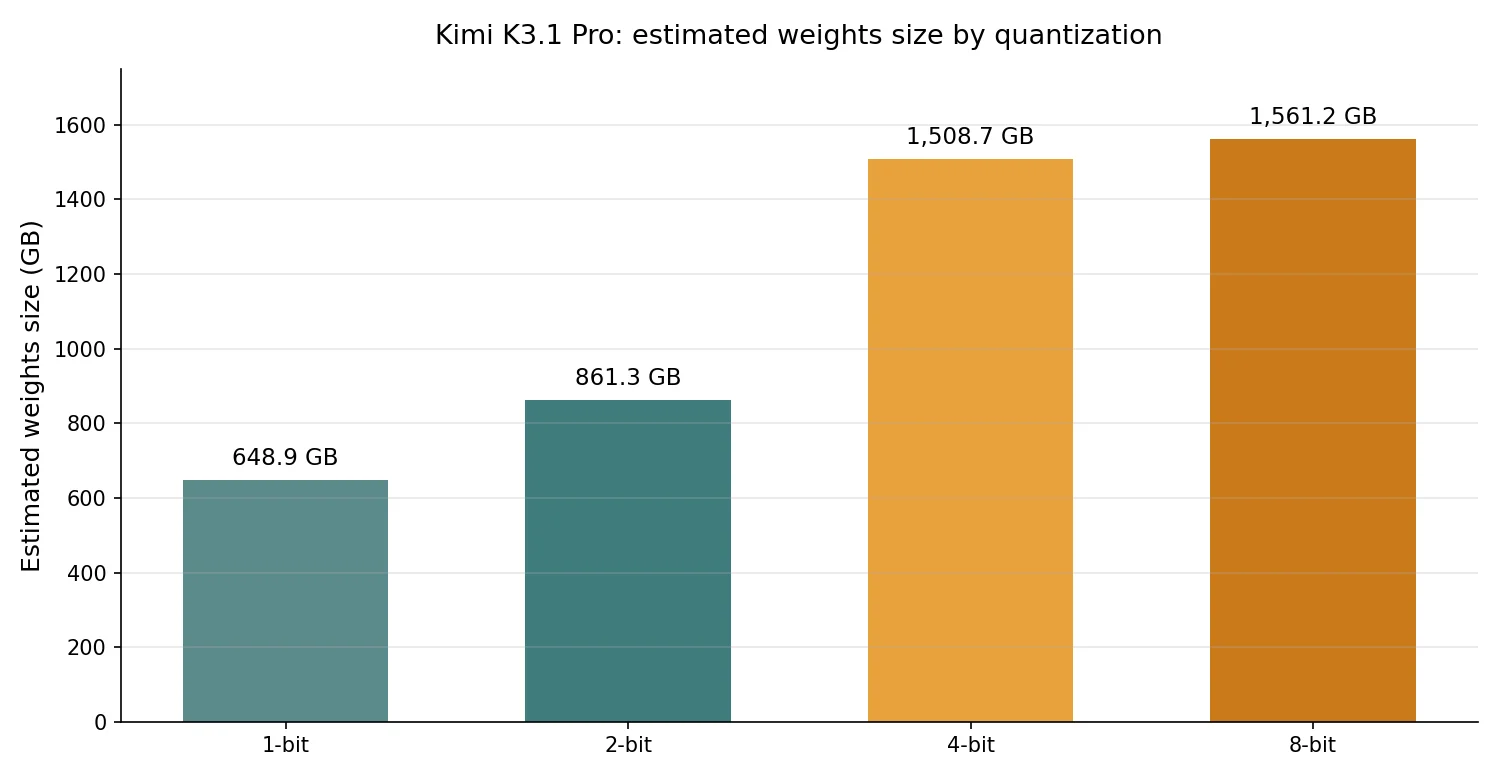
Read that chart carefully. Even a hypothetical 1-bit version would need about 649 GB of memory — roughly 27 high-end consumer graphics cards' worth. The 4-bit weights, which are what Moonshot actually shipped, sit near 1,509 GB. A home PC with a 24 GB card is not in the same conversation, and neither is a single workstation with two or four cards. This is a model for clusters, cloud providers, and labs — not for a laptop, and not for a Mac.
The download alone is a project: 1.56 TB of files before you spend anything on hardware. If you do not already have a multi-GPU node and fast storage waiting, the weights are something to read about, not something to install this weekend.
What you can actually do with it
The practical route for most people is the API, not the weights. Kimi K3.1 Pro runs on Moonshot's platform as kimi-k3.1-pro at $2 per million input tokens and $10 per million output tokens, with cached input at $0.20 per million. A faster Highspeed variant runs at 2 to 3 times the speed. Ollama has also said Kimi K3.1 Pro is coming to Ollama Cloud shortly, which would put it behind an API-style endpoint rather than a local download.
The weights still matter even if you never run them. Open weights mean independent testers can now check Moonshot's claims instead of taking them on trust. Those claims are strong: 65.7% on Terminal-Bench 4.0, a coding-agent test, against 66.4% for Claude Opus 5.5 and 58.2% for GPT-6 Astra; 94.2% on GPQA-Diamond; 92.1% on BrowseComp; and 79.6% on OSWorld V2.1. Every one of those numbers is still Moonshot's own, measured on its own harness. Until independent labs rerun them on the released files, treat them as a vendor scoreboard, not a verdict.
The other thing the weights unlock is the long tail: community quantization, smaller distilled versions, and fine-tunes. That is how earlier giant open models eventually became runnable at home — not by shrinking the original, but by training smaller models that imitate it. If a distilled K3.1 Pro appears at 30 billion parameters or below, that is the version worth watching for local use. Until then, the honest answer to "can I run it?" is no, and the useful answer is "you can use it through the API, and you can verify it, because the weights are public."
The takeaway
Kimi K3.1 Pro's weights landing on schedule is good news for open AI: a near-frontier coding model is now downloadable, inspectable, and free to use for nearly everyone. But open weights are not the same as runnable at home. At 2.8 trillion parameters and 1.56 TB, this model belongs to data centers for now. Use the API if you want its capability today, watch for independent benchmarks to test Moonshot's numbers, and wait for a distilled version before planning any local install. If you want to check what your own machine can actually run, start at /check.
Sources
- moonshotai/Kimi-K3.1-Pro model card and license, Hugging Face
- Kimi K3.1 Pro announcement, Moonshot AI
- Moonshot ships Kimi K3.1 Pro: 2.8T MoE with 1M context, AI Weekly (November 4, 2026)
- Moonshot AI releases Kimi K3.1 Pro weights, mlllm.io (November 4, 2026)
- Kimi K3.1 Pro: Open Weights Out, Price and Benchmarks, CellCog (November 4, 2026)
- Kimi K3.1 Pro VRAM requirements, VRAM Glass