
DeepSeek's dsh-superagent: a team coding agent that lives in your repo
DeepSeek open-sourced a coding agent that watches one GitHub repo, takes requests from the team, and answers with pull requests.
DeepSeek published dsh-superagent on October 31, 2026: an open-source coding agent that works for a whole team instead of one developer at a time. It is MIT-licensed, it runs on your own machine, and it is explicitly a research prototype, not a finished product. That honesty is part of the story. This is the most interesting idea in it, and the part you should be careful about.
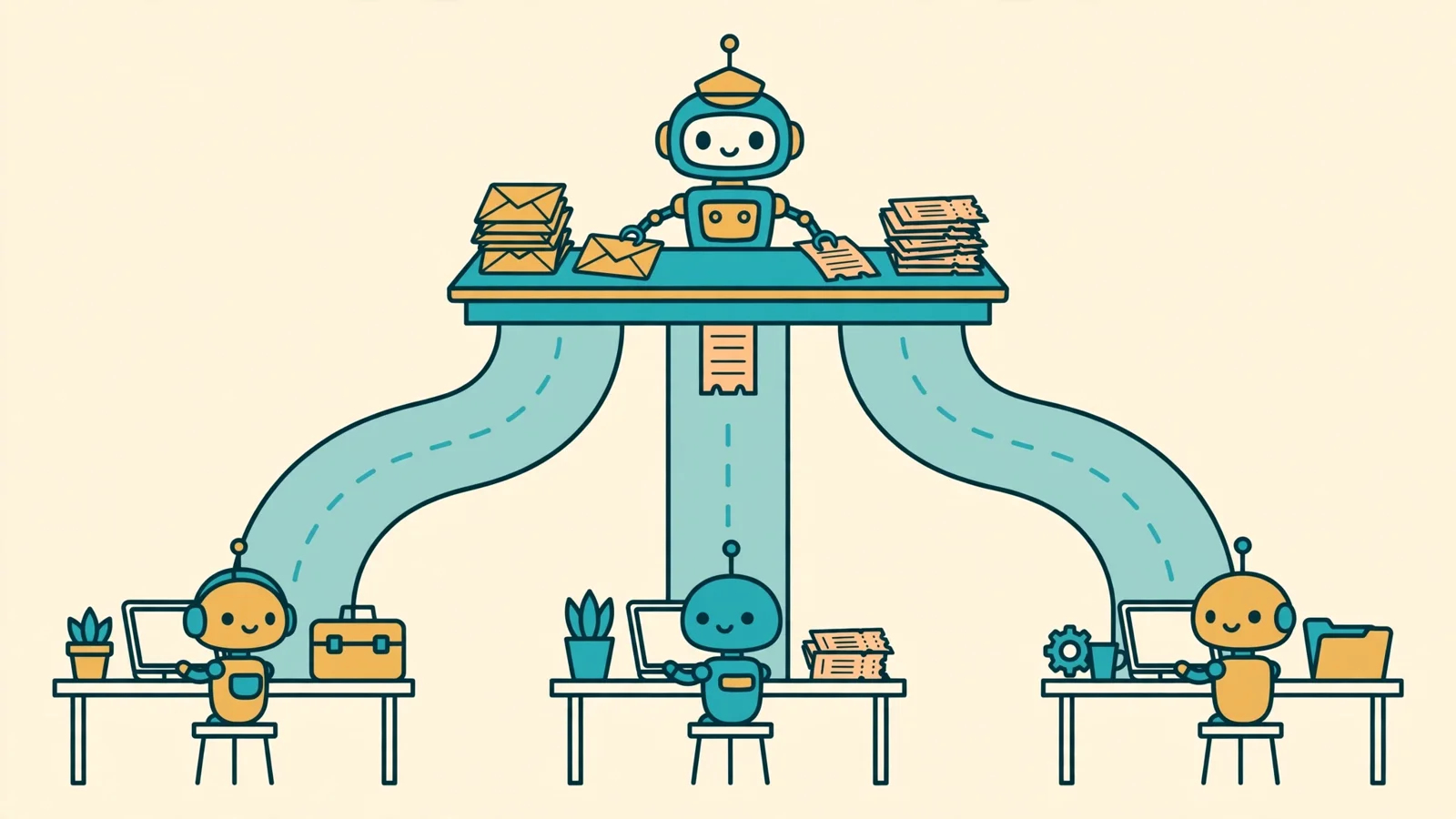
One agent for the whole repo
Most coding agents today work like this: you open a chat, you ask for something, you wait, you review. One developer, one session, one task at a time. Dsh-superagent flips that around. It lives inside a single GitHub repository and listens to it. When an approved team member asks for work in a comment or chat message, the agent opens a work item, does the job, and replies in the same conversation, usually with a pull request.
It is packaged as a bundle for DeepSeek Harness, DeepSeek's open-source agent framework. It also listens to Feishu, ByteDance's workplace chat app, if a team wants requests to come from chat instead of GitHub. A web panel shows only the items that need a human, so the team is not flooded with status noise.
The design principle is stated plainly in the README: take as little human attention as possible, and give as much value as possible. The agent acts only when asked, or when a rule the team wrote allows it. It speaks only when someone must act or can use a result. That restraint is the whole point. An agent that can act for a whole team can also waste a whole team's attention.
The router and the workers
The architecture is the part worth understanding, because it is a pattern you can reuse even if you never run this code. There are two layers:
- One Router. A single long-running session reads incoming GitHub events and messages, decides what counts as authorized work, and hands each accepted job to a worker. It never does the coding itself, and its tool set is deliberately small.
- Many Workers. Each accepted job, called a Ticket, gets its own worker session and its own working directory. The worker writes the code, runs tests, and opens the pull request. Workers run in parallel, so several tickets can move at once.
Splitting the dispatcher from the doers matters for a practical reason: a hung worker or a runaway install cannot freeze the thing listening for the next request. You can kill one worker, re-snapshot its ticket, and resume without restarting the whole agent. If you have ever watched a single long agent session grind to a halt on one bad command, you know why that separation is valuable.
What DeepSeek's own numbers do and do not prove
DeepSeek tested the design in simulation, not on real team work. In its simulated tests, under a noisy message stream, the router-worker design finished the slowest 5 percent of tasks in 15.7 minutes, compared with 29.5 minutes for a single-session baseline. The median task time in the same simulation was 12.4 minutes.
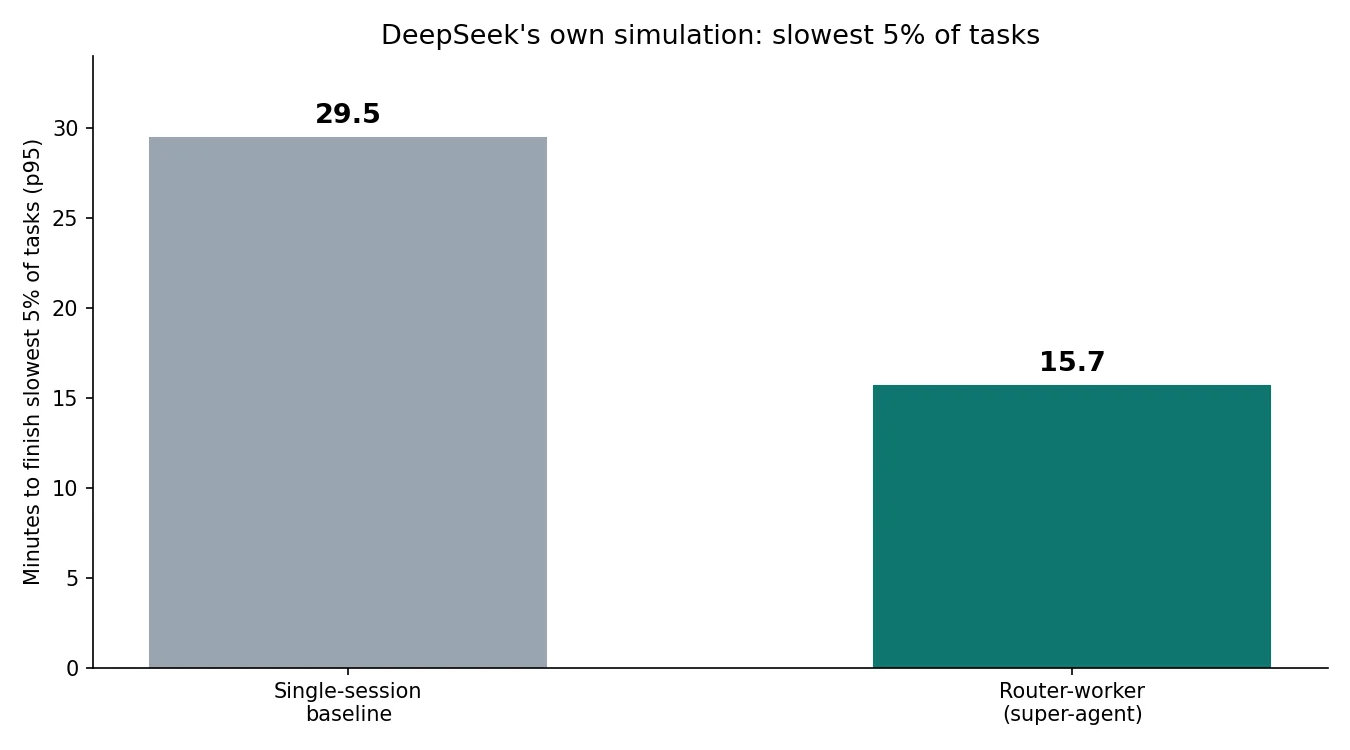
Treat those numbers as a direction, not a result. DeepSeek is clear that the test used synthetic messages and simulated tools, and that real-world code quality was not measured. The chart above shows DeepSeek's own simulation figures, not an independent benchmark. The honest reading is that parallel workers should beat a single session on slow jobs, and DeepSeek's simulation agrees. It does not prove your pull requests will get better or faster.
What it changes for running AI yourself
Here is the practical angle. This is not a new model. It is a way of running agents on hardware you control. The agent loop runs on your own machine as a DeepSeek Harness profile, and you configure the model provider in Harness. That means the orchestration, the repo access, and the conversation history are yours, not rented from a coding-agent service. For a small team or an open-source project, that is a real difference: no per-seat subscription for the agent layer itself, and the code that decides what your agent is allowed to do is code you can read.
But the self-hosted part comes with real setup work. You need a dedicated GitHub account for the agent, Node.js 22.19 or later, git, Python, tmux, and the GitHub CLI, and the deployment guide pins Harness version 0.2.1-rc.3. Only github.com is supported, not GitHub Enterprise Server. Setup is deliberately done with your own coding agent reading the project's SETUP.md, one question at a time.
The safety fine print, read before you run it
DeepSeek is unusually blunt about the risks, and you should take it at its word. The README says the code grew out of the team's day-to-day work, much of it written by coding agents, and asks readers to treat it as research code, not production-ready software. The published version is not identical to DeepSeek's internal version, and some designs in the companion article are future work, not implemented here.
The sharpest warning is about permissions. Both of the agent's presets run with full access as the operator's OS user, and a worker can execute programs by path and read the operator's home directory. DeepSeek recommends running it under a separate OS account for isolation, with a dedicated GitHub account for the agent. Do not run this on your main account on your main machine. Give it its own account, its own repo access, and nothing it does not need.
The takeaway
Dsh-superagent is not a product you should deploy to your team tomorrow. It is a published idea with working code: split the agent that listens from the agents that work, let the team ask in the place they already work, and spend human attention only on results, questions, and failures. If you run a small team or an open-source repo and you are comfortable setting up research software in an isolated account, it is worth reading the docs and trying it on a throwaway repo. If you want a coding agent you can trust with real access today, wait for the prototype to harden, and keep the router-worker pattern in mind for whatever you build next.
Sources
- DeepSeek, dsh-superagent-prototype repository on GitHub (README, SETUP.md, and docs 000-008)
- DeepSeek Harness product page
- MarkTechPost, DeepSeek Open-Sources dsh-superagent, a Router-Worker Coding Agent (November 1, 2026)
- On The Wire, DeepSeek publishes a research prototype of a proactive coding agent for one GitHub repository