
Mistral Voxtral 3: a full voice-agent stack that can live on your own servers
Mistral's Voxtral 3 bundles listening, reasoning, tool use and speaking into one real-time voice pipeline — API today, self-hosted on request.
On October 20, 2026, Mistral AI launched Voxtral 3: a family of speech models plus a voice-agent SDK built on LiveKit that brings listening, thinking, tool calling and speaking into a single streaming pipeline. The pitch is simple — a voice agent that handles a live conversation end to end, with each turn finishing in under a second, and no stage waiting for the one before it. The twist that matters for this blog: Mistral will run the whole stack on your own infrastructure, not just through its API.

What Voxtral 3 actually ships
Four models, one SDK, each swappable independently:
- Voxtral Small Transcribe 3 — speech-to-text covering more than 50 languages, including 24 official EU languages and lower-resource Asian and Indic languages. It identifies who said what (diarization), accepts key terms and free-form text to bias recognition toward your vocabulary without fine-tuning (context biasing), and detects when a speaker has finished so the agent replies promptly (end-of-turn detection). Mistral says it beats Whisper, Scribe v2 and Gemini 3.5 Transcribe on its own benchmarks.
- Voxtral Mini Transcribe 3 — a 4-billion-parameter model for cheaper transcription at $0.0035 per minute.
- Voxtral Mini Transcribe Realtime 3 — streaming transcription with latency below 500 milliseconds in over 35 languages, at $0.008 per minute.
- Voxtral Speech 3 (also called Voxtral Mini TTS 3) — text-to-speech in 35+ languages and 50+ dialects that adjusts emotion, pace and emphasis from the conversation's context. It supports voice presets in 18 languages, custom pronunciation hints and a vocabulary library. At $13 per million characters, Mistral says it costs less to run than OpenAI's TTS-1, Deepgram, ElevenLabs Flash and Gemini Flash.
On top sits Pro Voice: high-fidelity voice adaptation from 30 minutes of reference audio, aimed at reproducing a speaker's distinctive character, emotional range and style across languages.
The voice agent SDK is what turns the models into a product. Realtime transcription listens and spots when the caller stops talking, a reasoning model — Mistral Small 4 by default, or any model you pick — thinks and calls tools, and the speech model replies in the tone of the conversation so far. Everything streams, so the agent stops talking when the caller cuts in. Agents can verify an identity, check a bill or book an appointment mid-call through function calling, web search and retrieval over your own systems. Calls work over SIP telephony and over WebRTC in browsers and apps, plugging into the contact-center software teams already use.
The price list, in one chart
The full API table:
| Model | Price |
|---|---|
| Voxtral Mini Transcribe 3 (batch) | $0.0035/min |
| Voxtral Small Transcribe 3 | $0.0040/min |
| Voxtral Mini Transcribe Realtime 3 | $0.008/min |
| Voxtral Speech 3 (batch and realtime) | $13/1M chars |
| Voice agent API (Mistral Small 4 reasoning) | $0.04/min |
| Voice agent API (any other reasoning model) | $0.08/min |
Scaled to an hour of full use, the gap between the transcription pieces and the full agent pipeline is wide:
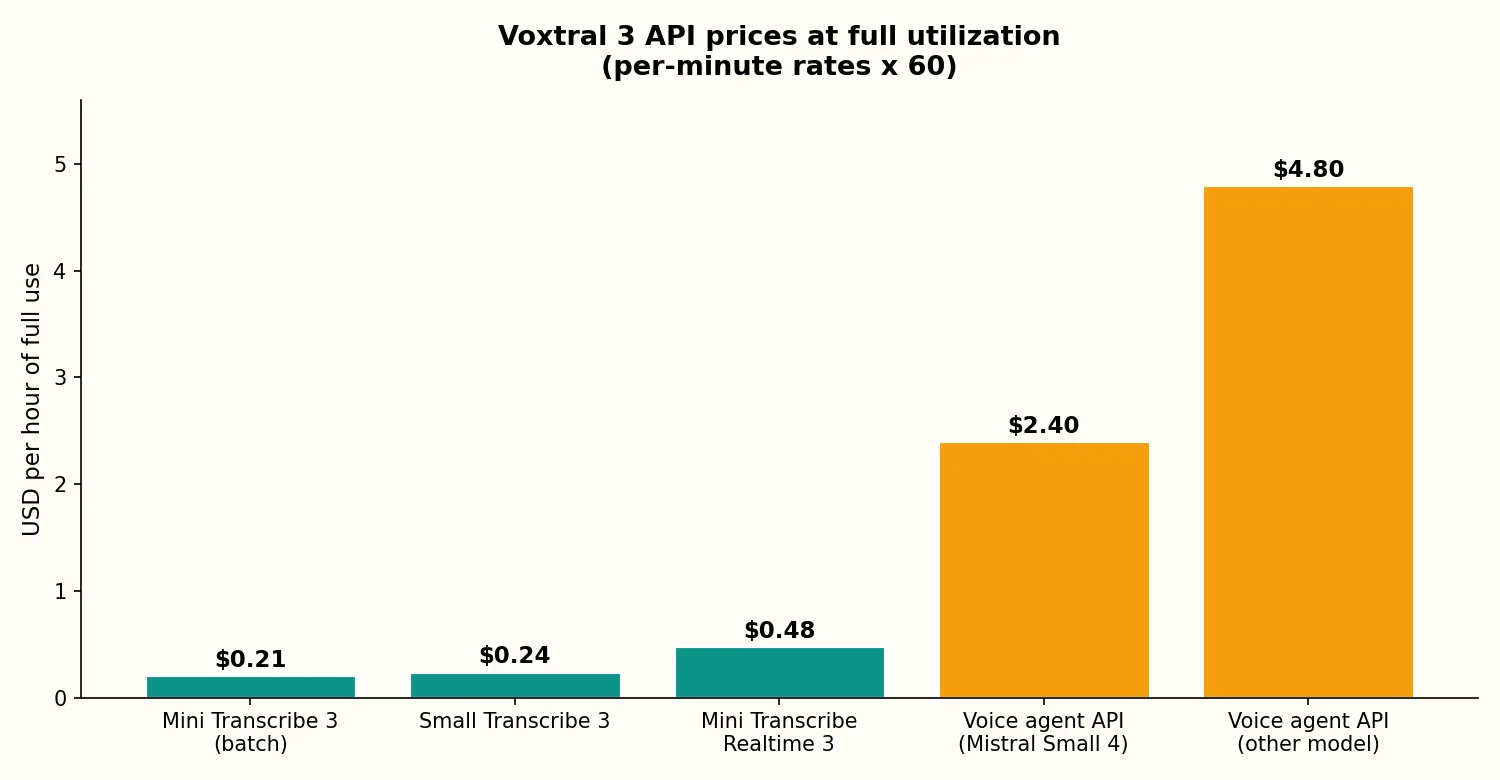
These are ceiling numbers — you only pay while the agent is active — but they set the budget envelope: a full hour of continuous agent conversation runs between $2.40 and $4.80 depending on your reasoning model, before the speech-generation characters are counted.
What this changes for you
One stack replaces three vendors. Until now, a voice agent meant stitching a transcription provider, an LLM and a TTS provider together yourself, then wiring interruption handling, turn detection and tool calls across all three. Voxtral 3's SDK ships that wiring as one streaming pipeline with each stage replaceable — swap the reasoning model or the voice without rewriting the agent. For anyone building a service-desk bot, a phone assistant or a hands-free copilot, that is the real feature: less integration work and a tighter latency budget.
The self-deployment option is the local angle. Mistral positions Voxtral 3 as sovereign deployment: run it through the EU-hosted API, or deploy the full stack on your own infrastructure, keeping audio processing in your environment and controlling whether conversations are retained. For health, legal and enterprise use, data-sovereignty is usually the deal-breaker for voice AI — this answers it. One honest note: self-deployment means talking to Mistral's team, not clicking a download button. As of launch, Mistral has not published the v3 weights as open downloads, so this is not the fully offline, run-it-on-your-GPU story we cover with open-weight models like Fish Audio Drama 3. Earlier Voxtral generations did ship open weights under Apache 2.0 for the speech-understanding side, so a downloadable v3 is plausible — but not promised.
The latency spec is the one to watch. Sub-500ms realtime transcription, under-one-second turns, end-of-turn detection and interruption handling are the numbers that decide whether a voice agent feels like a phone call or a walkie-talkie. It is no coincidence ElevenLabs launched its own realtime speech-to-speech models the same day — its v1 Max scores 98.8 percent on the Big Bench Audio benchmark with a 0.57-second response time. The race is now about "feels like talking," not just accuracy.
Read Mistral's benchmarks the way you'd read any vendor's. The transcription wins are on FLEURS word-error rates and Mistral's own charts; the TTS quality-per-dollar comparisons are internal evaluations judged by another AI model (gemini-3.8-flash). Directionally interesting, not proof. The features — diarization, context biasing, end-of-turn detection, SIP and WebRTC support — are the verifiable part, and they are the part that matters for production.
The bottom line
Voice AI is consolidating from do-it-yourself pipelines into single stacks. Mistral's bet is that the stack people want is one that can live where their data already lives — API for speed, self-deployed for control. If you are building voice agents today, price the agent API tier against your current stitch-and-pray bill. If your definition of "local" means weights on your own GPU, this release is not that — yet.
Sources
- Voxtral 3: Voice Agent SDK and Speech Models in 50+ Languages — Mistral AI (announcement)
- Mistral AI launches Voxtral 3, a full voice agent stack that listens, thinks, and talks in real time — The Decoder
- Mistral unveils new voice agent API and speech models with low-cost pricing — Crypto Briefing
- Mistral AI Launches Voxtral 3 With Voice Agent SDK and 50+ Languages — Technobezz
- Mistral AI Launches Voxtral 3 Voice Agent Stack — AI Daily Post