
Liquid AI's LFM3: six small open models that cover text, vision, audio, and decisions
Liquid AI's LFM3 family packs six open-weight models of about 2 billion parameters onto one shared backbone, built to run and fine-tune on your own hardware.
Liquid AI released LFM3 on October 27, 2026: six open-weight models, each around 2 billion parameters, all branched from the same 1.7-billion-parameter base. One family covers text, vision, audio, an all-in-one omni model, and two decision models that answer with probabilities instead of paragraphs. The weights are available on Hugging Face, and the models are built to run on your own hardware — not just in a cloud API.

Six models, one backbone
The shared starting point is LFM3-1.7B-Base, pre-trained on 22 trillion tokens. Liquid AI then specialized it six ways:
- LFM3-1.7B (text): a chat and agent model with a 256,000-token context window, post-trained to work in agent harnesses and call tools.
- LFM3-VL-2B (vision): takes text, images, and video as input, and reasons step by step before answering.
- LFM3-Audio-2B (audio): takes text or audio and replies with text, speech, or both, across 18 languages.
- LFM3-Omni-2B (omni): Liquid AI's first omni model — it sees, listens, and talks back in a single model.
- d1-2B (decision): reads text and pictures and answers your questions in one pass, each with a calibrated probability.
- d1-Omni-2B (decision with audio): the same idea, but it also listens, so a spoken request can be routed or checked like a typed one.
The decision models add typed answers beyond yes/no and scores. They can point to a box in an image, read text and numbers out of a document (and say "not found" when a field is missing), give a number with a likely range, or pick every option that applies. If you already read the recent decision-model posts here, this is the same idea at a smaller size: d1-2B replaces the earlier d1-3B with a third fewer parameters, and Liquid AI reports it scores higher on its decision benchmarks.
Why small is the point
A 2-billion-parameter model is not trying to beat a frontier model at everything. It is trying to be good enough at one job to live where the work happens: on a laptop, a small server, or an edge device, with your data staying on the machine.
Two numbers from Liquid AI's own measurements show what that buys you. The text model decodes 1.8 to 2.8 times faster than the next model on the three on-device setups it tested, and a full 128,000-token context needs only 1.6 GB of KV cache — the working memory a model uses to remember the conversation — against 4.3 GB for Qwen3.5-4B. Long conversations stay cheap, which matters if an agent runs in the background all day.
The architecture is also tuned for real devices, not just server GPUs. Liquid AI says it tested 14 device and backend combinations, including Samsung and OnePlus phones, a Raspberry Pi 5, an Apple M4 Max laptop, AMD Ryzen AI laptops, and Qualcomm's Hexagon NPU. Native support covers llama.cpp, MLX, and vLLM, so you are not locked to one runtime.
The benchmark picture, honestly reported
Liquid AI's own benchmark table is where the story gets specific — and where the limits show up too. On tool calling (BFCL V4), LFM3-1.7B scores 71.39, ahead of Qwen3.5-9B at 62.83 despite having roughly a fifth of the parameters. On browser tasks (WebArena-Verified), it scores 38.42 against 28.94 for Qwen3.5-9B. On instruction following (IFEval), it scores 96.66.
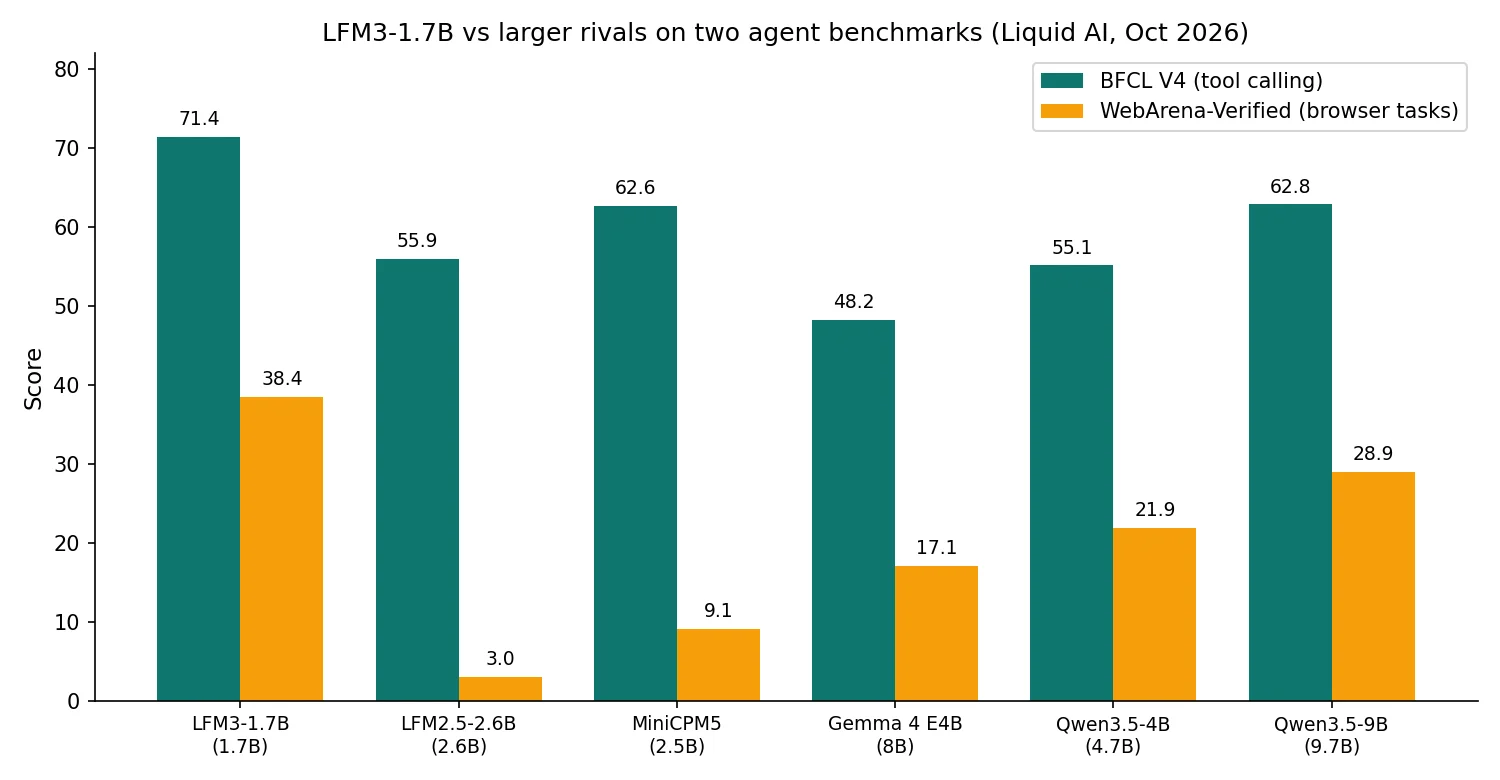
But Liquid AI is upfront about the other side: larger models still win on agentic coding and knowledge, where size matters most. On GPQA Diamond, a knowledge test, LFM3-1.7B scores 63.37 against 80.40 for Qwen3.5-9B. And all of these numbers are vendor-reported. Independent tests have not landed yet, so treat the chart above as Liquid AI's claim, not a settled verdict. The honest read is narrower: for tool use and browser-style agent tasks, a well-trained 1.7B model can now compete with models several times its size. For hard knowledge and coding, it cannot.
Fine-tune it for one job
The second reason this family matters for local AI is fine-tuning. Liquid AI says each model can be fine-tuned on a single GPU. Its own demo makes the case: it fine-tuned LFM3-VL-2B on about 3,000 public photos of wind turbine blades, for a few hours on one A100, to find and classify defects. Out of the box, both the base model and a frontier model identified the defect types in fewer than 10% of held-out images. After the short fine-tune, the small model reached 67% classification accuracy.
That is the pattern worth copying. A small open model will not be an expert in your niche on day one. But because the weights are open and the model is small, you can teach it one narrow job with a modest dataset and a single GPU, then run the result entirely on your own machine. A frontier API cannot be tuned that way, and a 70-billion-parameter model cannot be tuned that cheaply.
Try it today
Ollama shipped LFM3 support the same day, in version 0.40.12:
ollama run lfm3
ollama run d1:2b "I was charged twice for order 4417." --ask "Is this a billing issue?"
One caveat to know before you update: in this release, the Ollama builds of lfm3 and d1:2b are supported on Apple hardware, with Linux and Windows support coming soon. If you run Linux or Windows, use the Hugging Face weights with llama.cpp or vLLM instead, or wait for the Ollama builds to arrive. If you are still deciding what hardware to run models on, start with /check to match a model to the machine you already own.
The bottom line
LFM3 is not a frontier model, and it does not pretend to be. It is six small, open, specialized models on one backbone: a text agent, a vision model, an audio model, an omni model, and two decision models. The practical change for you is that agent-style work — tool calls, browser tasks, document triage, spoken commands — now has a credible option that runs locally, fine-tunes on one GPU, and keeps long contexts cheap. Start with the text model for agent tasks, try the decision models where you need a number instead of a paragraph, and measure any of them on your own data before you trust them with real decisions.
Sources
- Introducing LFM3: Every Modality for Specialized Intelligence, Liquid AI, October 27, 2026
- Ollama releases, Ollama, October 2026