
Kimi K3.1 Pro: a frontier-level model whose open weights arrive November 4
Kimi K3.1 Pro matches top closed models on coding tests, and its open weights arrive by November 4 — but you can't run it at home yet.
Moonshot AI released Kimi K3.1 Pro on October 23, 2026. It is the first model in the company's new K3.1 series, and Moonshot describes it as its most capable 3-trillion-parameter-class open-weight model so far. You can use it today through Kimi's chat app, desktop app, coding tool, and API. The part local AI users care about most — the downloadable weights — comes later: Moonshot says the full model weights will be released by November 4.

What Kimi K3.1 Pro is
Kimi K3.1 Pro is a post-trained version of Kimi K3, with much more post-training compute behind it. The headline facts from Moonshot's announcement:
- 3-trillion-parameter class, with a 1-million-token context window — enough room to hold very long documents or codebases in one conversation
- A faster sibling, Kimi K3.1 Pro Highspeed, which Moonshot says runs 2 to 3 times faster than the standard version
- Stronger results in coding, 3D creation, and financial research than K3
- Available now on Kimi.ai, Kimi Work, Kimi Code, and the Kimi API
The 1-million-token context is worth a plain explanation. A token is roughly three or four characters of English text, so a million tokens is on the order of a few thousand pages. For a coding assistant, that means an entire project can stay in view while the model works.
The benchmark numbers that matter
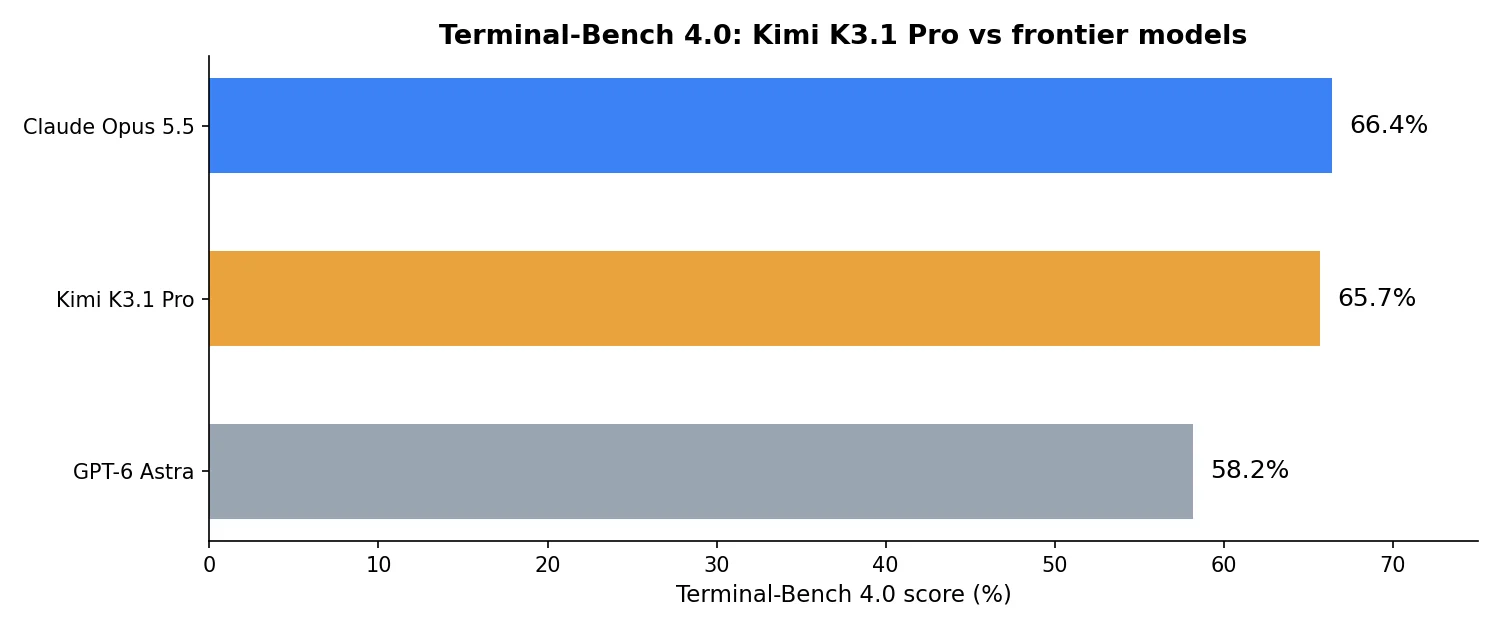
Moonshot reports its scores with reasoning effort set to maximum, so treat these as best-case vendor numbers, not independent tests. Still, the comparison is striking: on Terminal-Bench 4.0, a test of coding agents on realistic terminal tasks, K3.1 Pro scored 65.7%, ahead of GPT-6 Astra at 58.2% and just behind Claude Opus 5.5 at 66.4%.
Two other results fill out the picture. On Kimi's long-horizon coding test, K3.1 Pro scored 61.2%, up from K3's 55.95%. On BenchCAD, a test of turning descriptions into 3D models through CAD code, it scored 92.7% with tools, close to Claude Opus 5.5 at 96.2% and GPT-6 Astra at 95.9%. Moonshot also says the model's claim-level hallucination rate on its hard internal test fell from 23.4% for K3 to 8.3% — fewer made-up facts, though the company notes the test is deliberately stressful and the numbers do not reflect everyday error rates.
What this means for running AI yourself
Here is the honest version: you cannot run Kimi K3.1 Pro on your own machine today. The weights are not out yet, and no one outside Moonshot knows the file size, the license, or the hardware it needs. A 3-trillion-parameter-class model will not fit on a laptop or a single gaming GPU in any case — models of this size need server-grade hardware, as this blog's earlier posts on other large open models have shown.
So what does this release actually change for you?
- Try it now, hosted. If you want to judge the model itself, Kimi.ai and the Kimi API are open today, and Kimi Code lets you pick it with the
/modelcommand. That costs nothing to evaluate. - Mark November 4. When the weights land, the questions that matter are the license, the file size, and whether community quantization shrinks it to something a home server can hold. This blog will cover that release when it happens.
- Watch for the smaller versions. The pattern with very large open models is that distilled or quantized versions follow — a small model trained to imitate the big one, or a compressed file that trades some quality for a much smaller footprint. Those are usually the versions that end up running locally.
One more detail worth noting: Moonshot says it deliberately removed cyber-related data from K3.1 Pro's training, so the open release is less capable at finding software vulnerabilities than its own internal version. The company frames this as a safety choice for open weights. For everyday coding, writing, and research use, that trade-off should not matter.
The bottom line
Kimi K3.1 Pro is the strongest sign yet that open-weight models are closing the gap with the best closed models — at least on coding tests, and at least by the vendor's own numbers. For local AI users, the real event is still two weeks away: November 4, when the weights arrive and we can see what it actually takes to run one. Until then, try it hosted, and do not buy hardware for it yet.
Sources
- Kimi K3.1 Pro Tech Blog: Advancing Open Intelligence, Moonshot AI, October 23, 2026
- Model Inference Pricing Explanation, Kimi API Platform documentation, updated October 23, 2026