
MiniMax M3.1 Flash's open weights are out — what 428B needs to run
MiniMax published the weights for its 428B open model this morning; the real files need 250 GB of disk, four data-center GPUs, and a non-commercial license.
Four days after MiniMax launched M3.1 Flash as an API-only model, the company published the actual weights. Anyone can now download the model from Hugging Face and run it themselves. That is the good news. The fine print — the license, the 250 GB download, and the GPUs it takes — is what this post is about.
What landed this morning
The repository MiniMaxAI/MiniMax-M3.1-Flash went live on Hugging Face on October 23. The headline numbers, from MiniMax's own release:
- 428 billion total parameters, with only 23 billion active per token (a mixture-of-experts design, or MoE — the model picks a small subset of its experts for each answer)
- 1 million-token context window, with text, image, and video input
- Built for coding, agents, and computer-use tasks
This follows the pattern of 2026: API first, weights a few days later. Together AI is offering hosted production inference for developers who want to use the model without managing GPUs at all.

Why "only" 250 GB of disk
428 billion parameters at full 16-bit precision would need about 856 GB — more than most people own in total storage. Two engineering choices shrink that:
- Mixture of experts. Because only 23 billion parameters fire per answer, the model decodes at roughly the speed of a 23B model. But — and this trips up every beginner — all 428 billion parameters still have to live in memory. MoE saves compute, not RAM.
- 4-bit-class quantization built in. The config file shows the experts were quantized with NVFP4, a 4-bit floating-point format, using quantization-aware training. That is why the published files total about 250.1 GB across 49 file shards instead of 856 GB.
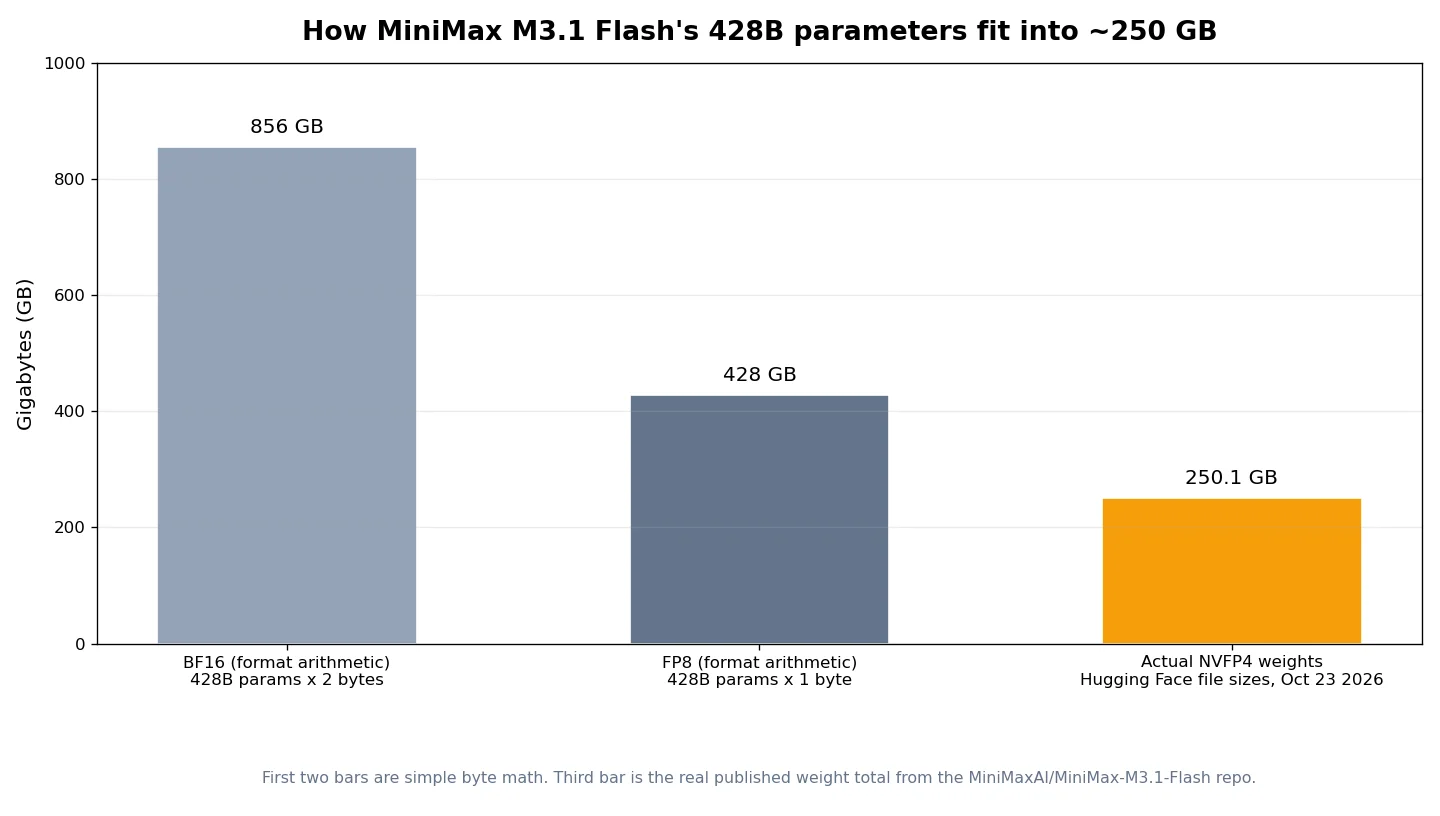
That quantization is the genuinely interesting part for local AI: the weights ship already compressed, with no third-party conversion needed. vLLM and SGLang support the model from day one.
The three checks before you download
1. The license is not what you might expect. The repo ships under the MiniMax Community License, and the first line of the LICENSE file grants rights "for non-commercial purposes." That means: fine for learning, experiments, and evaluation — not for putting into a product or a service you sell. Always read the actual license file before you build on any "open" model; "open weights" and "free for business use" are different things.
2. The download is 250 GB. You need that much free disk, plus a fast connection. The files are split into 49 pieces, so an interrupted download can be resumed — but it is still a quarter-terabyte.
3. You cannot run this on a home GPU. The honest math: 250 GB of weights needs roughly 320 GB of GPU memory to load with room for the working set. That is four 80 GB data-center cards (H100 or similar) at minimum, and in practice the serving guides assume more. NVFP4 support also depends on modern NVIDIA hardware with the right kernel support — this is not a model you quantize down to a 24 GB RTX 3090.
What it scores (vendor numbers)
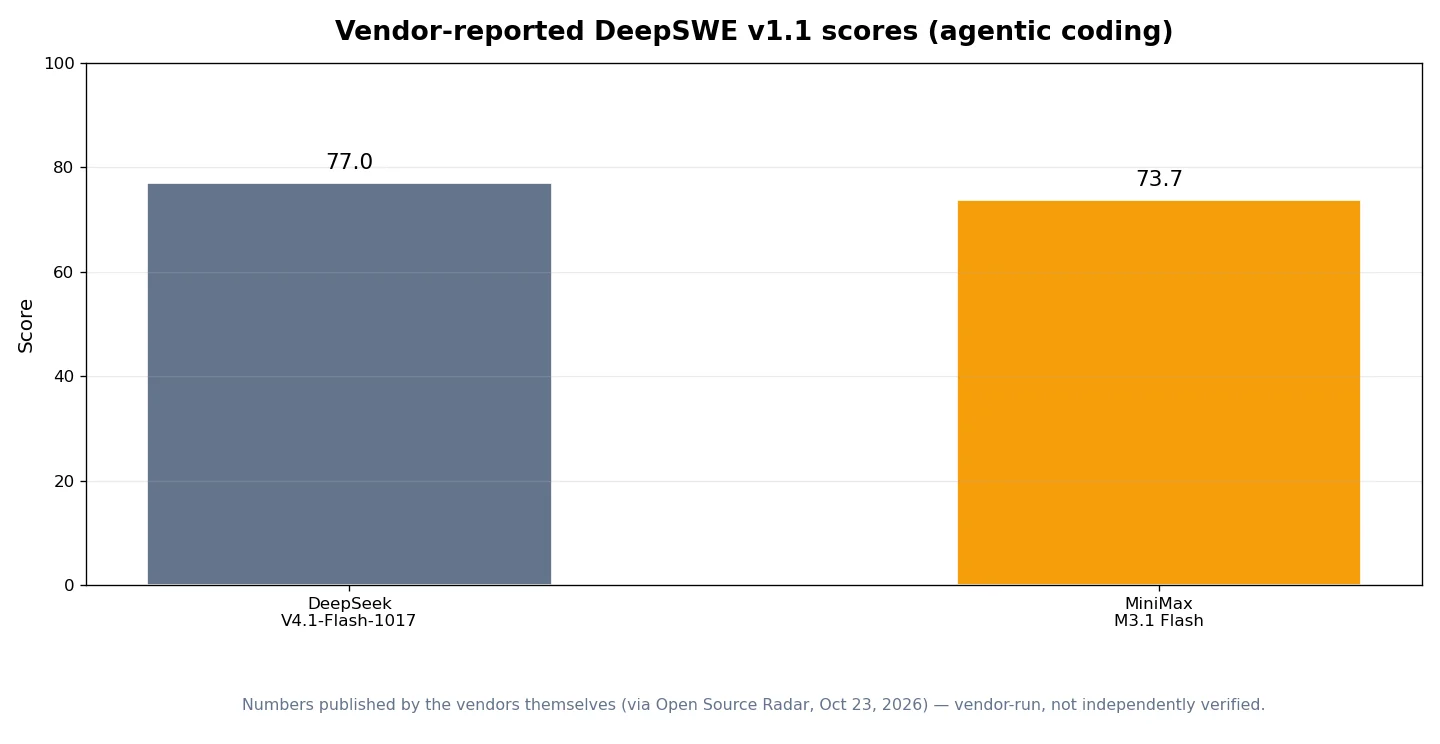
MiniMax's own model card claims 73.7% on DeepSWE v1.1 (agentic coding), 61.7 on OSWorld 2.0, and 82.2 on CyberGym — with DeepSeek's V4.1-Flash-1017 at 77.0 on DeepSWE for comparison. These are vendor-run numbers; independent reproductions have not landed yet, and the honest move is to wait for them before drawing conclusions.
So what changes for you?
On your own machine: nothing, yet. This model is a data-center workload. But the release still matters for local AI, three ways:
- The 23B active count is the template. MoE models keep growing in total size while active params stay flat — future community distills of this family could land in the runnable 20–30B class. That is where the real win for home rigs will be.
- You can use it today without any GPU. Together AI's hosted inference means you can call the model from an app without owning hardware. Compare that against your own machine's cost per task before assuming local always wins — try it on /check.
- The license lesson generalizes. This year, "open weights" increasingly means "downloadable but not commercial," with MiniMax's non-commercial grant one example. Check the license file every time; it is the part of a release that decides what you are actually allowed to do.
Want a sense of what does run on your hardware today? /hardware-for-model gives you honest memory math for models your machine can actually load.
Sources
- MiniMax releases open weights for 428-billion-parameter M3.1 Flash model, TechNode (Oct 23, 2026)
- Open Source Radar — October 23: MOSS-Image, MiniMax weights, siliconnoon (Oct 23, 2026)
- MiniMax M3.1 Flash open source 72 hours…, ChainCatcher (Oct 23, 2026)
- MiniMax opens M3.1 Flash weights with Together AI handling inference, RuntimeWire (Oct 22, 2026)
- MiniMaxAI/MiniMax-M3.1-Flash on Hugging Face, model card, config.json, and LICENSE file (MiniMax Community License, non-commercial grant)