
Nace's Drex Max v1: a 27B decision model whose open weights run on a Mac
Nace AI released Drex Max v1's open weights today: a 27B model that answers in probabilities, not paragraphs, and runs on a 24GB Mac.
Nace AI released the open weights of Drex Max v1 on November 1, 2026. It is the company's most capable decision model, and it is the first version of it you can download and run on your own hardware instead of calling an API. Unlike a chat model, it does not write you an answer. You give it some text, JSON, or an image plus a set of named questions, and it returns a probability for every option in one forward pass. Nothing is generated.

What a decision model actually does
Most everyday AI jobs are not conversations. They are decisions: where should this ticket go, should this request be approved, how urgent is this message. A chat model answers those questions by generating sentences, which costs time and tokens on every call. A decision model skips the sentences and returns the answer directly as probabilities.
Drex Max v1 supports three question types: a choice among named options, a yes-or-no question, and an ordered score against levels you define. You can ask several questions about the same input in one request, with up to 255 options per question. The model is a dense 27-billion-parameter model with a 262,144-token window, though the default limit is 16,384 tokens per request. You raise that limit with an environment setting or a command flag, up to the full window.
A concrete example from the model card shows the shape of an answer. Given a ticket that says "I was charged twice for the same order," the model returns billing at 0.9988, technical at 0.0003, and other at 0.0009, plus a separate yes-or-no answer and an urgency score. That output is machine-readable by design. Your code can act on the top label, or send low-confidence cases to a human, without parsing prose.
How good is it, honestly
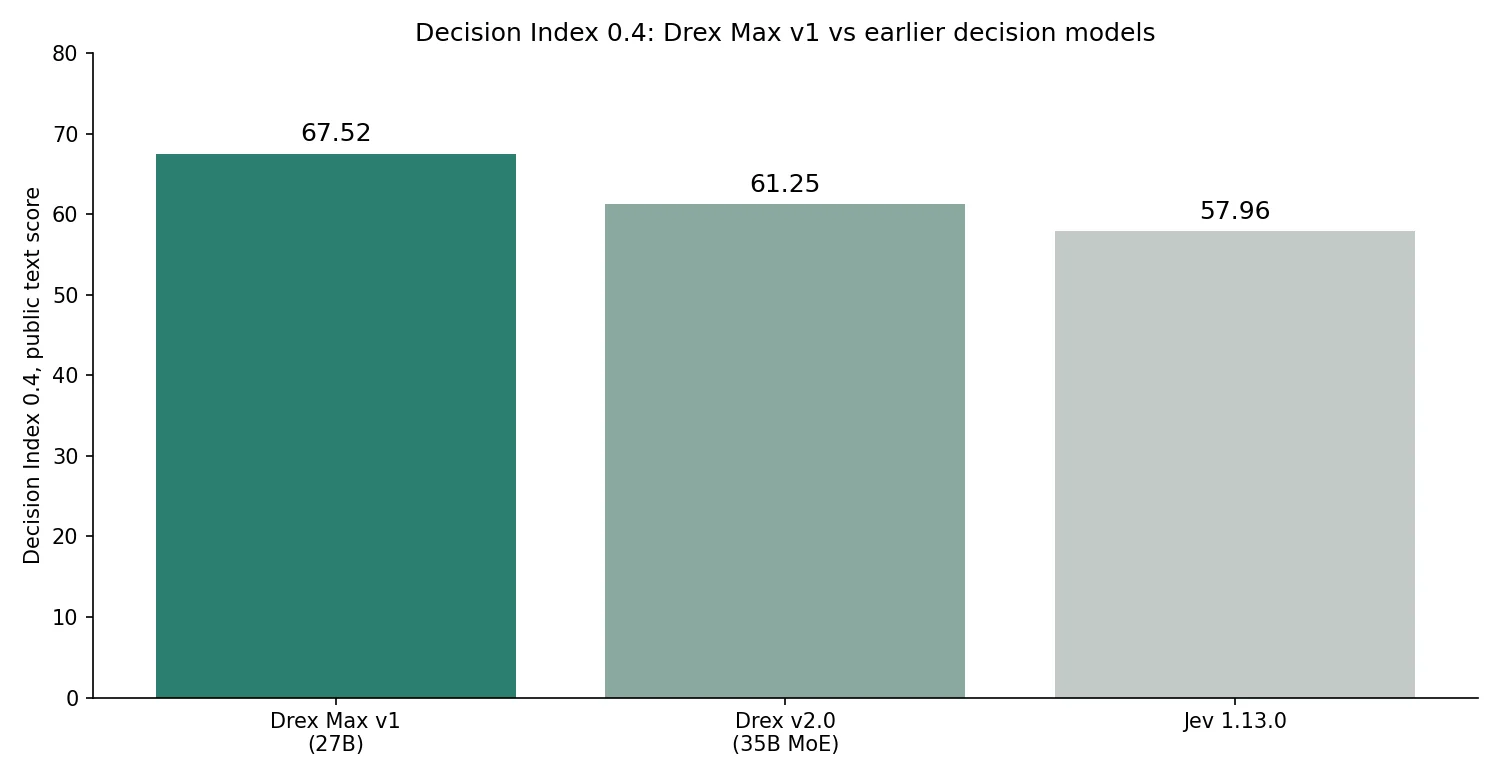
All of these scores are reported by Nace AI, not independently verified yet. On the public text split of Decision Index 0.4, Drex Max v1 scores 67.52, ahead of its predecessor Drex v2.0 at 61.25 and Jev 1.13.0 at 57.96. On the Artificial Analysis Decision Index it scores 64, ranking fourth of 18 models, one point behind the leaders at 65. Its strongest area on the public index is Tools, at 81.9, and its public vision index is 73.92, including 97.3 on InfographicVQA.
That ranking matters less than the trade-off it shows. Drex Max v1 is the strongest decision model in its family, but it is also much larger than the small decision models covered here before, such as the 2B joey-1. You pay for the accuracy in memory. The full bf16 weights take about 49 GB, and loading the backbone in 8-bit takes about 26 GB.
What you need to run it
This is where the release is genuinely useful, and where it needs care. On an Apple Silicon Mac, the affine Q4 checkpoint runs on Macs with 24 GB of memory or more through Kapitsa or MLX. The Q8_0 GGUF file needs 48 GB. On those Mac paths, only the text backbone runs: images are not included in the Mac builds, so image questions still need the Python path on an NVIDIA GPU. Nace also ships forks of llama.cpp and Ollama on a drex-max-v1 branch, because the model uses non-causal attention that a plain chat run does not reproduce. Do not expect stock Ollama to load it.
Two practical notes before you download anything. First, the Q8_0 GGUF file is about 27 GB, and converting it yourself needs the roughly 49 GB bf16 weights on disk, so download the ready-made GGUF unless you have a reason to convert. Second, the weights are released under the Nace.AI Open RAIL-M license, which is a use-restricted license, not a permissive open-source license like MIT or Apache 2.0. Read the license before using it in a commercial product.
On accuracy after quantization, Nace reports that on a 48 GB Apple M5 Pro, the Q8_0 GGUF answers within 0.02 of the bf16 weights run on an NVIDIA H100, and that 8-bit probabilities stayed within 0.03 of bf16 on its example. Those are vendor measurements on one example, not a guarantee for your data. If you adopt it, test it on your own tickets, forms, or screenshots first, and keep a human in the loop for low-confidence answers.
The takeaway
Drex Max v1 does not change what a decision model is. It changes where the strongest one in this family can live: on your own machine, with your data staying local, and with no per-token API bill for every small decision. The cost is a serious Mac or a 48 GB GPU, a special fork of your usual tools, and text-only support on Macs for now. If you already run agents that make repeated routing, triage, or guardrail decisions, that trade is worth testing. If you just need a quick classifier on a laptop, a smaller decision model is still the saner starting point.
Sources
- Nace AI, Drex Max v1 model card, Hugging Face: https://huggingface.co/nace-ai/drex-max-v1
- MarkTechPost, "Nace AI Open-Sources Drex Max v1: A 27B Decision Model That Runs Locally on Apple Silicon," November 1, 2026: https://www.marktechpost.com/2026/11/01/nace-ai-open-sources-drex-max-v1-local-inference/