
Hy-Memory-30B-A3B: an open model that does your AI agent's remembering
Tencent's Hy-Memory-30B-A3B is an open model that writes memories for AI agents — it edged out Claude Opus 5 on memory benchmarks and fits on one 24GB card.
Your AI agent forgets everything between sessions. It starts every conversation from zero, and the memory frameworks that fix this — Mem0, MemOS, and friends — normally hand the "decide what to remember" job to a big general-purpose model. On October 16, Tencent Hunyuan open-sourced a model built for exactly one job: remembering. Hy-Memory-30B-A3B is a 30-billion-parameter open-weight model that writes memories into your agent's memory bank, and Tencent says it beats Claude Opus 5 at the task.

What Hy Memory 2.0 is
The release has three layers, all under Apache 2.0:
- Hy-Memory-30B-A3B, the memory-writer model. In Tencent's naming, "30B-A3B" means roughly 30 billion total parameters with about 3 billion active per token — a mixture-of-experts design, so inference costs look like a 3B model, not a 30B one.
- The Hy-Memory framework, which splits memory into three scenes: chat memory, working memory, and code memory. Code memory is the interesting one — it tracks not just what changed in your code, but why, as a chain of diffs.
- MemHub, a local-first app that syncs authorized conversation history and memories across AI tools.
How it works
Most agent memory systems work like this: a general chat model reads the conversation, decides what matters, and writes it to a store. Hy-Memory swaps in a specialist for that decision. It drops directly into existing frameworks — Mem0, MemOS, and Hy-Memory itself — replacing the general LLM as the writer, and it transfers to frameworks it was never trained on, like EverMemOS.
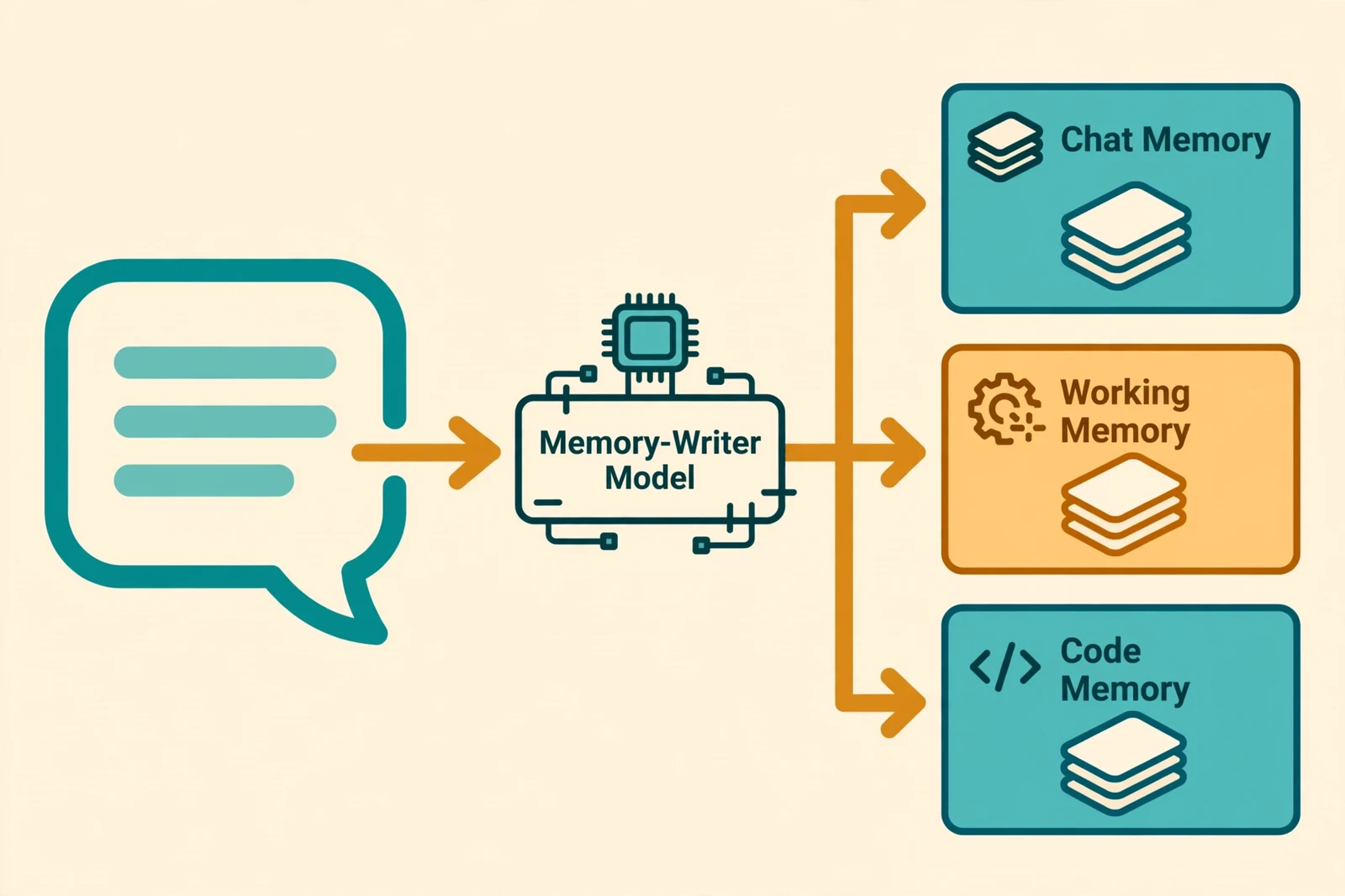
Training happened in two stages, both done inside the actual memory frameworks rather than on static text: first Memory On-Policy Distillation, where the model learns each framework's write protocol, then reinforcement learning where it gets rewarded for banks that help answer future questions. Tencent even published nine failed experiments alongside the results, which is refreshingly honest for a vendor report.
The numbers — read carefully
Tencent's headline: across four memory harnesses (Mem0, Hy-Memory, MemOS, and held-out EverMemOS), Hy-Memory-30B-A3B averages 55.49, ahead of Claude Opus 5 at 54.62 and DeepSeek V4.1 Flash at 53.64.
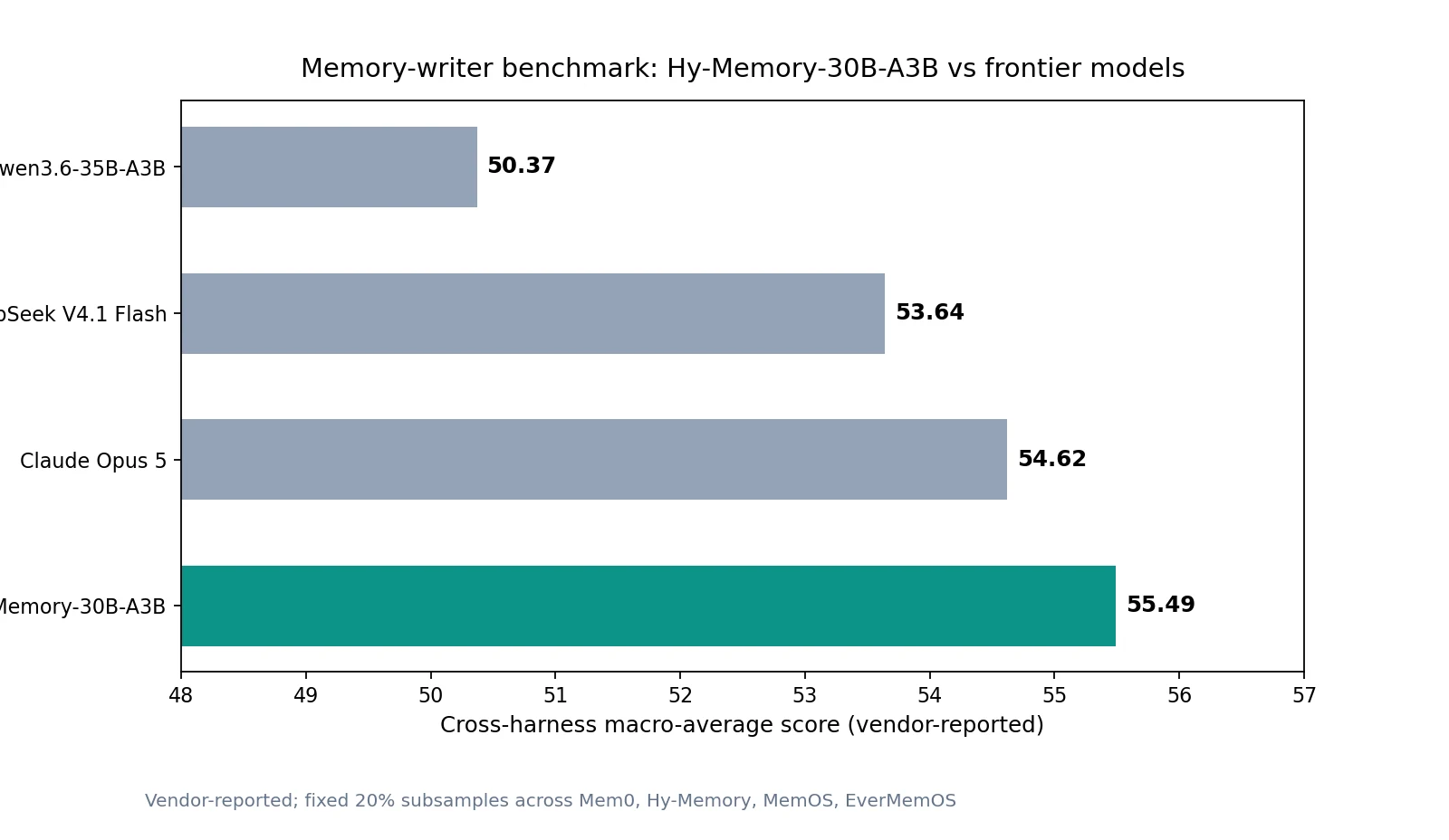
The honest version: these are Tencent's own numbers, measured on fixed 20% subsamples of the benchmarks, not independent tests. Some margins are razor-thin — on Tencent's own Hy-Memory harness, the model scores 60.55 against Opus's 60.53, which is a rounding error, not a victory. It looks strongest where memory differs from chat: on LongMemEval within the Mem0 harness, it scores 73.00 against Opus's 66.00. The specialist beats the generalist at memory tasks; the generalist still wins plenty of individual cells.
The memory math: can you run it?
Here is what the weights cost:
- Full precision: the Hugging Face checkpoint is 60.13 GB across 51 safetensors files. That is two datacenter GPUs, or offloading — not a home PC.
- 4-bit quant: roughly 17–18 GB (30B params × ~0.55 bytes). That fits comfortably on a single 24GB card like an RTX 3090, 4090, or 5090.
- Inference cost per token is closer to a 3B model, since only ~3B parameters activate.
A community walkthrough reports it running on a single 24GB card, and the model serves through vLLM with an OpenAI-compatible API:
vllm serve tencent/Hy-Memory-30B-A3B --served-model-name hy-memory
MemHub, the companion app, installs from npm:
npm i -g memhub-cli
memhub install && memhub serve
If you're experimenting with which machine fits a workload, a 30B-MoE model that computes like a 3B one is exactly the kind of thing to check against your VRAM.
What this changes for running AI yourself
Memory is the part of an agent stack you least want to send to a cloud API: it is a diary of everything you've told the agent, and routing it through someone else's server defeats half the point of local AI. A small, fast, open model that does the remembering locally means the diary-writer can live on your own machine — while the heavy chat model still runs wherever you want it. That is the practical win here, more than any benchmark cell.
Two honest caveats. First, a memory is only as good as the framework using it — MemHub is described as local-first, but anything routed to third-party AI services still follows those services' data handling, so read the permissions before syncing memories across tools. Second, an independent developer testing Hy Memory on LongMemEval found it is only as good as the LLM doing the writing and the harness around it; the framework is new, and community quants, Ollama packages, and integration polish will take weeks.
Takeaway
Hy Memory 2.0 is not a chatbot — it is infrastructure: a small specialist model that lets agents remember, open under Apache 2.0, runnable on a single 24GB GPU. The benchmarks are Tencent's own and should be read as "test-worthy, not trust-worthy," but the direction is right: memory is one of the first agent jobs that genuinely fits on your own hardware. If you're building local agents, try the memory-writer locally and measure it on your conversations — that is the benchmark that matters.
Sources
- Hy-Memory-30B-A3B model card — architecture, benchmark tables, quickstart
- Technical report (arXiv 2610.22196)
- Tencent-Hunyuan/Hy-Memory on GitHub — framework code and evaluation utilities
- WallstreetCN / Longbridge coverage of the Oct 16 release
- alextech.ai: Tencent opens Hy-Memory 30B
- agientry: Hy Memory 2.0 running-it-yourself notes
- Independent LongMemEval measurement (dev.to)
- lapaasvoice: Hy Memory 2.0 shared-memory overview
- local-ai-zone October 2026 model updates roundup
- Community walkthrough: Hy-Memory 30B for local AI agents (YouTube)