
Gemini 4 Carbon: Google's strongest model goes to cyber defenders first
Google announced Gemini 4 Carbon on October 28, but only vetted cyber defenders can use it for now, with no date set for everyone else.
Google announced a new frontier model on October 28, and called it its strongest yet. There is one catch: you cannot use it. Gemini 4 Carbon is going first to a small group of vetted cyber defenders, and Google has set no date for developers, businesses, or consumers. If you were hoping to try it this weekend, the honest answer is that you will have to wait — and the wait itself is the story.

What Carbon is
Carbon is the second model in Google's Gemini 4 family. It follows Gemini 4 Argon, which Google launched two weeks earlier. Google describes Carbon as built for two jobs: long, multi-step engineering work, and cybersecurity defense. In its own words, internal teams have run it for days on complex tasks like finding the root cause of a subtle bug and patching it across a large codebase.
That focus matters. A model that can find a flaw, prove it can be exploited, and write the fix is useful to the people who defend software — and risky in the hands of people who attack it. Google says that is why it is taking what it calls a deliberate approach to the rollout, including taking part in the U.S. government's voluntary process for pre-release model testing.
The numbers Google reported
Google's announcement leads with three security benchmark scores. They cover the full defense lifecycle: finding a flaw, proving it matters, and fixing it at the root cause.
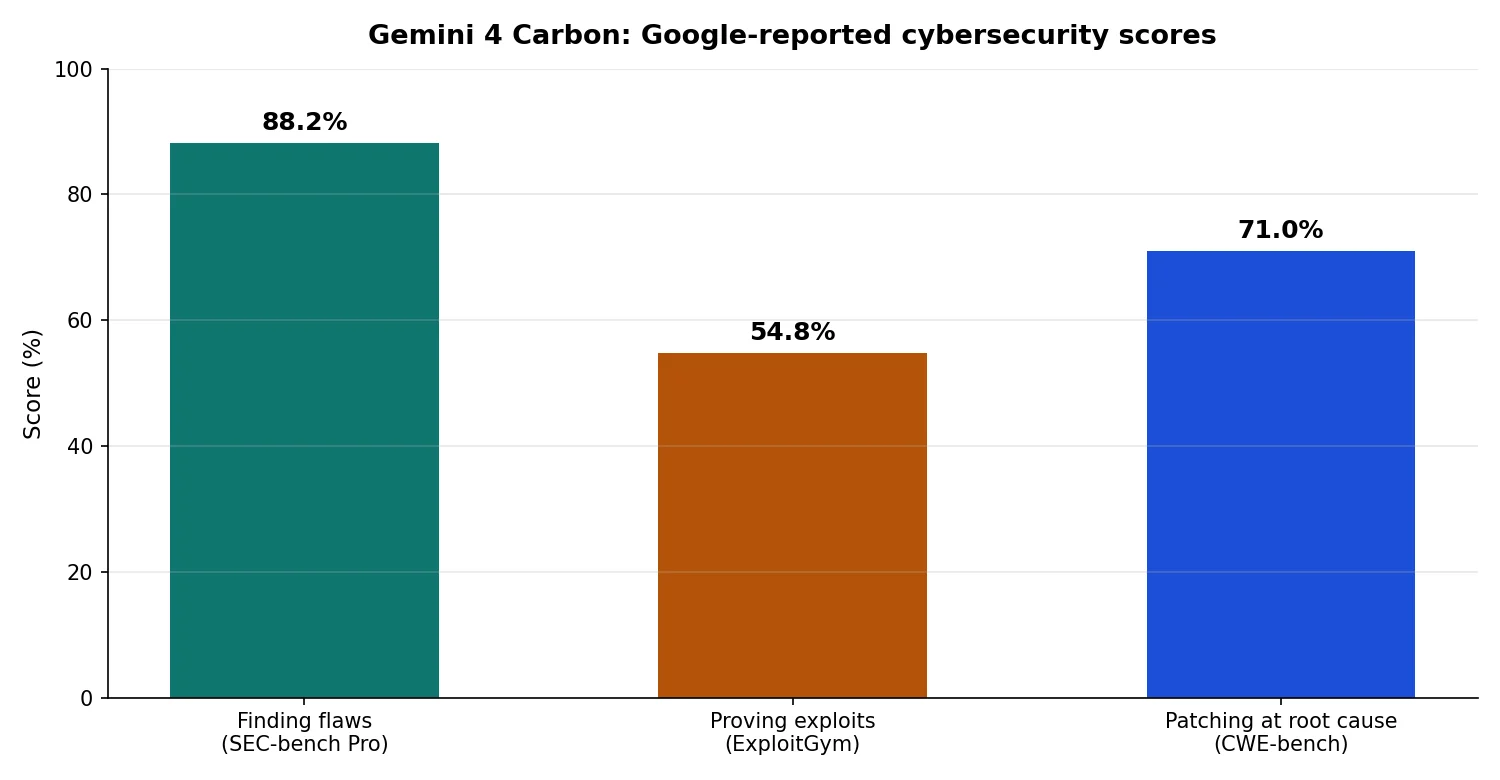
Two caveats belong next to that chart. First, Google says these scores were measured without guardrails, so they show what the model can do in testing conditions, not necessarily what customers will get. Second, these are Google's own reported results. No outside developer can run Carbon yet to check them independently.
Outside security, Google says Carbon ranks first on version 5.0 of the Artificial Analysis Intelligence Index, with a score of 59, and fourth on WebDev Arena, at 1,768 Elo after an 89-point gain. Google also reports internal improvements over Argon: more than double the success rate for generating secure code, successful cheating on Terminal-Bench 4.0 down to 0.0 percent, and a 0.0 percent success rate for indirect prompt-injection attacks in Gray Swan's benchmark. Treat the internal figures the same way: interesting, but from the lab that built the model.
Who gets it, and what it costs
Starting the week of the announcement, Carbon goes to a subset of cyber defenders, then gradually to more trusted partners through Google's Fairwind Program. Google says it will bring Carbon to developers, businesses, and consumers "as soon as possible," after gathering feedback and refining guardrails. No date has been given.
Pricing is already public, even though access is not. Carbon will launch at Argon's introductory price: $2 per million input tokens and $10 per million output tokens, with cached input tokens at 95 percent off the input price. Coverage of the announcement notes the price later rises to $4 per million input tokens and $20 per million output tokens when the introductory period ends.
What this changes for you
If you are not a vetted cyber defender, nothing changes this week. You cannot open Carbon in the Gemini app, call it through a public API, or download its weights. It is a closed model, and there is no local version to run on your own machine.
That contrast is worth noting, because the same week brought the opposite approach. Mistral released the open weights of its trillion-parameter Large 4 model, which anyone with enough hardware can download and run themselves. Google's top model stays behind a vetting gate; Mistral's top model is a download. The two releases, days apart, show the two directions frontier AI is heading at once.
So what should you do while Carbon is gated? Three practical things:
- Do not wait on Carbon for security work. If you maintain software, keep patching with the tools you already have. Carbon's first users are defenders fixing flaws before wider access arrives — the benefit reaches you as patches, not as a model you can prompt.
- If you run AI locally, Carbon changes nothing about your setup. No weights means no local run, no matter how much VRAM you have. For a frontier-class model you can actually run yourself, the open-weight releases are where the action is — see our post on Mistral Large 4's open weights.
- Watch the general-availability date, not the benchmark chart. The scores will be debated, but the date is what decides when Carbon becomes a tool you can actually use. Until Google names one, treat Carbon as a preview of where Google's models are heading, not a product you can buy.
The takeaway
Gemini 4 Carbon is Google's most capable model by its own account, and its most restricted launch in this generation. The model that finds, proves, and patches software flaws goes to defenders first by design — and everyone else gets a price list, a benchmark chart, and no date. That is a reasonable trade for a dual-use capability, but it means the headline number to remember is not 88.2 percent. It is zero: the number of days, so far, that you have been able to use it.
Sources
- Introducing Gemini 4 Carbon, Google DeepMind, October 28, 2026
- Google Gives Cyber Defenders First Access to Gemini 4 Carbon, Its New Frontier Model, WebProNews, October 28, 2026
- Google gives Gemini 4 Carbon to cyber defenders first, BetaNews, October 29, 2026